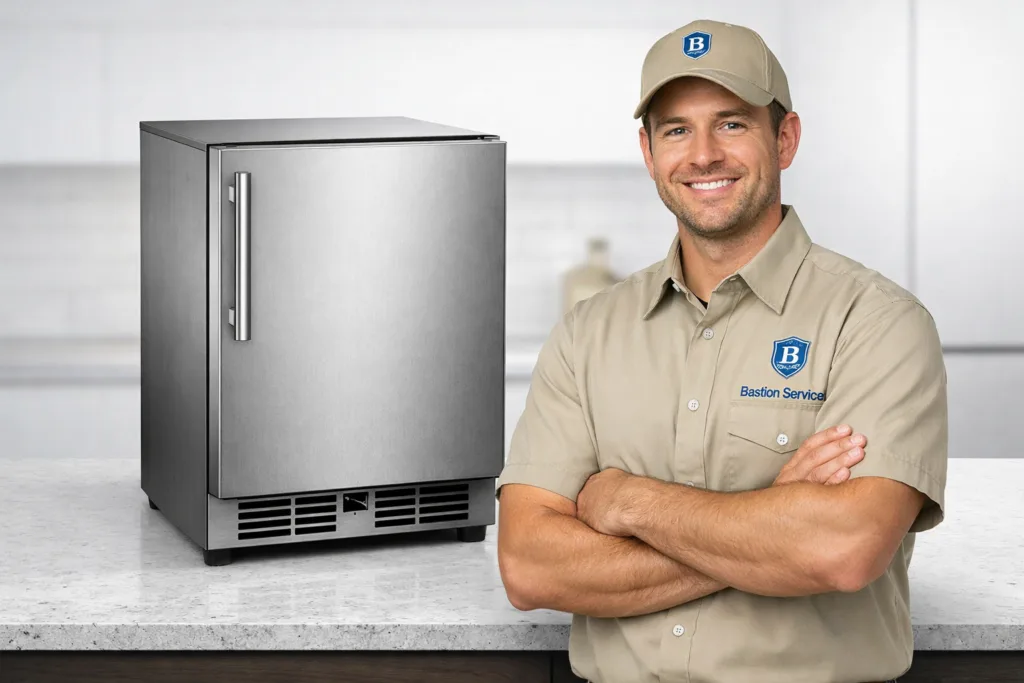
Ice makers usually give warning signs before they stop completely. One day the bin is only half full, then cubes start coming out smaller than normal, or water begins to collect under the appliance. With Summit units, those symptoms can point to very different faults, so the most useful first step is identifying whether the problem is related to water supply, temperature, the harvest cycle, or the ice maker assembly itself.
What often causes Summit ice maker problems
A Summit ice maker depends on several systems working together. The freezer has to stay cold enough for a full cycle, the inlet valve has to open at the right time, the fill path has to stay clear, and the mechanism has to release finished cubes properly. When one part of that sequence breaks down, the symptom you notice at home may not immediately reveal the actual failed component.
In Los Angeles homes, a few conditions commonly affect performance over time:
- Fluctuating freezer temperature from door traffic or cooling issues
- Restricted water flow from a supply problem or buildup in the fill path
- Frozen fill tubes that prevent proper water entry
- Worn internal ice maker components that no longer cycle reliably
- Valve or control faults that cause underfilling, overfilling, or no fill at all
Because multiple issues can create the same outward symptom, part-swapping without testing often leads to wasted time and repeat problems.
Symptom-based troubleshooting homeowners can use
No ice at all
If the bin stays empty, start with the basics: make sure the ice maker is switched on, the shutoff arm is not stuck, and the freezer is holding a proper temperature. If those basics check out, the issue may be a frozen fill tube, failed inlet valve, broken cycling mechanism, or a control problem that prevents the unit from starting a new batch.
A complete no-ice condition is often more than a simple clog. If the appliance has also seemed a little warmer lately, the lack of ice may be tied to cooling performance rather than the ice maker alone.
Slow ice production
When the unit still makes ice but cannot keep up with normal household use, look for signs of low water fill or temperature instability. Small, thin, or hollow cubes often suggest restricted water flow. A Summit ice maker that produces only occasional batches may also be struggling to complete the cycle consistently.
This kind of problem tends to develop gradually. Many homeowners do not notice it right away because the machine has not failed completely, but reduced output is often an early sign that service is needed.
Leaking or puddling near the appliance
Water on the floor or around the bin should not be dismissed as harmless condensation. Leaks can come from a cracked line, an inlet valve that does not close correctly, a misdirected fill stream, or an overfill condition that spills and freezes in the wrong place. Once that happens, the unit may begin jamming with ice buildup around the mechanism.
If the leak appears during an ice-making cycle, that detail can help narrow down whether the problem happens during fill, freeze, or harvest.
Clumped ice or a solid mass in the bin
Clumped ice usually means unwanted melting and refreezing or water entering the bin when it should not. A valve that seeps slightly can create repeated dripping between cycles. Poor temperature control can also soften stored cubes enough for them to fuse together.
If you break apart the ice and the same issue returns, the cause is probably not just an old batch of cubes. Repeated clumping points to a condition that needs correction.
Bad taste, odor, or cloudy cubes
Not every ice complaint means a failed part. Ice can pick up freezer odors, especially if old cubes stay in the bin too long or strongly scented foods are stored nearby. Cloudiness may be related to water quality or trapped air. But if odd-tasting or misshapen ice appears together with low production, dripping, or erratic cycling, the problem may be more than routine maintenance.
Buzzing, clicking, or grinding sounds
Some operating noise is normal, especially during fill and harvest. What is not normal is a repeated buzz with no ice production, a clicking pattern that never completes, or grinding that sounds harsher than usual. Those sounds can indicate a jammed mechanism, water not entering when called for, or a motorized component failing during the cycle.
Why freezer temperature matters more than many people expect
An ice maker can seem like a separate feature, but it depends heavily on stable freezer conditions. If the compartment is only slightly too warm, the refrigerator may still appear to be cooling while ice production slows, stops, or becomes inconsistent. That is why an ice complaint sometimes turns out to be connected to airflow, frost buildup, door sealing, or another refrigeration issue affecting the freezer section.
When a Summit unit shows both cooling changes and ice problems at the same time, it is important to evaluate the full pattern instead of treating the ice maker as an isolated problem.
When to stop using the ice maker until it is checked
It is usually best to stop operation if you notice any of the following:
- Water leaking onto the floor or into cabinetry
- Repeated overfilling or sheets of ice forming where they should not
- Heavy frost or ice buildup around the fill area or mechanism
- Loud new mechanical noises during attempted cycles
- A stuck cycle that repeats without producing normal ice
Continuing to run the unit in these conditions can worsen internal damage and increase the chance of water-related damage around the appliance.
Repair or replace?
For many households, repair makes sense when the issue is limited to the ice maker assembly, inlet valve, fill system, or an electrical fault that can be addressed directly. If the rest of the appliance is in good condition and cooling performance is stable, a targeted repair is often the better value.
Replacement becomes more likely when the ice problem is only one part of a larger refrigeration issue, when failures keep returning, or when overall appliance condition has declined. The deciding factor is usually not the symptom itself, but whether the problem is isolated and repairable or part of broader wear affecting the unit as a whole.
Helpful details to note before scheduling service
If you are arranging Summit ice maker repair in Los Angeles, a few observations can make the visit more efficient:
- Whether the problem started suddenly or developed slowly
- Whether the unit makes any sound during fill or harvest
- Whether leaking happens during a cycle or appears later
- Whether the cubes are small, hollow, cloudy, or fused together
- Whether the freezer seems warmer or less consistent than usual
- Whether any recent plumbing work, shutoff, or filter-related change occurred
These details often help distinguish between water supply trouble, a temperature problem, and a fault inside the ice maker mechanism.
Focused help for Summit ice maker issues in Los Angeles homes
Residential ice maker problems are easiest to solve when the repair path matches the exact symptom pattern. A unit that leaks needs a different approach than one that makes hollow cubes, and a machine that is silent requires different testing than one that cycles but never fills. For Summit ice maker repair in Los Angeles, that symptom-based approach helps homeowners decide whether the fix is straightforward, whether continued use risks more damage, and whether repair is a sensible next step for the appliance they have.