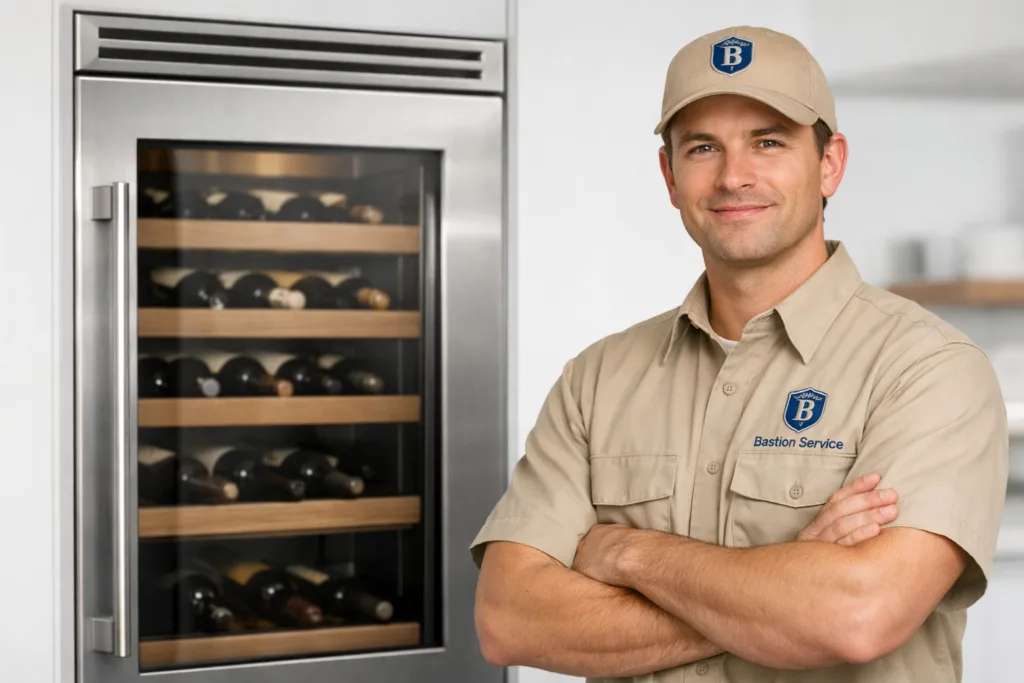
A Sub-Zero wine cooler that starts warming, sweating, vibrating, or cycling strangely can put an entire collection at risk faster than most homeowners expect. Because temperature drift, moisture, noise, and control problems can come from very different causes, replacing parts without testing often wastes time and money.
What common wine cooler symptoms usually mean
Wine coolers are designed to hold a narrow, steady range. When that stability changes, the symptom itself often points toward the system that needs attention. The key is to look at the full pattern, not just one moment when the unit seems warm or noisy.
Cabinet temperature is too warm
If bottles are no longer staying at the set range, the problem may involve restricted airflow, a fan issue, a faulty sensor, a control problem, or declining cooling performance. A unit that cools at night but warms during the day, or one that seems close to the correct setting but never quite gets there, usually needs more than a simple reset.
Homeowners often notice this first when reds feel too warm to the touch or whites lose their usual chill. Even small temperature shifts matter when they happen repeatedly, because the cabinet is no longer storing wine under stable conditions.
Temperature swings up and down
Fluctuation is different from a unit that is simply running warm. If the interior cools, then rises, then cools again without settling, that can point to a thermostat or sensor problem, intermittent fan operation, control board issues, or a system that is struggling under load. This type of behavior is worth checking early, since irregular cycling can place extra strain on other components.
Condensation on the glass, frame, or labels
Moisture around the door or inside the cabinet often suggests warm air is entering where it should not. Common causes include a worn door gasket, a door that is slightly misaligned, shelves or bottles preventing full closure, or cooling that is not holding the interior at the proper temperature.
In Santa Monica homes, humidity can make sealing problems more noticeable. If condensation keeps returning after the door is fully closed and the cabinet is not overcrowded, the issue usually goes beyond normal day-to-day operation.
Fan noise, rattling, or buzzing
Some operating sound is normal, but a change in sound usually matters. A fan that starts scraping, humming loudly, or pulsing on and off may be wearing out or struggling with airflow. Rattling can come from loose mounting, vibration against surrounding cabinetry, or an internal component that is no longer running smoothly.
Noise that appears together with warming or long run times is especially important, because it may indicate the cooler is overworking while still failing to maintain proper conditions.
Unit runs constantly or cycles too often
A wine cooler that rarely shuts off may be compensating for heat intrusion, poor sealing, dirty airflow paths, control errors, or cooling-system weakness. On the other hand, short cycling, where the unit starts and stops too frequently, can point to sensor or control faults and should not be ignored.
Either pattern can increase wear. When operating behavior changes noticeably, it is usually a sign that the unit is no longer regulating itself the way it should.
Display or controls are not responding
If the display is blank, settings do not change, or the shown temperature does not match what the cabinet is actually doing, the issue may involve the user interface, wiring, sensors, or the main electronic control. These cases often look simple from the outside but require proper testing, since the visible symptom is not always the failed part.
Why diagnosis matters before any repair decision
The same complaint can come from very different failures. A warmer-than-normal cabinet could be caused by a bad gasket, a stalled evaporator fan, a misreading sensor, or a deeper refrigeration problem. Condensation might be a door-seal issue, or it might be the result of poor temperature control inside the cabinet.
That is why the most useful first step is identifying the actual source of the problem. Once the fault is narrowed down, it becomes much easier to decide whether the repair is straightforward, whether continued operation could cause more damage, and whether the appliance is still a good candidate for service.
Signs the problem is getting more serious
Some issues begin subtly, then become harder to ignore. It is smart to pay closer attention when you notice any of the following:
- The temperature setting is correct, but bottle temperature is not
- The cabinet seems to run longer every week
- Moisture returns soon after wiping it away
- The door feels loose, uneven, or does not seal firmly
- Noise is getting louder or changing in character
- The display works intermittently or resets unexpectedly
These patterns often indicate a problem that is developing rather than staying contained. Addressing it sooner can help avoid a broader failure.
When to stop relying on the cooler
If the unit is clearly not maintaining storage temperature, it is best not to assume it will recover on its own. Continued use during active warming, short cycling, or repeated moisture buildup can add stress to fans, controls, and cooling components while still leaving the collection unprotected.
This is especially important if the cooler is storing bottles you plan to age or keep at a specific serving range. A cabinet that is visibly struggling is no longer doing the job it was built to do.
Repair versus replacement: what usually makes sense
Many Sub-Zero wine cooler problems are repairable, particularly when the issue is limited to controls, sensors, fan motors, door sealing, or other isolated components. If the cabinet is otherwise in good condition and the fault is clearly identified, repair is often the sensible path.
Replacement becomes more likely when there are multiple overlapping issues, a significant cooling-system failure, or a history of repeated breakdowns. Built-in wine storage appliances also deserve a more careful evaluation because the decision is not only about cooling performance, but about fit, appearance, and the cost of changing out a built-in unit.
What homeowners can check before scheduling service
A few simple observations can help clarify the symptom:
- Make sure the door is fully closing and not being blocked by bottle placement
- Check for visible gasket gaps, tears, or areas that do not sit flush
- Listen for fan noise changes, clicking, or repeated restarting
- Compare the displayed temperature with actual cabinet conditions
- Notice whether condensation is limited to the door area or appears throughout the interior
These checks do not replace diagnosis, but they can help describe the problem more accurately and reveal whether the issue appears related to sealing, controls, airflow, or cooling performance.
Built-in wine cooler issues in Santa Monica homes
In many Santa Monica kitchens, bars, and entertaining spaces, a Sub-Zero wine cooler is integrated into cabinetry where airflow, leveling, and door alignment all matter. That means a symptom like noise or condensation is not always coming from the same source it would in a freestanding appliance.
Careful service matters with built-in units because the goal is not just to make the cooler turn on again. It is to restore stable storage conditions, confirm why performance changed, and recommend the repair path that makes sense for the appliance as a whole.