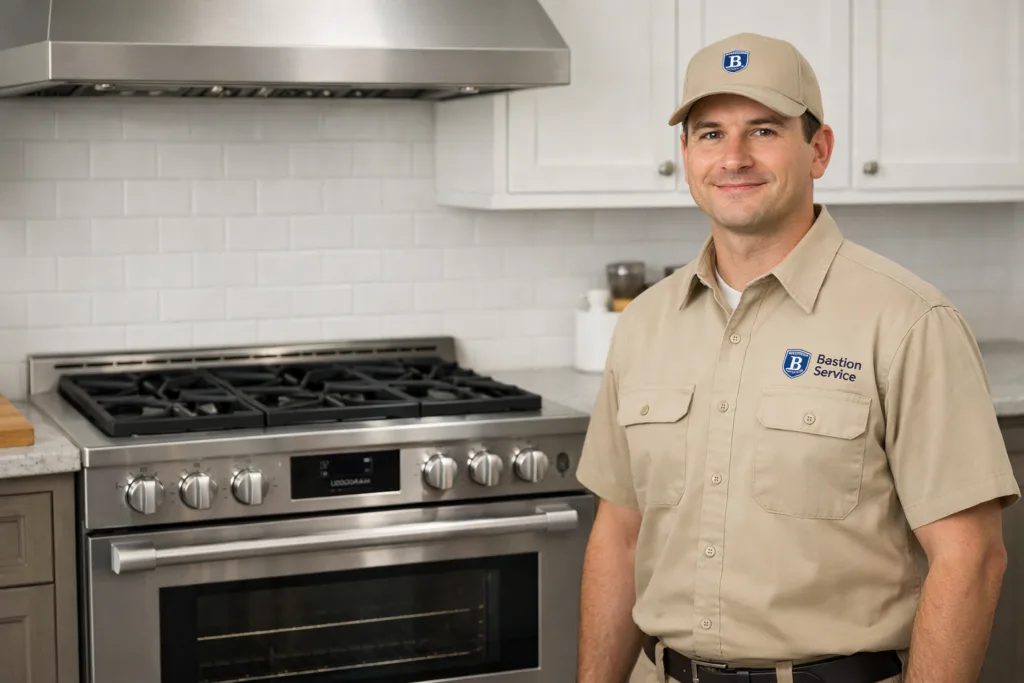
Range problems rarely stay limited to one simple symptom. A burner may click and fail to light one day, then work normally the next. An oven may preheat, yet still bake unevenly or miss the set temperature by enough to affect everyday cooking. On Monogram ranges, those patterns usually point to a specific fault path, and identifying that path matters more than guessing at parts.
For homeowners in El Segundo, the most useful starting point is to look at what the range is actually doing: whether the issue affects the cooktop, the oven, the controls, or several functions at once. That symptom pattern often reveals whether the problem is likely tied to ignition components, heating parts, temperature sensing, electronic controls, door sealing, or power and gas supply conditions.
Why range symptoms need to be interpreted carefully
A range combines multiple cooking systems in one appliance. Surface burners, oven heating, broiling, convection, timers, displays, and safety features can overlap in ways that make one failure look like another. That is why a range that “isn’t working right” can be difficult to judge based on appearance alone.
For example, an oven that cooks slowly may not have a complete heating failure. It may still heat, but with a weak igniter, an inaccurate sensor, or a control issue that causes long preheat times and poor temperature recovery. A burner that seems unreliable may have a simple alignment problem, or it may be part of a larger ignition system issue. Sorting out the difference helps avoid unnecessary replacement of still-working parts.
Common Monogram range problems and what they may mean
Burner clicks but does not ignite
This is one of the most common complaints on gas ranges. In some cases, the burner cap is out of position or the ignition area is damp after cleaning. In others, food debris blocks the burner ports and prevents proper flame spread. If those simpler causes are not present, the issue may involve the spark igniter, ignition wiring, switch, or spark module.
Repeated clicking without ignition should not be ignored. Delayed lighting can affect normal operation and may point to a condition that becomes less reliable over time.
Burner lights, but flame is weak or uneven
If the flame looks patchy, low, or inconsistent around the burner, the cause may be clogged ports, improper cap seating, or a burner head issue. On some calls, homeowners notice that pans no longer heat as evenly as before, even though the burner technically turns on. That often signals a performance problem rather than a total failure.
Oven does not heat at all
When the oven remains cold, the fault may depend on whether the unit is gas or electric. Possible causes include a failed igniter, heating element problem, thermal issue, sensor fault, wiring failure, or electronic control problem. If the display appears normal but the oven cavity never reaches cooking temperature, the control system is not the only suspect.
Oven takes too long to preheat
Slow preheating is often treated as an annoyance, but it can be an early warning sign. A weak igniter, drifting temperature sensor, or control-related fault can allow the oven to heat sluggishly long before it stops heating altogether. In daily use, that usually shows up as delayed meals, inconsistent baking, and recipes that suddenly need more time than expected.
Uneven baking, roasting, or browning
If one side of a dish browns faster, the bottom cooks too hard, or multiple racks no longer perform evenly, the problem may involve temperature regulation rather than basic heating. Convection performance, heat distribution, door sealing, and sensor accuracy can all affect cooking results. Homeowners often notice this first with familiar meals that no longer turn out the same way.
Oven overheats or runs hotter than the setting
An oven that overshoots the selected temperature can damage cookware, ruin food, and create broader control concerns. This may be tied to a faulty sensor, relay issue, calibration problem, or electronic control failure. If the appliance seems to run hotter than the display indicates, it is best not to assume the setting is simply off by a small amount.
Display or keypad stops responding
Modern Monogram ranges depend on electronic controls to manage temperature, cooking modes, and timing. A blank display, unresponsive keypad, flashing error, or settings that change unexpectedly can point to interface problems, main control faults, loose connections, or power-related issues. When controls become erratic, normal operation can become unpredictable even if some heating functions still work.
Door does not close properly
A door issue may sound minor, but it can change cooking performance significantly. Worn hinges, latch trouble, gasket problems, or misalignment can let heat escape and make preheating or temperature stability harder to maintain. On self-clean models, latch issues can also interfere with cycle operation and create additional stress on components.
Signs the range should not keep being used normally
Some problems allow limited use until service is scheduled, but others should be treated more cautiously. It is wise to stop regular use if you notice:
- delayed gas ignition
- persistent clicking that does not stop
- burners that fail intermittently
- an oven that overheats or will not regulate temperature
- error codes paired with loss of heating functions
- electrical irregularities such as flickering displays or tripped breakers
If there is a strong or lingering gas smell, discontinue use immediately and address the gas safety issue first. Appliance repair should follow only after the immediate hazard has been handled.
How a symptom-based repair decision helps
Not every range problem points to a failing appliance overall. Many repairs make sense when the issue is isolated to a specific ignition component, sensor, switch, element, door part, or control-related part and the rest of the range remains in solid condition. That is especially true with premium appliances, where overall build quality may justify repairing a single failed system.
Replacement becomes more likely when the appliance has several major issues at once, shows repeated control failures, has extensive wiring damage, or has reached a point where repair cost no longer matches the condition of the unit. The important distinction is whether the symptom is isolated or part of wider wear across the range.
What homeowners in El Segundo often notice before a complete failure
Range problems often begin as performance changes rather than complete breakdowns. Paying attention to those smaller signs can help prevent a more disruptive outage later.
- Preheat times slowly getting longer
- Burners that need multiple tries to light
- Clicks that continue after ignition
- Recipes that suddenly cook too fast or too slow
- Temperature settings that no longer match actual results
- Controls that work inconsistently from one use to the next
These are the kinds of changes that often signal a component weakening before it fully fails.
Monogram-specific repair considerations
Monogram ranges often include advanced cooking features, integrated electronic controls, and premium design elements that make correct diagnosis more important than trial-and-error repairs. A symptom that looks straightforward on a basic range can involve a more specific control, sensor, or ignition path on a Monogram model.
That is one reason homeowners tend to benefit from a repair plan based on the exact way the appliance is failing. If the problem is confined to one system, repair is often worthwhile. If symptoms span several systems, the next step should be based on the full condition of the appliance rather than one visible complaint.
Choosing service for a range problem in El Segundo
When a Monogram range stops performing the way it should, the best next step is to focus on the actual symptom pattern instead of assuming the most obvious part has failed. Whether the issue involves burner ignition, oven heating, temperature accuracy, clicking, or control behavior, the goal is to identify the cause clearly and decide whether repair is the sensible path for the appliance you have.
For households in El Segundo, that means looking beyond the surface complaint and addressing the condition that is interrupting everyday cooking. A well-targeted repair restores more than heat or ignition; it restores predictable use of an appliance that plays a central role in the kitchen.