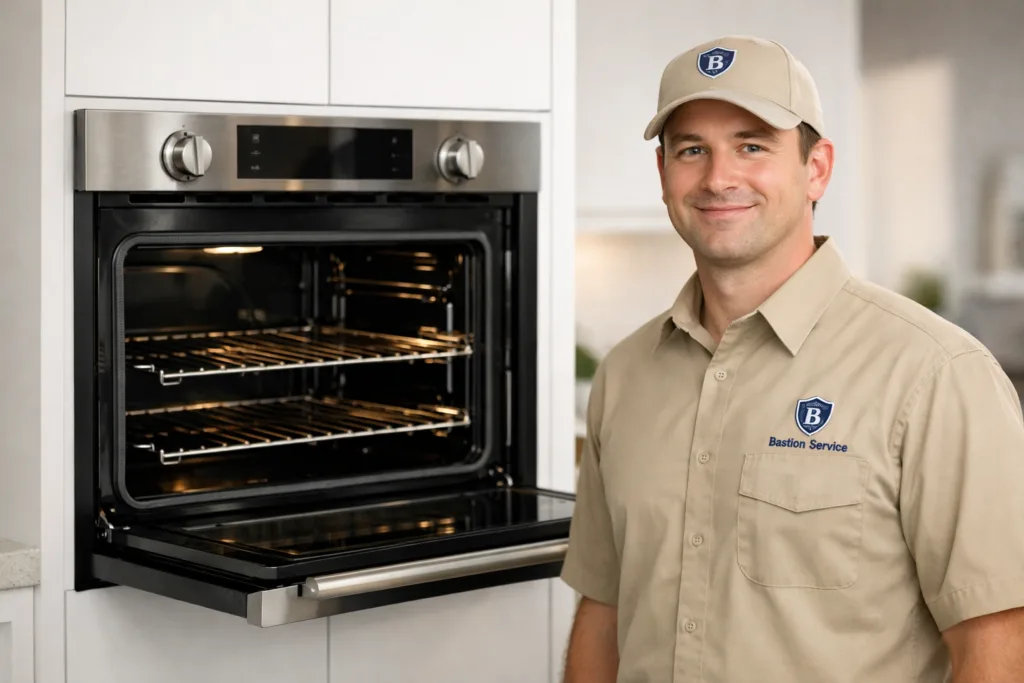
Wall ovens often give warning signs before they fail completely. A JennAir unit may power on normally yet struggle to preheat, bake unevenly, shut off mid-cycle, or stop responding to the controls. Those symptom patterns usually point to a specific failed component or electrical issue, and the best repair plan depends on identifying that fault before parts are replaced.
Common JennAir wall oven problems homeowners notice in Santa Monica
Most service calls start with a performance complaint rather than a fully dead oven. Paying attention to how the problem shows up can help narrow down what may be wrong.
Oven will not heat
If the display works but the oven cavity stays cold, the problem may involve a bake element, broil element, sensor, relay, control board, or power supply issue. In some cases, one heating circuit fails while the panel still appears normal, which can make the problem seem more confusing than it is.
Homeowners often notice this first when preheat takes far too long or never completes. If the oven is not producing normal heat, it is better to stop guessing and have the heating system tested directly.
Slow preheating
A wall oven that eventually reaches temperature but takes much longer than it used to may have a weakened element, sensor problem, control issue, or airflow-related fault. Slow preheat can also show up before a complete heating failure, especially in units that still work intermittently.
This is one of the more frustrating symptoms because the oven seems usable, but daily cooking becomes unpredictable. If dinner timing is regularly thrown off, there is usually a repairable cause behind it.
Uneven baking or roasting
When one rack cooks faster than another, cookies brown unevenly, or casseroles remain underdone in the center, temperature regulation should be checked. Common causes include a drifting sensor, inconsistent element operation, control irregularities, or poor heat distribution inside the cavity.
Many homeowners first suspect cookware or recipe changes, but repeated uneven results from the same JennAir wall oven usually indicate the appliance is no longer maintaining heat the way it should.
Temperature swings during cooking
If the oven runs hotter or cooler than the set temperature, or if results vary from one use to the next, the issue may involve the temperature sensor, control board, relay behavior, or calibration drift. Some ovens also cycle too aggressively, which can lead to scorched edges and undercooked centers.
Temperature complaints are worth addressing early because they affect every meal and can gradually get worse over time.
Control panel errors or unresponsive touch controls
Flashing codes, random beeping, touchpads that do not respond, or settings that change on their own often point to an electronic control issue. Loose connections, failing user interface components, and control board faults can all create similar symptoms.
Intermittent electronics problems rarely stay intermittent for long. If the controls are unreliable, normal cooking can become difficult and the oven may stop mid-cycle without warning.
Door, latch, or lock problems
A wall oven door that will not close tightly can affect both safety and cooking performance. Heat may escape, preheat may take longer, and baking results may suffer. Door-related issues can involve hinges, springs, seals, latch mechanisms, or lock components tied to the self-clean system.
If the door remains locked after self-clean, will not latch correctly, or feels misaligned, the unit should be checked before regular use continues.
What these symptoms can mean
Several different failures can create the same outward complaint. For example, an oven that will not reach temperature could have a bad sensor, a failed element, an electrical supply problem, or a control fault. That is why symptom-based diagnosis matters more than replacing the most common part and hoping for the best.
Built-in appliances also require more planning than freestanding units. Access, disassembly, and part selection all depend on the exact model and failure point, so accurate testing helps avoid wasted time and unnecessary expense.
Signs the oven should not keep being used
Some wall oven problems are mainly inconvenient, while others can raise safety concerns. It is wise to stop using the appliance and schedule service if you notice any of the following:
- The oven overheats far beyond the selected temperature.
- The control panel shuts the oven off during cooking.
- The unit trips a breaker or shows inconsistent power behavior.
- There is a burning electrical smell coming from the cabinet area or control section.
- The door will not seal, latch, or unlock properly.
- Error codes return repeatedly after reset attempts.
Continued use in these conditions can put extra stress on controls, heating parts, and wiring, while also making the appliance less predictable for everyday meal preparation.
Repair versus replacement for a JennAir wall oven
Many JennAir wall oven issues are repairable, especially when the problem is limited to a sensor, element, latch component, switch, interface part, or a single control-related failure. Repair usually makes sense when the rest of the oven is in good condition and the unit has been performing well aside from the current problem.
Replacement becomes a more serious consideration when there are repeated electronic failures, significant structural wear, multiple major component issues at the same time, or repair costs that are too close to the practical value of keeping the appliance. Age alone does not decide the answer. Overall condition and the nature of the failure matter more.
For homeowners in Santa Monica, the most useful service visit is one that explains what failed, whether the issue is isolated or part of a broader decline, and what the realistic next step should be.
How a symptom-based repair approach helps
Different symptoms call for different testing. An oven that heats unevenly should not be approached the same way as one with a dead display or a stuck door lock. Looking at the exact behavior of the appliance helps determine whether the issue is mechanical, electrical, temperature-related, or tied to the controls.
That approach is especially helpful when the oven still works sometimes. Intermittent problems can be easy to dismiss, but they often point to parts that are weakening rather than fully failed. Catching those patterns early can help prevent a complete loss of cooking function at a more inconvenient time.
What homeowners can note before service
A few simple observations can make diagnosis faster and more accurate. Before scheduling JennAir Wall Oven Repair in Santa Monica, it helps to note:
- Whether the oven fails during preheat or later in the cooking cycle
- If the problem affects bake, broil, or both
- Any error codes shown on the display
- Whether the door closes and seals normally
- If the issue is constant or comes and goes
- Whether the oven runs too hot, too cool, or never reaches temperature
Those details often reveal the pattern behind the complaint and make it easier to decide on the right repair path.
Built-in oven issues are easier to solve when the cause is identified early
A JennAir wall oven is a core part of the kitchen, so even a partial failure can disrupt daily cooking. Slow preheat, uneven baking, control errors, and heat regulation problems usually do not improve on their own. Once the source of the symptom is confirmed, it becomes much easier to determine whether repair is straightforward, whether further use is advisable, and whether the oven can be returned to reliable household use without unnecessary work.