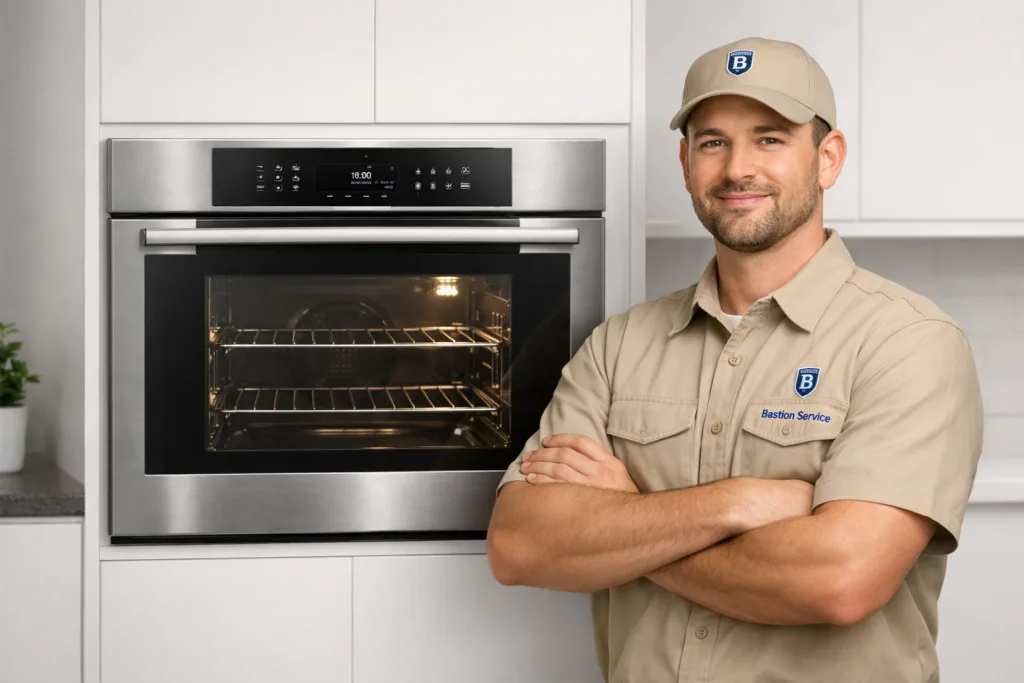
Common Bosch wall oven problems homeowners notice

Wall oven problems usually show up as cooking results that no longer match the setting on the display. A Bosch unit may turn on normally but fail to heat, take much longer than usual to preheat, bake unevenly from front to back, or shut down mid-cycle. In other cases, the control panel works but the cavity never gets hot enough to cook food safely.
Because built-in ovens rely on several systems working together, the same symptom can come from different causes. Heating performance may be affected by the temperature sensor, a relay or control issue, a weak heating circuit, cooling airflow trouble, or a door that is not sealing as it should. Looking at the full symptom pattern helps narrow the repair path instead of assuming a single part is always to blame.
Oven not heating at all
If the display responds but the oven stays cold, the problem may involve the bake circuit, broil circuit, sensor feedback, control board output, or incoming power. Some homeowners notice the interior light and clock still work, which can make the oven seem partially functional even though the heating system is not operating correctly.
This is also why a non-heating oven should not be judged by appearance alone. A unit can look normal from the outside while failing to send proper power to the heating components inside.
Slow preheat and weak cooking performance
When preheat takes too long, meals can end up undercooked or require constant extra time. Slow heating can point to a weak element circuit, inaccurate temperature sensing, or a control problem that is not energizing the oven properly throughout the cycle. If one cooking mode seems stronger than another, that detail can help identify whether the issue is tied to bake, broil, or regulation of both.
Uneven baking and temperature swings
Cookies browning on one side, casseroles cooking faster on top than in the center, or food needing different times from one use to the next often suggests a temperature management issue. A sensor that is reading incorrectly, inconsistent cycling of the heating system, heat loss around the door, or airflow problems can all affect consistency.
Not every baking variation means the oven is broken, but noticeable changes from the way it used to perform are worth attention. A pattern of hot-and-cold results usually means something measurable has changed in the oven’s operating system.
Error codes, random shutdowns, and control issues
Fault codes, frozen controls, beeping during operation, or a unit that shuts off without warning can indicate trouble with electronics, communication between components, or protective safety systems. If the clock resets or the display becomes unreliable during use, the issue may extend beyond simple temperature loss.
Repeated shutdowns should not be ignored. They can interrupt cooking, but they may also signal stress on internal components that can worsen over time.
Door, latch, and fan-related symptoms
Some Bosch wall ovens develop problems around the door or heat-management system rather than the heating circuit itself. A door that does not close firmly, a latch that will not release, or a fan that runs for an unusually long time after the cycle ends can all affect normal operation.
These symptoms matter because built-in ovens are designed to manage heat within tight cabinet spaces. When airflow or door function is off, the oven may struggle to maintain temperature or may trigger protective shutdown behavior.
Symptoms that usually mean service should be scheduled soon
It is a good idea to arrange service when the oven repeatedly fails to reach temperature, shows the same error more than once, loses power during cooking, or behaves differently from cycle to cycle. Problems that come and go are often harder on components than a single obvious failure because the oven may continue operating under stress.
- The oven powers on but does not produce heat
- Preheat has become much slower than normal
- Cooking temperatures seem inaccurate or unstable
- The control panel is unresponsive or displays faults
- The oven shuts off before cooking is complete
- The door will not close, lock, unlock, or seal properly
- The breaker trips when the oven is used
If there is a burning electrical smell, visible sparking, repeated breaker tripping, or obvious overheating around the controls or door area, stop using the oven until it can be evaluated. Those signs suggest a more urgent electrical or safety-related problem.
What may be causing the problem
On a Bosch wall oven, a symptom like “not heating” can have several possible causes. The repair process usually begins by determining which system is failing rather than replacing parts based on guesswork. In many cases, the source is one of the following:
- Temperature sensor readings that are out of range
- Heating circuit failure in bake or broil mode
- Control or relay problems affecting power delivery
- Wiring or connection issues inside the built-in unit
- Cooling or ventilation faults causing protective shutdowns
- Door switch, latch, or seal issues affecting operation
Because wall ovens are installed into cabinetry, access is more involved than with freestanding appliances. That makes accurate testing more important, especially when the failure is intermittent or tied to a specific mode such as baking, broiling, convection, or self-clean.
Repair or replacement: what usually makes sense
For many households in Santa Monica, repair is worth considering when the oven is otherwise in good condition and the issue is limited to a specific system. A targeted repair can make sense when the cabinet fit, kitchen layout, and overall performance of the appliance have been satisfactory up to this point.
Replacement becomes more likely when the oven has multiple unrelated failures, a record of repeat breakdowns, or signs of broader wear that make additional repairs hard to justify. The right decision often depends on the age of the unit, the condition of surrounding components, and whether the needed repair is likely to hold up well over time.
A practical repair guidance approach weighs the current symptom against the appliance’s overall condition, rather than treating every problem as either an automatic fix or an automatic replacement.
What to note before a service appointment
A few observations from the homeowner can make diagnosis easier. The most helpful details are usually the ones tied to timing and repeatability rather than general impressions.
- Whether the oven heats at all or only partially
- How long preheat takes compared with normal use
- Whether bake, broil, convection, or self-clean behaves differently
- Any error code shown on the display
- Whether the issue happens every cycle or only sometimes
- If the fan runs constantly or much longer than it used to
- Whether the clock resets or the controls become unresponsive
If one rack position cooks much faster than another, or if the problem shows up only after the oven has been on for a while, that pattern can also be useful. Small details often help separate a sensor issue from a control issue or a heat-retention problem from a true heating failure.
Why Bosch wall ovens benefit from symptom-based troubleshooting
Bosch wall ovens combine electronic controls, temperature regulation, and built-in installation requirements that call for a careful diagnosis. A complaint such as uneven baking or slow preheat can involve more than one system, and the lasting fix depends on identifying the actual source rather than just the visible symptom.
For homeowners in Santa Monica, that means the most useful repair visit is one focused on how the oven is failing in real use: whether it loses heat during baking, misreads temperature, responds unpredictably to commands, or develops door and latch problems that interfere with normal operation. Once the fault is narrowed down, the next step is much easier to evaluate with confidence.