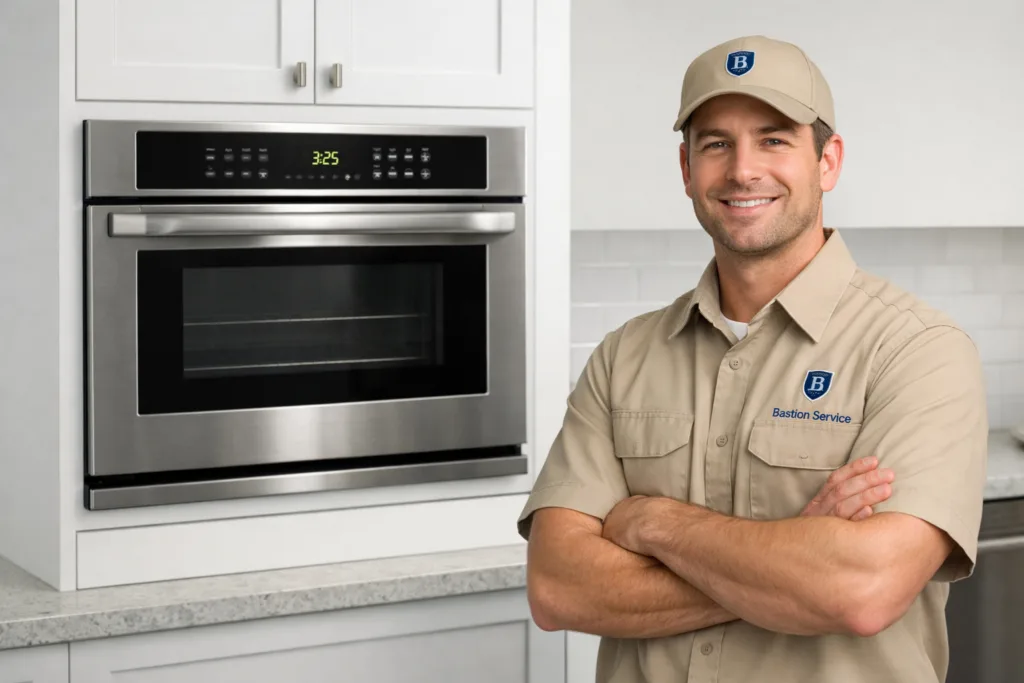
Common GE wall oven symptoms and what they usually mean

Wall ovens often fail in ways that look simple at first but have several possible causes underneath. On a GE unit, the difference between a heating problem, a control issue, and a power-related fault matters because the repair path can change completely depending on what testing finds.
Oven will not heat at all
If the display turns on but the cavity stays cold, the problem may involve a failed bake element, broil element, relay, temperature sensor, thermal protection component, wiring fault, or incoming power issue. Some built-in ovens can appear normal from the front while still lacking the electrical supply needed to heat correctly. That is why a non-heating oven should be tested rather than guessed at.
Slow preheat or weak heating
An oven that eventually reaches temperature but takes far too long often points to a heating element that is weakening, a sensor reading inaccurately, or a control that is not cycling heat the way it should. Homeowners usually notice this first when weeknight meals take longer than they used to or baking times stop matching familiar recipes.
Uneven baking or temperature swings
If one side browns faster than the other, cookies bake differently from rack to rack, or dishes come out overdone one day and underdone the next, the cause may be an inaccurate sensor, convection fan trouble, a weak element, calibration drift, or heat loss around the door. Uneven results are often a sign that the oven is still operating, but not regulating temperature properly.
Error codes, beeping, or frozen controls
When a GE wall oven starts flashing a fault code, resetting on its own, locking up mid-cycle, or ignoring touch inputs, the issue may be in the control board, sensor circuit, keypad, latch system, or related wiring. The displayed code is useful, but it is only a starting point. It still needs to be matched to the oven’s actual behavior and electrical test results.
Door, latch, and self-clean problems
Door issues can affect both safety and cooking performance. A door that will not close fully can let heat escape and create long preheat times or uneven baking. A latch that will not lock or unlock after self-clean can point to a failed latch motor, switch problem, or control fault. Self-clean cycles can also expose weakened electronic parts because of the extra heat stress involved.
Why the same symptom can have different causes
One of the more frustrating parts of wall oven repair is that a single symptom does not always mean a single failed part. Slow preheat might come from a weak bake element, but it can also come from a bad sensor, relay trouble, or incorrect voltage. An oven shutting off during cooking might be related to overheating protection, a loose connection, or a failing control board.
Because GE wall ovens are built in, access is usually more involved than with a freestanding range. That makes accurate diagnosis especially important before replacing parts. A targeted repair is usually far more cost-effective than trial-and-error part swapping.
Signs the problem is getting worse
Some wall oven problems stay intermittent at first. A unit may only miss temperature occasionally, flash an error once in a while, or need an extra few minutes to preheat. Over time, those symptoms often become more frequent and easier to reproduce. That pattern usually suggests a component that is deteriorating rather than a one-time glitch.
- Preheat times keep getting longer
- The same error code returns after resets
- The oven shuts off during longer cooking cycles
- Temperature becomes less consistent from one use to the next
- The door starts sticking, sagging, or failing to seal well
When these patterns show up in a Santa Monica home kitchen, the oven may still be usable for short periods, but reliability is already slipping.
When continued use is not a good idea
Some symptoms should be treated as stop-using-it issues rather than inconveniences. If the oven is tripping the breaker, giving off a burning smell, overheating surrounding cabinetry, failing to shut off properly, or showing signs of sparking or arcing, it should be checked before being used again.
The same applies if the door will not latch or unlock correctly and has to be forced. With built-in cooking appliances, heat and electrical faults can worsen quickly when operation continues after warning signs appear.
Repair decisions for a GE wall oven
Many GE wall oven problems are repairable, especially when the failure is limited to a sensor, heating element, door component, fan motor, relay, or a specific electronic part. In those cases, the oven may return to normal performance without a major overhaul.
Replacement becomes more worth considering when there are multiple major failures at the same time, significant wiring damage, repeated control problems, or limited parts support for an older model. The better choice usually depends on four things:
- The age of the oven
- Its overall condition beyond the current symptom
- The scope of the present repair
- Whether the issue appears isolated or part of a broader decline
For many households in Santa Monica, the goal is not simply to get the oven running once, but to determine whether the repair is likely to restore dependable everyday use.
What homeowners can notice before service
A few details can make symptom-based diagnosis easier. It helps to note whether the problem happens in bake, broil, convection, or all cooking modes. It is also useful to know whether the oven fails from a cold start, after preheating, or only during longer cooking cycles.
Other helpful observations include whether the display goes blank, whether the interior light behaves normally, whether the breaker has tripped, and whether the issue started after a self-clean cycle or power interruption. These details can help separate a heating failure from a control or supply issue more quickly.
Built-in wall oven issues deserve focused troubleshooting
Unlike countertop appliances, a wall oven is part of the kitchen’s daily workflow and installed directly into cabinetry. That makes recurring faults more disruptive and makes access more technical. When a GE wall oven starts showing clear symptom patterns, focused troubleshooting is usually the fastest way to decide whether the next step is a straightforward repair or a larger replacement conversation.
For homeowners in Santa Monica, that means looking closely at how the oven heats, how it responds to commands, and whether the problem is isolated to one system or affecting overall operation. Once the exact fault is identified, the repair decision becomes much clearer.