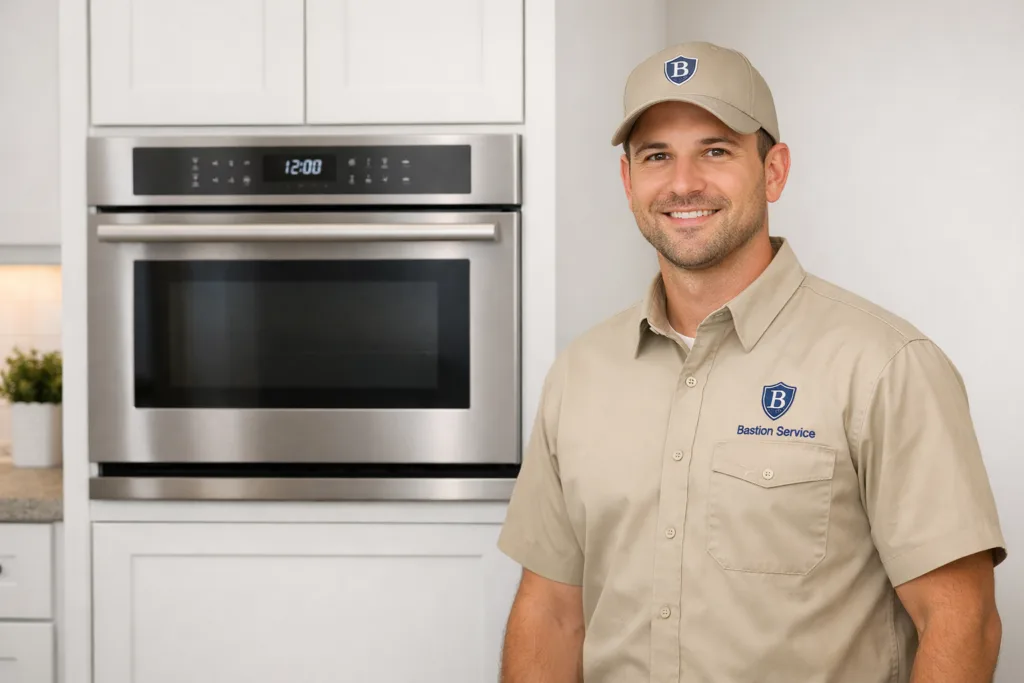
Temperature problems in a built-in oven usually start showing up in everyday cooking before the unit fails completely. You may notice cookies browning too fast on one side, casseroles needing extra time, or a preheat cycle that feels noticeably longer than it used to. With a Frigidaire wall oven, those symptoms can point to several different causes, so it helps to look at the pattern instead of assuming one part is automatically bad.
Common Frigidaire wall oven problems in Santa Monica homes
Most wall oven service calls come from a handful of repeat issues. Some affect heating directly, while others show up through error messages, erratic controls, or a door that no longer operates the way it should.
Oven will not heat
If the display comes on but the oven stays cold, the failure may involve the bake element, broil element, temperature sensor, electronic control, thermal protection component, or wiring inside the unit. In some cases, the oven is receiving partial power, which can make the controls appear normal while the heating system does not operate correctly. Because built-in ovens use higher-voltage power, diagnosis should separate an appliance fault from an electrical supply problem before parts are replaced.
Uneven baking or roasting
Uneven results often mean the oven is heating, but not cycling the way it should. A weak element, drifting sensor, calibration issue, or control problem can all lead to temperature swings. Homeowners sometimes first notice this when familiar recipes stop turning out the same way they used to, even though cookware and settings have not changed.
If one rack cooks much faster than another, or if the oven seems too hot one day and too cool the next, that usually suggests more than simple user error. Intermittent temperature regulation is often a sign that a component is degrading.
Slow preheating
A long preheat time can happen when one heating element is not fully performing, when the sensor is reporting inaccurate temperatures, or when the control board is not energizing heat correctly. The oven may still eventually reach the set temperature, but the extra time often comes with inconsistent cooking once the cycle begins.
Display, keypad, and control issues
A blank display, beeping, touchpad problems, flashing codes, or buttons that respond only sometimes can indicate a failing interface, loose connection, control board issue, or moisture and heat damage around the console area. Error codes are helpful clues, but they are not always the final answer. Two ovens can show the same code and still need different repairs depending on what testing reveals.
Door latch and self-clean problems
If the door will not close, lock, or unlock properly, the oven may not run safely or maintain temperature correctly. Self-clean cycles can also expose weak components because of the extreme heat involved. When a Frigidaire wall oven stops working after self-clean, it is important to note exactly what changed, whether that means a dead display, a locked door, or a no-heat condition.
How symptom patterns help narrow the cause
One useful way to think about oven problems is to separate them by behavior:
- No heat at all: more likely related to elements, power supply, thermal protection, or control failure.
- Heats, but cooks wrong: often tied to sensors, calibration drift, cycling problems, or a weakening element.
- Works intermittently: may point to relays, loose wiring, control board faults, or heat-related electronic failure.
- Problem started after self-clean: often associated with latch components, fuses, sensors, or control damage from high heat exposure.
This kind of symptom-based review matters because replacing the first likely part without testing can lead to repeat failures, extra cost, and more downtime.
When the oven should stop being used
Some problems are inconvenient but manageable for a short time, while others mean the oven should be shut off until it is checked. Stop using the unit if you notice any of the following:
- Burning smells that continue beyond normal first-use or spill-off odors
- Visible sparking
- Breaker trips during operation
- Overheating around the control panel or door area
- A door that does not close securely
- Error codes paired with loss of heating or loss of control response
These issues can affect not only cooking performance, but also wiring, controls, and surrounding cabinet areas if ignored.
Why built-in wall ovens need careful diagnosis
Wall ovens are different from freestanding ranges because access is tighter, removal can be more involved, and surrounding cabinetry has to be protected during service. In Santa Monica homes, that matters when a repair requires checking connections, confirming voltage, or inspecting components behind the oven. The right repair path depends on both the internal failure and the way the appliance is installed.
It is also common for multiple symptoms to overlap. An oven that seems underheating may actually be cycling off too soon. A dead control panel may be a board issue, but it could also trace back to a fuse or power interruption. That is why accurate testing matters before deciding whether repair is worthwhile.
Repair or replace: what usually makes sense
Many Frigidaire wall oven problems are worth repairing when the issue is limited to a heating element, sensor, latch assembly, fuse, or a specific control-related component and the oven is otherwise in good condition. Repair becomes less attractive when the appliance has repeated electrical faults, multiple major component failures, serious door or cavity damage, or limited part availability due to age.
For most homeowners, the decision comes down to three practical questions:
- Is the failure isolated or part of a larger pattern?
- Is the oven in solid overall condition?
- Will the repair reasonably extend the useful life of the appliance?
Answering those questions based on the actual fault is more reliable than judging the situation by symptom alone.
What helps speed up a service visit
Before scheduling Frigidaire wall oven repair in Santa Monica, it helps to note a few details:
- Whether the oven does not heat at all or heats inconsistently
- Whether broil works if bake does not
- Any error code shown on the display
- Whether the issue started after self-clean
- Whether the failure is constant or intermittent
- The full model number if it is easy to access
Those details can make diagnosis more efficient and help determine whether the likely repair path is straightforward or points to a deeper control or electrical issue.
Practical next steps for homeowners
If your oven is still operating but cooking results have changed, it is usually best to address the problem before it turns into a complete no-heat failure. Gradual symptoms often mean a component is weakening rather than suddenly breaking, and that stage can provide important clues about what is actually wrong.
If the oven has stopped responding, is showing repeated faults, or has developed signs of overheating, it makes sense to stop normal use and have the unit evaluated. For a Frigidaire wall oven in a Santa Monica household, the goal is not simply to restore power or heat, but to identify the source of the problem and choose a repair plan that makes sense for the appliance’s condition.