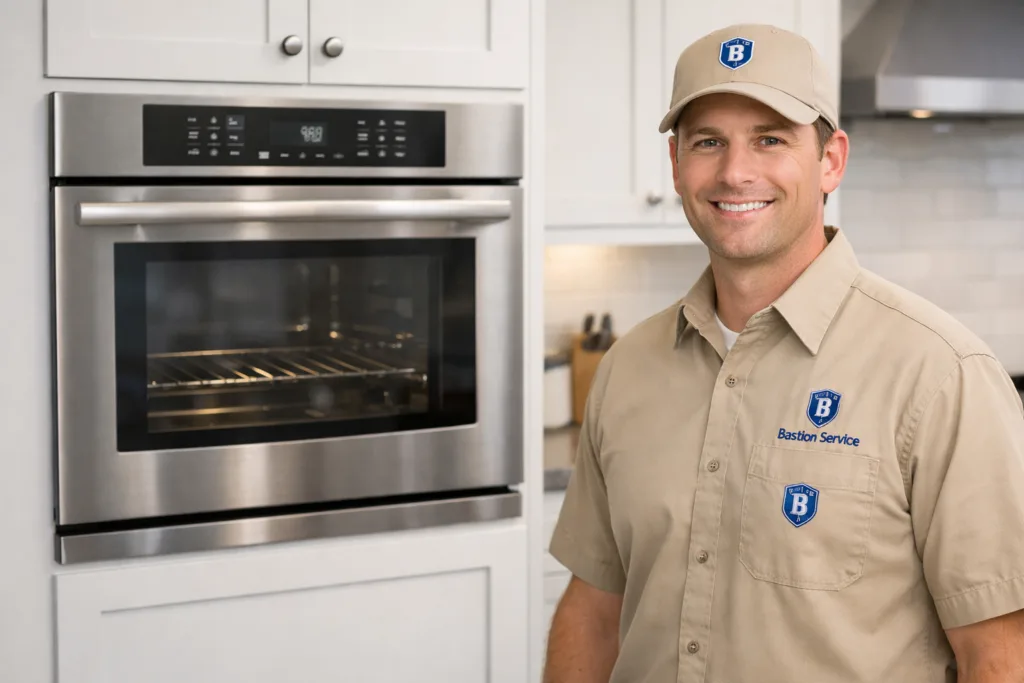
Many GE oven failures start with a symptom that seems simple but has several possible causes. An oven that will not heat, for example, might have a failed igniter or element, but it can also point to a sensor problem, a control fault, or a power issue affecting how the appliance cycles. Looking at the exact pattern of failure usually tells you more than the symptom name alone.
How GE oven problems usually show up at home
The oven will not heat at all
If the cavity stays cold after you start a bake cycle, the problem may be with the heating system, ignition system, temperature sensing, or electronic control. On some GE ovens, the display and lights still work normally even though the oven itself never begins heating. That difference matters because a dead display and a cold oven suggest a different repair path than a powered-on oven that simply never reaches cooking temperature.
Homeowners often notice this issue first during preheat. You set the temperature, hear normal startup sounds, and wait much longer than usual with little or no temperature rise. That is often a sign that the oven is trying to operate but a key component is not doing its job.
Preheat is slow
Slow preheat is one of the most common complaints with household ovens. A GE unit may eventually reach temperature, but take so long that weeknight cooking becomes difficult. This can happen when an igniter weakens, an element loses output, or the sensor sends inaccurate readings that confuse the control about actual oven temperature.
Slow preheat should not be ignored just because the oven still works. Components that are weakening often continue to deteriorate, and the extra cycling can affect cooking times and strain related parts.
Food bakes unevenly
Uneven baking can look different from one kitchen to another. Cookies may brown too much at the back, casseroles may stay cool in the center, or one rack may cook much faster than another. In GE ovens, this can be tied to bake performance, convection airflow, sensor drift, door seal issues, or calibration errors.
If recipes that used to come out reliably now require constant rotation or adjusted cooking times, the oven may no longer be regulating heat the way it should. That is especially noticeable for homeowners who cook often and know how their oven normally behaves.
Temperature swings during cooking
All ovens cycle on and off, but excessive swings can create obvious results: scorched bottoms, undercooked centers, or dishes that need much longer than expected. A GE oven with unstable temperature may have a sensor issue, a control problem, or a heating component that is no longer cycling correctly.
When temperature problems get worse gradually, it is easy to blame cookware or recipes first. If the same inconsistency keeps showing up across different meals, the appliance itself is a more likely cause.
The display or keypad is not responding
A blank display, partial display, or keypad that only works some of the time can point to a user interface failure, main control issue, wiring problem, or intermittent power interruption. In some cases, the oven may still heat but be hard to control. In others, the controls fail completely and the appliance cannot be used.
Intermittent electronic issues are worth checking sooner rather than later because they rarely improve on their own. They usually become more frequent until the oven stops operating reliably.
The door will not close, lock, or unlock correctly
Door and latch problems can make the oven unusable even when the heating system is otherwise fine. A misaligned door, worn hinge, failed latch motor, or switch problem may prevent normal baking or trap the oven in a locked state after self-clean. On some GE models, self-clean related faults also affect whether the control allows the oven to run at all.
Symptom patterns that help narrow down the problem
A good repair decision usually starts by noticing what the oven does before, during, and after a cycle. These details can save time and help separate one failure from another:
- Cold oven with working display: often points to a heating, ignition, sensor, or control issue rather than total power loss.
- Very slow preheat but eventual heating: often suggests a weak component rather than a complete failure.
- Uneven results on multiple racks: may indicate airflow, calibration, or heat distribution problems.
- Shutoff during cooking: can be related to overheating, control interruption, loose wiring, or a failing safety component.
- Error codes that return after resetting power: often mean the underlying fault is still present and needs testing.
When the problem is urgent
Some oven problems are inconvenient, and some are safety issues. If a GE oven in Santa Monica shows signs of overheating, sparks, burning odor from wiring, or repeated power loss during operation, it is smart to stop using it until the cause is identified. For gas models, any ongoing or strong gas smell should be treated as a priority safety concern first. Leave the area if needed and contact the gas utility or emergency services before arranging appliance repair.
Is repair still worth it?
In many cases, yes. Repair is often reasonable when the issue is limited to a serviceable part such as an igniter, bake element, sensor, latch assembly, or related component and the oven is otherwise in solid condition. It becomes a harder decision when the appliance has multiple problems, recurring electronic failures, or signs of heavier wear that suggest more than one repair may be approaching.
Age matters, but condition matters more. A well-kept GE oven with one clear fault can still be a sensible repair candidate. By contrast, an oven with control problems, door issues, and inconsistent heating at the same time may be less practical to keep investing in.
What to check before scheduling service
There are a few basic observations homeowners can make without taking anything apart:
- Does the display work normally?
- Does the oven start preheating but never get hot enough?
- Are broil and bake both affected, or only one function?
- Did the problem begin after a self-clean cycle or power interruption?
- Is the issue constant, or does it happen only sometimes?
Those details help make the service visit more efficient and give a better picture of whether the problem is likely mechanical, electrical, or control-related.
What homeowners in Santa Monica can expect from oven service
Useful service starts with symptom-based testing rather than guessing at parts. That means checking how the oven responds to commands, whether it actually reaches and holds temperature, and whether the fault is isolated to a specific component or tied to the control system. For households in Santa Monica, that kind of evaluation is the most reliable way to decide whether repair is practical and what the next step should be.
If your GE oven has become unreliable for everyday meals, the most helpful next move is to have the problem identified while the symptoms are still clear. That gives you a better chance of fixing the right issue before performance gets worse or additional components are affected.