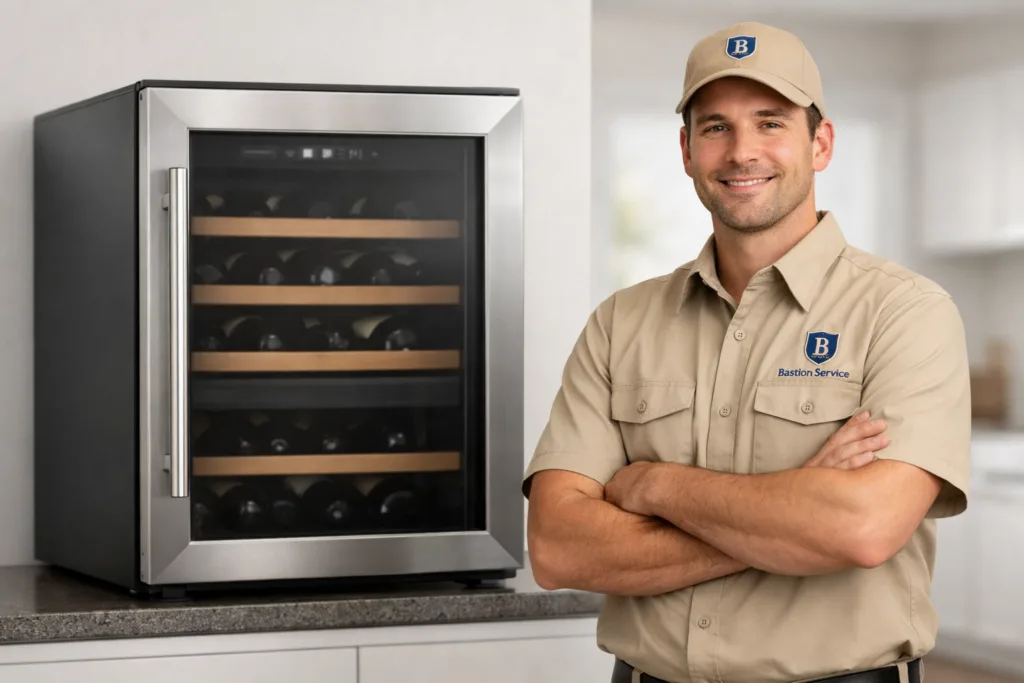
An EdgeStar wine cooler that starts running warm, cycling nonstop, or collecting moisture can put a home wine collection at risk faster than many owners expect. These units depend on stable airflow, accurate sensing, good door sealing, and proper heat removal. When one of those systems falls out of range, the result is usually inconsistent storage conditions rather than a simple on-or-off failure.
Common EdgeStar wine cooler symptoms and what they may mean
Several different faults can produce similar warning signs. Looking at the exact symptom pattern usually makes it easier to understand whether the problem is likely related to airflow, controls, drainage, or cooling performance.
Not cooling enough or drifting above the set temperature
If the cabinet no longer holds a steady temperature, possible causes include blocked ventilation, dirty condenser coils, weak fan operation, sensor trouble, control problems, or a sealed-system issue. In some West Los Angeles homes, tight built-in placement can make heat buildup worse and expose ventilation weaknesses more quickly. If the cooler takes too long to recover after the door is opened or bottles feel noticeably warmer than expected, the unit should be checked before wine quality is affected.
Too cold, partially freezing, or uneven shelf temperatures
Wine coolers are designed for stable storage, so overcooling is just as important as undercooling. If bottles near the back wall are getting too cold, lower shelves feel much different from upper shelves, or the unit seems to overshoot its setting, the issue may involve a faulty temperature sensor, evaporator airflow restriction, control board misreading, or frost interfering with circulation. Uneven cooling often starts as a small annoyance and becomes more obvious over time.
Water inside the cabinet or on the floor
Moisture usually points to condensation, a blocked drain path, a door gasket problem, or frost that forms and later melts. Water under the unit should not be treated as harmless. It can damage nearby flooring and can also be a sign that the cooler is not managing humidity and airflow correctly. If moisture returns after being wiped up, there is usually an underlying cause that needs repair.
Buzzing, rattling, clicking, or loud fan noise
A wine cooler will always make some operating sound, but new or worsening noise often signals wear or stress. Rattling may come from vibration against cabinetry or loose mounting points. A rough or scraping sound can suggest fan blade interference or motor wear. Repeated clicking may indicate trouble with a start component, relay, or control response. When unusual noise shows up alongside weak cooling, the problem is rarely something to ignore.
Display, lighting, or control problems
If the panel does not respond, the display resets, interior lights behave inconsistently, or the shown temperature does not match actual conditions, the fault may be in the control system rather than the cooling circuit alone. These issues can affect cycle timing and cause the cooler to run too much, shut off too early, or hold the wrong temperature without making the cause obvious.
Why symptom-based diagnosis matters
Two EdgeStar wine coolers can show the same warm-cabinet symptom and still need completely different repairs. One may have simple airflow restriction or a maintenance-related issue, while another may have a failing fan motor, sensor problem, or sealed-system concern. Replacing parts based on guesswork can add cost without fixing the root cause. A proper diagnosis helps determine what failed, whether continued use could cause more strain, and whether repair is the sensible next step.
When to stop using the cooler and schedule service
It is usually time to schedule service when the temperature will not stay stable, the compressor seems to run almost constantly, condensation keeps returning, frost builds back quickly, or the controls stop behaving normally. Intermittent cooling is also a warning sign. A unit that works only part of the time can slip into full failure without much notice.
If valuable bottles are inside, it is generally better to reduce door openings and avoid assuming the cooler will recover on its own. The longer the unit struggles, the more likely it is to place added stress on fans, controls, and cooling components.
Conditions that can make EdgeStar wine cooler problems worse
Some operating conditions accelerate failure or make symptoms more severe. Poor ventilation around the cabinet can trap heat and force longer run times. A door that does not close squarely can allow warm, humid air inside and lead to condensation or frost. Heavy dust on coils can reduce heat transfer and make the cooler seem weak even when other components are still functioning. Continued operation in that state can increase wear and make the final repair more involved.
Repair or replace: how the decision is usually made
Many EdgeStar wine cooler issues are repairable when they involve components such as fans, sensors, controls, lighting, door sealing, or drainage. Replacement becomes a more serious consideration when diagnosis points to a major sealed-system problem, repeated prior failures, or overall condition that no longer supports a worthwhile fix. The real question is not simply whether the unit can be repaired, but whether the repair makes financial and practical sense based on the cooler’s age, condition, and failure type.
What to check before the appointment
A few details can help make service more efficient. Note the set temperature and whether the cabinet feels evenly cooled from top to bottom. Pay attention to whether the compressor seems to run constantly or only sometimes. If there is water, check whether it is appearing inside the cabinet, beneath the door, or under the unit. If there is noise, try to identify whether it happens during startup, while the fan is running, or throughout the entire cooling cycle.
It also helps to see whether the cooler is tightly enclosed, whether air vents are blocked, and whether the door gasket seals evenly all the way around. These observations do not replace diagnosis, but they often help narrow down the most likely repair path.
What homeowners in West Los Angeles can expect from a focused repair approach
For homeowners in West Los Angeles, the most useful service visit is one that evaluates cooling behavior, airflow, controls, drainage, and door sealing together instead of focusing on a single symptom in isolation. That approach usually leads to a more accurate recommendation, whether the solution is a straightforward component repair or a decision that replacement is the better long-term move.
When an EdgeStar wine cooler begins showing temperature swings, moisture issues, unusual noise, or control trouble, early attention usually gives the best chance of protecting both the appliance and the wine stored inside.