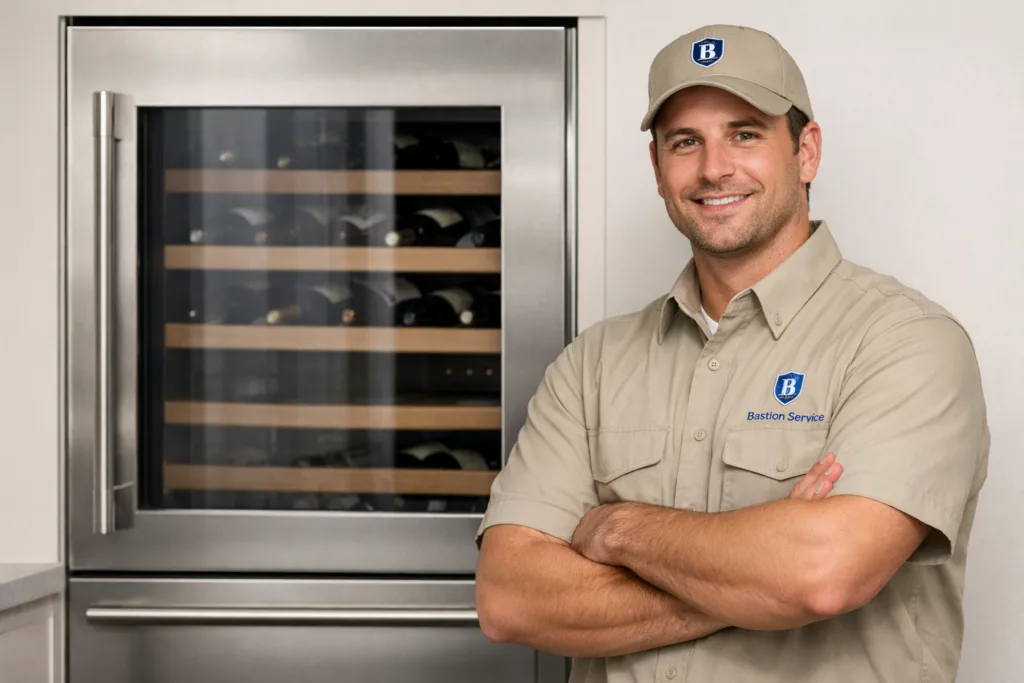
Temperature instability in a wine cooler can affect more than convenience. Even small swings can change storage conditions, and symptoms like excess moisture, constant running, or new noise often point to a problem that is already developing beyond normal wear. With Monogram units, the underlying cause is not always obvious from the first symptom alone.
Common Monogram wine cooler problems in West Los Angeles homes
Most wine cooler failures start with a pattern: the cabinet feels a little warm, the fan sounds different, condensation begins to appear, or the control panel stops behaving normally. Paying attention to that pattern helps narrow down what is actually failing.
Not cooling enough
If the interior temperature stays above the selected setting, several issues may be involved. Restricted airflow, dirty condenser areas, a weak fan motor, a faulty sensor, or a control problem can all reduce cooling performance. In some cases, the cooler still powers on and appears normal from the outside, even while the internal temperature continues to drift.
When weak cooling continues for days, the unit may start running longer and longer in an effort to recover. That added strain can make a smaller airflow or fan problem turn into a more expensive repair if it is ignored.
Running constantly
A Monogram wine cooler that rarely cycles off is usually having trouble reaching or maintaining target temperature. Common causes include poor ventilation, warm air entering through a worn door gasket, sensor errors, or a refrigeration-related issue. Continuous operation is a sign that the unit is compensating for a condition it cannot correct on its own.
Condensation, interior moisture, or leaking
Moisture inside the cabinet can mean the door is not sealing well, humid air is entering too often, or drainage is not working as it should. Water around the base of the appliance may point to a drain problem or another cooling issue that is causing abnormal condensation. These symptoms are worth addressing early because repeated moisture can lead to odor, shelf residue, or damage around the installation area.
Fan noise, clicking, or buzzing
Changes in sound often tell you something before the temperature display does. Rattling may come from vibration or loose components, while clicking, buzzing, or grinding can indicate fan wear, compressor strain, or airflow obstruction. If new noise appears along with weak cooling, the repair should not be postponed.
Control and display problems
An unresponsive panel, flashing display, incorrect temperature reading, or repeated alarm can point to failures in the interface, control board, wiring, or temperature sensing system. These issues can be misleading because the cooler may still run, but it may no longer be regulating temperature accurately.
Why symptom-based diagnosis matters
Two wine coolers can show the same complaint and need completely different repairs. A cabinet that feels warm might have a fan issue, a sensor problem, a door-seal leak, or a sealed-system fault. Replacing parts based only on the most visible symptom can lead to unnecessary expense without fixing the real cause.
In West Los Angeles homes, installation conditions also matter. Built-in placement, surrounding cabinet clearance, room heat, and frequency of door opening can all affect how the appliance behaves. The goal is to separate normal operating stress from a true component failure.
Signs service should be scheduled soon
- The cooler no longer holds the set temperature.
- The unit runs for long periods without cycling off.
- Condensation keeps returning on the door, shelves, or interior walls.
- Water appears under or near the appliance.
- The fan or compressor sounds different than usual.
- The controls stop responding or the display becomes inconsistent.
- Cooling varies noticeably from one section of the cabinet to another.
When these symptoms appear together, the problem is often advancing. A fan issue combined with rising temperature, for example, can place extra load on the cooling system and lead to broader failure if the unit is left to struggle.
When continued use is a bad idea
If the cabinet is clearly warm, temperatures are swinging, or the appliance is making loud mechanical noise, limiting use is usually the safer choice until the issue is checked. Continued operation in that condition can stress high-value components and make the eventual repair more involved.
Water leakage should also be taken seriously. Even a small recurring leak can affect nearby flooring, trim, or cabinetry if the source is not corrected.
Repair versus replacement for a Monogram wine cooler
Repair is often worthwhile when the fault involves serviceable parts such as fans, controls, sensors, door gaskets, or drainage components, and the cabinet itself remains in solid condition. These issues can usually be evaluated directly against the age and overall performance of the unit.
Replacement becomes a stronger consideration when there is major sealed-system trouble, repeated high-cost failures, or general deterioration that makes reliable operation unlikely even after repair. For many homeowners in West Los Angeles, the real decision comes down to whether the confirmed repair restores stable cooling without creating a cycle of repeat expense.
What a useful repair visit should accomplish
A proper service call should do more than react to the most obvious complaint. It should identify why the temperature changed, why moisture developed, or why the cooler started sounding different in the first place. That makes it easier to decide whether the appliance is a good repair candidate and what the next step should be.
For Monogram wine cooler repair in West Los Angeles, the most helpful outcome is a repair path based on the actual failure, the condition of the appliance, and the likelihood of restoring steady performance in everyday household use.