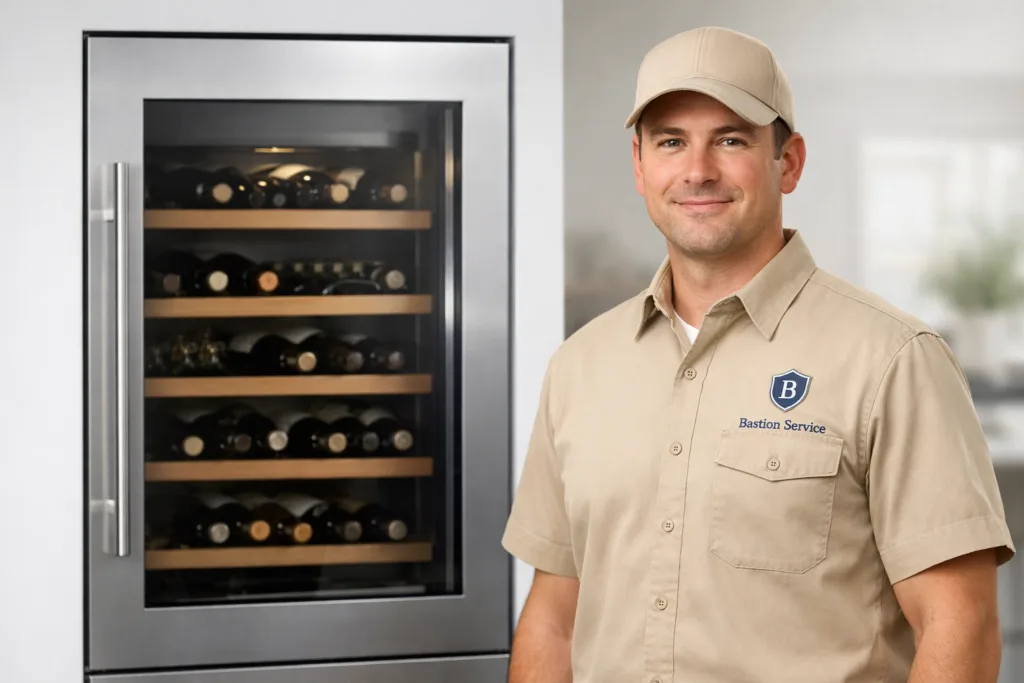
Stable storage conditions matter in a wine cooler, so small changes in cooling performance can become important quickly. If your Miele unit starts running longer than usual, develops moisture inside, or no longer matches the set temperature, the symptom pattern usually gives the best clue about what is happening.
How to read the symptoms before repair
Different Miele wine cooler problems can look similar at first. A cabinet that feels warm might have a fan issue, a sensor problem, restricted airflow, a door seal leak, or a more serious cooling-system fault. A unit with interior condensation may not be “not cooling” in the usual sense at all; it may be pulling in humid room air through a weak gasket or struggling with drainage.
Looking at when the problem happens is often just as helpful as the problem itself. Does the temperature rise only in the afternoon? Does the fan get louder after the door closes? Does moisture appear near the top of the door or collect near the bottom? Details like these help narrow down whether the issue is airflow, controls, sealing, or cooling performance.
Common symptom groups
- Temperature swings: The display changes often, bottles feel warmer than expected, or one area of the cabinet seems inconsistent.
- Not cooling properly: The unit runs but does not bring the interior down to the selected setting.
- Condensation or water: Fogging on glass, damp shelves, or moisture near the base can point to seal, drainage, or temperature-balance issues.
- Fan or mechanical noise: Buzzing, rattling, clicking, or unusually loud airflow can suggest fan wear, vibration, or stress in the cooling cycle.
- Display or control trouble: Buttons do not respond, settings do not hold, or error indications appear without an obvious cause.
What specific Miele wine cooler issues often indicate
Temperature drifting warmer than the setting
If the cabinet gradually warms up, common causes include weak internal air circulation, inaccurate temperature sensing, dirty heat-rejection surfaces, or a control issue that is not managing the cycle correctly. If the unit is running but still losing ground on temperature, service should not be put off for long.
One zone feels different from another
Uneven temperatures can come from sensor drift, airflow imbalance, a fan that is slowing down, or a door that is not sealing evenly. In some cases, homeowners notice that bottles near one side feel different from bottles on another shelf even though the display looks normal.
Constant running
A wine cooler that rarely shuts off is not always facing a major failure. It may be compensating for warm air entering around the door, poor ventilation, or controls that are not reading conditions accurately. But if nonstop running is paired with rising temperature, that is a stronger warning sign.
Water, fogging, or interior moisture
Condensation can form when humid air enters the cabinet repeatedly or when the unit is not maintaining stable internal conditions. Drain-related issues can also leave moisture inside or near the base. If the problem keeps returning after wiping things down, the underlying cause should be checked rather than monitored indefinitely.
Loud fan sound or new vibration
Some operating noise is normal, but a noticeable change usually means something has shifted. A fan blade may be obstructed, mounting components may be vibrating, or a worn fan motor may be getting louder as it struggles. The timing of the noise matters: whether it happens at startup, during longer cooling cycles, or all the time.
Why wine cooler diagnosis needs to be precise
Wine coolers depend on consistency more than raw cooling power. Replacing parts based only on a broad complaint like “not cold enough” can miss the actual fault and leave the storage environment unstable. A proper evaluation should look at real cabinet temperatures, fan response, control behavior, seal condition, drainage, and overall cooling performance.
This is also how homeowners avoid unnecessary repair work. A symptom that seems major may trace back to a smaller issue such as a gasket leak or sensor problem, while a symptom that seems minor may actually be early evidence of a larger cooling failure.
When it makes sense to stop using the unit until it is checked
Continued operation can add wear if the wine cooler is obviously struggling. It is best to limit use and avoid repeated resets when you notice any of the following:
- The interior stays clearly warmer than the selected setting
- The unit runs continuously without recovering temperature
- The compressor area feels unusually hot
- A loud new mechanical sound starts suddenly
- The controls stop responding or the display behaves erratically
Repeatedly changing settings, unplugging and restarting the cooler, or opening the door often to check on bottles can make the problem harder to evaluate and may increase temperature instability.
Repair or replacement: what usually matters most
Many Miele wine cooler problems are worth repairing when the fault is isolated to a fan, sensor, control component, seal, or drainage issue. Replacement becomes a more serious consideration when the confirmed repair is extensive, when cooling-system problems are significant, or when the overall condition of the unit suggests multiple issues at once.
The smartest decision usually depends on three things: what has actually failed, how the appliance has been performing overall, and whether the repair is likely to restore reliable temperature stability. That is why a clear diagnosis and a practical repair plan matter before deciding which direction to take.
What homeowners in West Los Angeles should pay attention to
In West Los Angeles homes, wine coolers are often installed in built-in cabinetry, entertainment spaces, kitchens, or bar areas where airflow and door clearance can affect performance. If your Miele wine cooler has started running hotter after a layout change, nearby heat exposure, or reduced ventilation around the cabinet, those conditions should be considered as part of the service process.
Intermittent problems also deserve attention. A unit that works normally for a period and then starts warming again may have a component that is failing under load rather than failing completely. Catching that earlier can help prevent spoilage and reduce stress on the rest of the system.
What a focused service visit should cover
Useful service should go beyond a quick part swap. It should include symptom verification, temperature review, inspection of seals and airflow, and testing of the components most closely tied to the complaint. That approach helps identify whether the problem is mechanical, electrical, control-related, or part of the cooling system itself.
For homeowners dealing with Miele wine cooler repair in West Los Angeles, the goal is not just to get the unit running again, but to restore steady storage conditions and make sure the repair path makes sense for the appliance in the home.