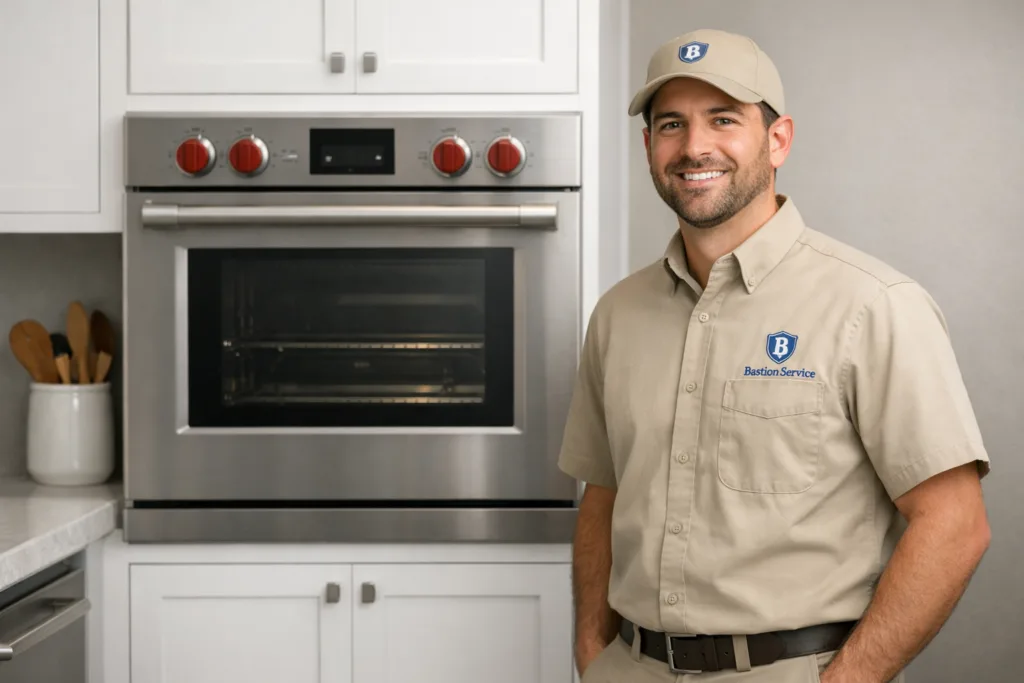
Performance changes in a Wolf oven usually show up in the kitchen before they show up as a complete failure. Cookies start browning unevenly, casseroles take longer than expected, or preheat drags on well past the usual time. Those details matter because the exact symptom pattern often points toward a specific repair path rather than a general oven problem.
Start with the way the oven is failing
Two ovens can seem to have the same issue while needing very different repairs. One unit may appear to be “not heating” when the real problem is that it heats too weakly to reach the selected temperature. Another may heat at first, then lose temperature during the cycle because a sensor, control, or heating component is failing intermittently.
That is why symptom-based diagnosis is so useful for homeowners in Rancho Palos Verdes. It helps separate a power issue from a temperature regulation problem, an ignition issue from a control fault, and a worn door seal from a true heating failure.
Common Wolf oven problems and what they may mean
Oven will not heat at all
If the display turns on but the oven cavity stays cold, the problem may involve the bake element, broil element, igniter, thermal protection, wiring, or electronic control. A completely dead oven can point more strongly to a power supply or control issue, while an oven with lights and display but no heat often suggests a failed heating circuit.
For gas models, a failed or weak igniter is a common cause of no-heat complaints. For electric models, an open heating element or related electrical fault is often part of the diagnosis.
Slow preheating
Slow preheat is one of the most common complaints because the oven still works just well enough to cause confusion. You may hear it cycling, see the display counting up, and assume it is functioning normally, yet meals take longer and results are less consistent.
This can be caused by a weak igniter, a sensor that is reading incorrectly, a heating element that is deteriorating, or a control problem that is not driving the heating system properly. When preheat becomes noticeably slower than normal, it is usually a sign that a component is weakening rather than operating at full performance.
Uneven baking or roasting
If one side of a pan cooks faster than the other, or the top browns while the center stays underdone, the issue may involve temperature sensing, convection airflow, heating balance between bake and broil functions, or calibration drift. Homeowners often first notice this when familiar recipes suddenly stop turning out the same way.
Uneven results can also happen when the oven reaches the set temperature briefly but cannot hold it consistently. In practical terms, that means the display may look normal while cooking performance is not.
Temperature swings
Some cycling is normal in any oven, but large swings are not. If food alternates between undercooked and overdone, or if an oven thermometer shows wide variation from the selected setting, the likely causes include a faulty temperature sensor, control board issue, or heating component that is not responding correctly during the cycle.
Temperature instability is especially frustrating because it affects nearly every type of cooking, from baking to roasting to broiling.
Oven overheating
An oven that runs hotter than the selected temperature can scorch food, damage cookware finishes, and put added stress on internal parts. Common causes include a defective sensor, calibration problem, or electronic control fault that is not shutting the heating cycle down at the right time.
If the oven is consistently overheating, continued use can make the problem more expensive by affecting additional components.
Error codes, resets, or mid-cycle shutdowns
Intermittent shutdowns often indicate a control, communication, or sensor issue. If the oven starts normally and then stops during baking, the failure may be related to heat-sensitive electronics, unstable power delivery inside the appliance, or a safety condition being triggered incorrectly.
Error codes can help narrow the possibilities, but they still need to be matched to real-world testing. A code points in a direction; it does not always identify the failed part by itself.
Door not sealing properly
A worn gasket, misaligned door, or hinge problem can reduce heat retention and create longer cook times. Homeowners sometimes overlook door issues because the oven still turns on and produces heat, but poor sealing can affect both efficiency and temperature stability.
If you notice heat escaping around the door, a loose feel when closing it, or visible gasket wear, that condition is worth addressing before it leads to more strain on the oven.
Signs the problem is getting worse
Oven issues rarely improve on their own. A weak igniter can become a no-ignition failure. A temperature sensor that is reading off by a little can drift further. A control problem that causes occasional shutdowns can turn into a full loss of operation.
- Preheat times keep increasing from week to week
- Recipes that used to be reliable now come out inconsistently
- The oven needs multiple attempts to start or reach temperature
- Error codes appear more often
- The oven shuts off during use or resets unexpectedly
- The door no longer closes with a firm, even seal
When those patterns show up in a Rancho Palos Verdes home, waiting usually means more disruption and a greater chance that the repair becomes more involved.
When to stop using the oven
Some symptoms call for immediate caution. If there is a strong or persistent gas odor around a gas oven, stop using the appliance and address the gas concern first through the proper emergency channel. If the oven is overheating severely, tripping breakers, showing signs of burning, or shutting down in an unusual way, it is also best to stop using it until it has been checked.
Even when the issue seems smaller, such as slow preheat or uneven baking, it is smart to avoid repeated heavy use if the oven is clearly not operating normally.
Repair or replacement: what usually matters most
Many Wolf oven problems are repairable when the failure is isolated to a sensor, igniter, heating element, control-related component, hinge, or seal issue. Repair tends to make sense when the appliance is otherwise in good condition and the problem has a defined cause.
Replacement becomes more worth considering when there are multiple major failures, repeated breakdowns close together, or overall condition concerns that make future repairs harder to justify. The key is not to guess based on one bad dinner or one error code, but to look at the appliance’s actual condition and the scope of the fault.
What a useful service visit should answer
Most homeowners do not just want a part named. They want to know what is failing, whether it explains the symptoms they are seeing every day, whether the oven is safe to use, and whether repair is likely to restore normal cooking performance.
A good evaluation should help answer practical questions such as:
- Why is the oven not reaching or holding temperature?
- Is the issue limited to one component or affecting several systems?
- Is continued use likely to worsen the damage?
- Does the recommended repair fit the condition of the appliance?
Focused help for Wolf ovens in Rancho Palos Verdes
Households in Rancho Palos Verdes often call for service when cooking has become unpredictable rather than impossible. That matters because problems caught early are often easier to diagnose and resolve than failures that are ignored until the oven stops working altogether.
For Wolf oven repair in Rancho Palos Verdes, the most effective next step is to match the repair plan to the actual symptom pattern, whether that means addressing no-heat operation, uneven baking, slow preheat, temperature swings, or control-related issues. That gives homeowners a clearer picture of what the oven needs and whether repair is the sensible way forward.