
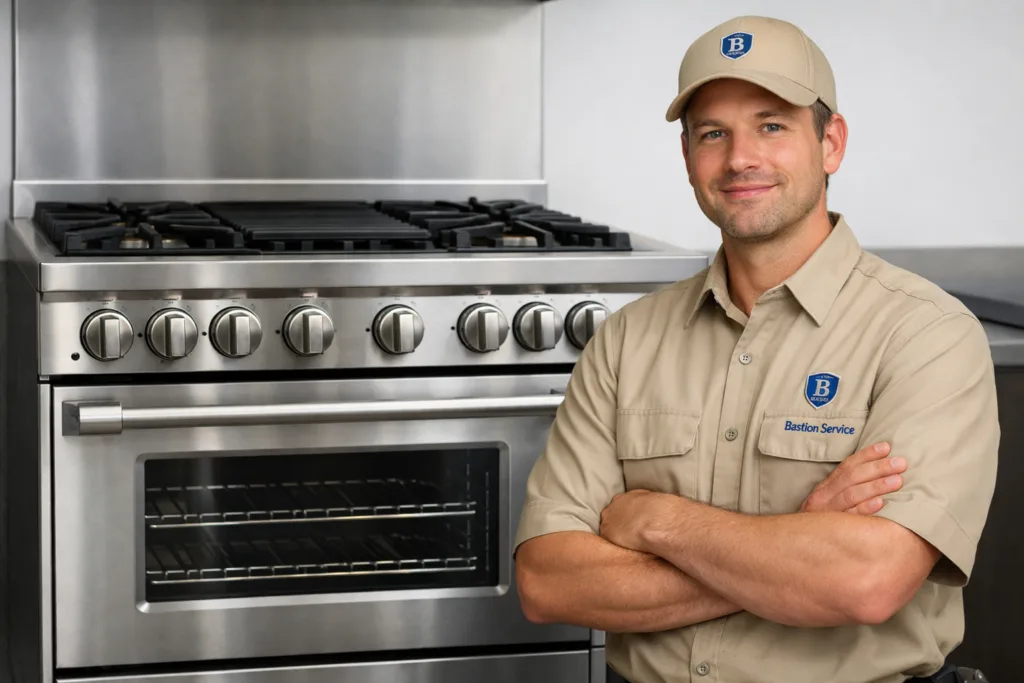




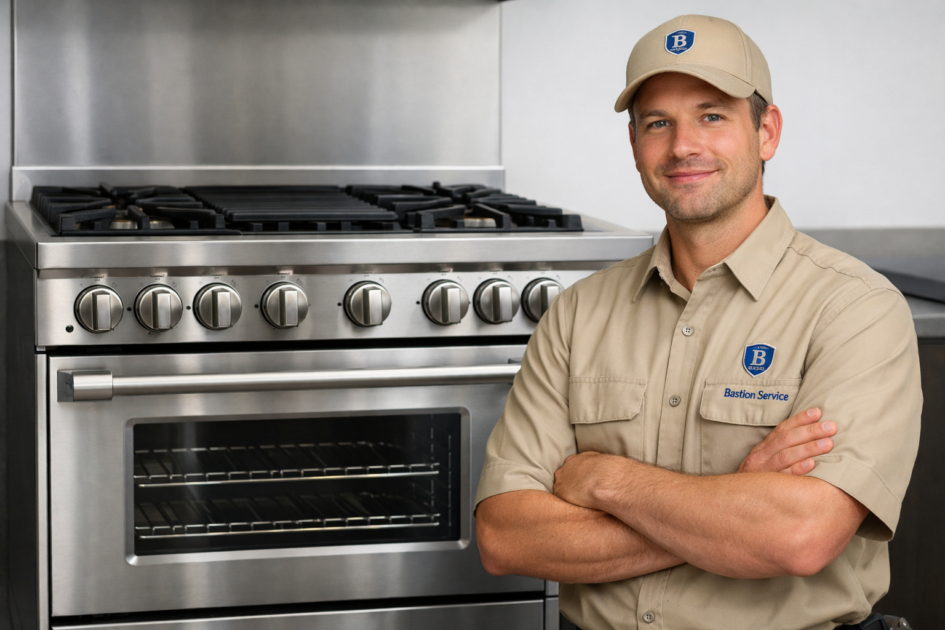
When a Wolf oven starts losing temperature, heating unevenly, failing to ignite, or shutting down during a busy shift, the issue quickly affects production, timing, and food quality. For businesses in Del Rey, the most effective response is to schedule service based on the exact symptom pattern instead of guessing at parts. Bastion Service works on Wolf oven problems by testing the heating, ignition, sensor, control, and power-related systems that commonly cause recurring performance issues.
Related commercial service paths in Del Rey include Wolf Commercial Repair in Del Rey, Commercial Oven Repair in Del Rey, and Wolf Range Repair in Del Rey.
How Wolf oven problems are diagnosed on a service call
Many oven complaints sound similar at first but lead to different repairs. An oven that runs cool may have a sensor problem, a calibration issue, a weak igniter, a relay fault, or heat loss from a sealing problem. An oven that stops mid-cycle may point to overheating protection, unstable controls, voltage issues, or a failing component that only drops out after the unit has been running.
A productive service visit usually starts with symptom review and performance testing. That includes checking whether the oven preheats normally, how closely actual temperature matches the set point, whether recovery between loads is slowing down, and whether the failure happens all the time or only during heavier use. For kitchens in Del Rey, that information helps move the repair decision forward faster and reduces the chance of replacing the wrong part.
Common Wolf oven symptoms and what they often indicate
Not heating at all
If the oven does not produce heat, likely causes can include ignition failure, electrical supply issues, a failed heating component on electric models, a control fault, wiring problems, or a safety device interrupting operation. A no-heat condition usually needs prompt attention because it takes the oven completely out of production.
Heating slowly or struggling to reach set temperature
Slow preheat or low temperature performance can come from a weak igniter, inaccurate sensor readings, failing relays, calibration drift, restricted airflow, or door seal problems that let heat escape. In day-to-day kitchen use, this often shows up as longer cook times, inconsistent batch results, and staff adjusting settings repeatedly to compensate.
Uneven baking or hot and cold spots
Uneven results often point to sensor issues, convection or airflow problems, improper heat cycling, or components that are not responding correctly under load. This is one of the most disruptive oven problems because the unit may appear to be working while still producing inconsistent product quality. In Del Rey kitchens, that can lead to waste, delayed service, and avoidable strain on staff workflow.
Ignition delay or intermittent startup
When the oven takes too long to light or starts only some of the time, the issue may involve the igniter, flame sensing, gas delivery, controls, or a safety circuit. Intermittent startup faults are especially important to address early because they often get worse before they become a complete no-start failure.
Shutting off during operation
An oven that runs for a while and then turns off may be dealing with overheating protection, unstable controls, electrical interruptions, sensor faults, or a component that fails after it reaches operating temperature. This pattern is often harder to catch without testing because the unit may restart later and seem normal for a short period.
Error codes, display faults, or unresponsive controls
Control-related symptoms can include blank displays, repeated resets, keypad problems, fault codes, or settings that do not respond correctly. These issues may be limited to the interface, but they can also overlap with heating and temperature complaints. That is why code-based problems are best evaluated alongside actual oven performance.
Why uneven heat and temperature complaints should not be ignored
Temperature problems are not just an inconvenience. They affect cook consistency, recovery time, throughput, and product quality. If staff members are rotating pans unusually often, extending bake times, or changing settings from batch to batch to get acceptable results, the oven is already affecting operations even if it has not failed completely.
Continued use can also make some problems worse. A weak igniter may progress to a no-heat condition. A door that is not sealing properly can force longer run times. A control issue can lead to wider temperature swings and more stress on connected components. Early repair is often less disruptive than waiting for the oven to stop working in the middle of service.
When service should be scheduled right away
Some symptoms should move to the front of the schedule because they create a higher risk of downtime or unsafe operation. Prompt service is usually the better choice when a Wolf oven:
- Will not heat or cannot maintain cooking temperature
- Shuts down unexpectedly during operation
- Shows repeated fault behavior or constant resets
- Has ignition delays or inconsistent startup
- Overheats, runs erratically, or produces unreliable results
- Trips breakers or shows signs of electrical instability
For businesses in Del Rey, acting on these warning signs early can help prevent a smaller repair from turning into a longer outage.
Repair or replace: how the decision is usually made
Not every oven problem leads to the same recommendation. In many cases, repair makes sense when the failure is isolated to a sensor, igniter, control component, switch, relay, door hardware issue, or a specific electrical or gas-related part. If the rest of the oven is in solid condition, restoring normal operation is often the practical path.
Replacement becomes a more serious consideration when the unit has repeated breakdowns, multiple systems showing wear at once, poor reliability during production periods, or a repair history that keeps interrupting operations. The real question for many Del Rey businesses is not just whether the oven can be fixed, but whether the next repair supports consistent output and reasonable uptime.
What to have ready before the technician arrives
A few details can make diagnosis more efficient. It helps to note:
- Whether the problem is constant or intermittent
- If the oven fails during preheat, during cooking, or during recovery between loads
- Any fault codes or display messages
- Whether staff noticed unusual odors, clicking, delayed ignition, or unexpected shutdowns
- If there was a recent power interruption, cleaning event, or change in performance
- How the issue is affecting output, timing, or menu execution
The more specific the symptom history, the easier it is to identify the likely failure path and schedule the right repair approach.
Service-focused support for Wolf ovens in Del Rey
Wolf oven repair is most effective when the problem is tied to actual operating behavior rather than assumptions. If your oven is not heating evenly, not reaching temperature, taking too long to preheat, or shutting down without warning, the next step is to arrange service that targets the fault, helps limit downtime, and supports a reliable return to daily kitchen operation in Del Rey.


