
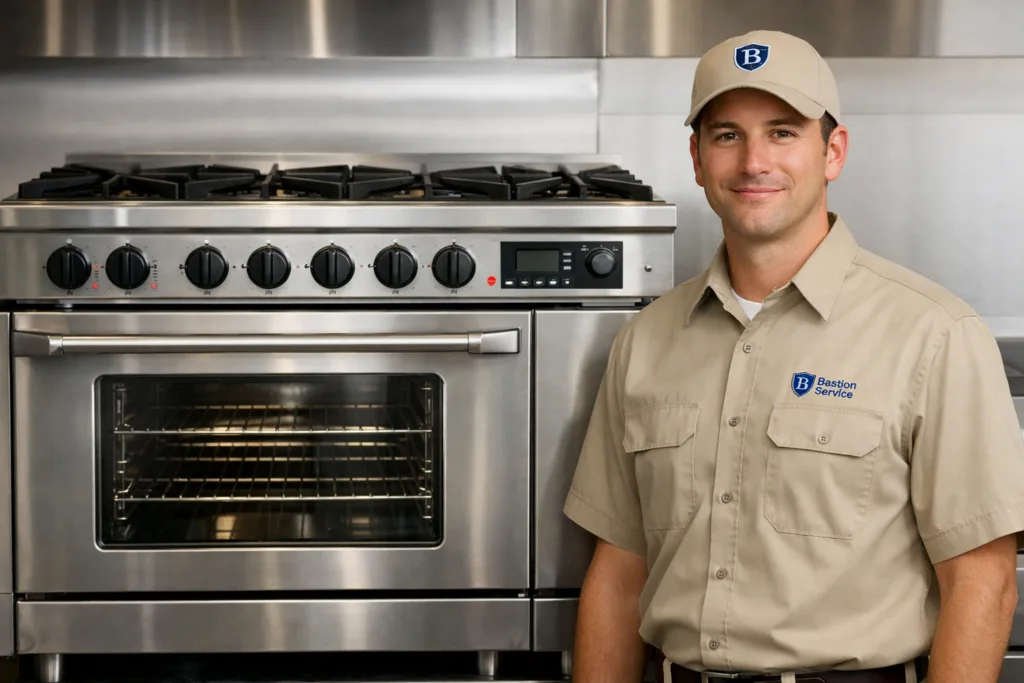




When a Vulcan oven stops holding temperature, heats unevenly, or drops out during service, the issue can disrupt ticket times, prep flow, and product consistency. For businesses in Del Rey, the best next step is usually to schedule service around the exact symptom pattern rather than guessing at a single failed part. Problems that look similar from the outside can come from ignition faults, sensor drift, airflow restrictions, failing controls, worn heating components, or door-related heat loss. Bastion Service works with Del Rey businesses to identify the cause, explain the repair path, and help reduce unnecessary downtime.
Related commercial service paths in Del Rey include Vulcan Commercial Repair in Del Rey, Commercial Oven Repair in Del Rey, and Vulcan Range Repair in Del Rey.
How Vulcan oven problems usually show up in daily operations
Oven failures rarely start as a complete shutdown. More often, staff notice slower preheat, longer cook times, inconsistent browning, or temperature swings during busy periods. A unit may appear usable between shifts and then struggle once demand increases. That pattern matters because it often points to a performance problem under load rather than a simple on-or-off failure.
In many kitchens, early warning signs include:
- Food finishing unevenly from one rack position to another
- The oven taking too long to recover after the door opens
- Set temperature not matching actual cooking results
- Intermittent ignition or delayed burner operation
- Control panel irregularities, resets, or inconsistent cycling
- Operators changing cook times or rotating pans more than usual
When these issues start affecting output or consistency, repair scheduling becomes a production decision, not just a maintenance task.
Why is my Vulcan oven not heating evenly or reaching set temperature?
This symptom can come from several different sources, which is why targeted diagnosis matters. On gas models, the issue may involve ignition sequence problems, burner performance, gas flow components, flame-sensing faults, or control-related interruptions. On electric models, likely causes can include failing elements, relays, contactors, wiring faults, or control board problems.
Temperature accuracy issues can also come from sensors, thermostat calibration drift, weak convection performance, or door seal problems that allow heat to escape. If an oven technically turns on but still cannot deliver stable heat, the repair focus should be on how the unit behaves during an actual cooking cycle, not just whether it powers up.
From an operations standpoint, this symptom often appears first as:
- Undercooked centers with overbrowned edges
- Batch-to-batch inconsistency
- Slow preheat in the morning or after idle periods
- Extended cooking times during peak use
- Frequent manual adjustments by staff to compensate
Uneven baking, hot spots, and inconsistent browning
When a Vulcan oven produces different results across pans or rack positions, the problem is not always the heating source itself. Air movement, fan performance, blocked airflow paths, sensor inaccuracy, and calibration issues can all affect bake consistency. Even a small gasket failure or door alignment issue can change how the cavity holds and circulates heat.
These complaints are important because they often develop gradually. Staff may adapt by shifting trays, rotating product, or changing recipes, which can hide the underlying equipment problem for a while. Once that pattern starts, the oven is already affecting labor efficiency and output quality.
If the unevenness gets worse as the shift gets busier, that can help narrow the diagnosis. It may suggest an issue with recovery performance, airflow under load, or a component that fails intermittently once heat builds up.
Ignition delays, shutdowns, and cycling problems
An oven that lights inconsistently, drops heat in the middle of operation, or shuts down without warning needs attention before it becomes a full no-heat call. Intermittent failures can involve igniters, flame sensing, safety controls, loose connections, relays, wiring damage, or control board issues. In some cases, a unit may restart on its own or work again after cooling, which can make the problem seem minor when it is not.
These faults are especially disruptive in food-service environments because they create uncertainty. A kitchen cannot plan around an oven that may or may not complete a cycle. If operators are resetting the unit, retrying starts, or avoiding certain settings because the oven behaves unpredictably, service should be scheduled before the problem spreads to additional components.
Door, hinge, and gasket issues that affect cooking performance
Heat retention problems are often underestimated because the oven still appears to be running. But worn door gaskets, loose hinges, poor door alignment, and damaged closing surfaces can all reduce cavity stability. That means longer preheat, weaker recovery after opening, and more strain on heating and control components.
In a busy Del Rey kitchen, a door-related issue can show up as:
- Cook times gradually getting longer
- Visible heat loss around the door
- Product inconsistency near the front of the cavity
- The door not sealing or closing evenly
- Operators needing to push the door closed more firmly than before
Mechanical wear in these areas may seem minor at first, but it can contribute to larger temperature-control complaints if left unaddressed.
Signs the oven should be checked soon
Some problems can wait for planned service, but heat-control and ignition issues usually should not. If the oven is affecting throughput, quality, or staff workflow, the cost of delay can rise quickly. It is smart to schedule service when symptoms are repeatable, even if the unit has not completely stopped working.
Priority warning signs include:
- Failure to reach or hold cooking temperature
- Breaker trips or unexplained power loss
- Longer-than-normal preheat times
- Burner ignition that is delayed or inconsistent
- Control display irregularities or unresponsive settings
- Abnormal electrical overheating odors
- Different performance from one shift to the next
For gas units, any persistent or strong gas odor should be treated as a safety concern rather than a routine scheduling issue. The appliance should not continue operating under those conditions.
When continued use can make repairs more expensive
Running an oven with unstable temperature control, weak airflow, intermittent ignition, or heat loss can put added stress on related parts. What begins as one failed component can turn into secondary control, wiring, or performance issues if the unit stays in heavy use without correction. A kitchen may be able to work around the problem for a short time, but repeated operation under fault conditions often leads to broader downtime later.
This is especially true when staff have already changed their process to compensate. If recipes, timing, or pan placement are being adjusted around the oven instead of the oven doing its job consistently, the equipment should be evaluated before the problem becomes more disruptive.
Repair or replacement: what usually matters most
Not every oven issue points to replacement. Many Vulcan ovens can be repaired effectively when the fault is isolated, the structure of the unit is sound, and the repair is likely to restore stable operation. In many cases, replacing the failed component and confirming temperature performance under load is the practical path.
Replacement becomes more likely when the oven has overlapping failures, repeated recent breakdowns, major control issues combined with heating problems, or a history of unreliable operation even after service. Age matters less than condition, parts availability, and whether the next repair will genuinely improve daily reliability.
For businesses making that decision, the useful question is not simply whether the oven can be turned back on. The better question is whether the repair returns the unit to dependable production use without ongoing workarounds.
How to prepare for a service visit
A little information from the site can make diagnosis faster and more accurate. Before the appointment, it helps to note when the problem started, whether it happens every cycle or only under heavy use, and what staff are seeing in actual cooking results. If the issue is intermittent, details about time of day, temperature setting, and what happens before shutdown can be valuable.
Helpful information includes:
- The model and approximate age of the oven
- Whether the unit is gas or electric
- If the complaint is constant or intermittent
- Any recent part replacements or previous service history
- Whether the problem appears during preheat, recovery, or full production
- Specific examples of food quality changes or timing delays
That context helps connect the symptom to the likely failure path and supports more efficient repair planning.
Service decisions should match the way the oven is actually used
Vulcan oven repair should be based on how the equipment performs in real kitchen conditions, not only on a quick visual check. An oven that runs poorly during rush periods, misses setpoint after repeated door openings, or browns inconsistently across batches is already telling you something important about its condition. When that starts affecting scheduling, output, or product consistency in Del Rey, a diagnostic service visit is usually the most practical next step. The goal is to identify the cause, confirm whether repair is the right move, and get the unit back to stable daily operation as efficiently as possible.


