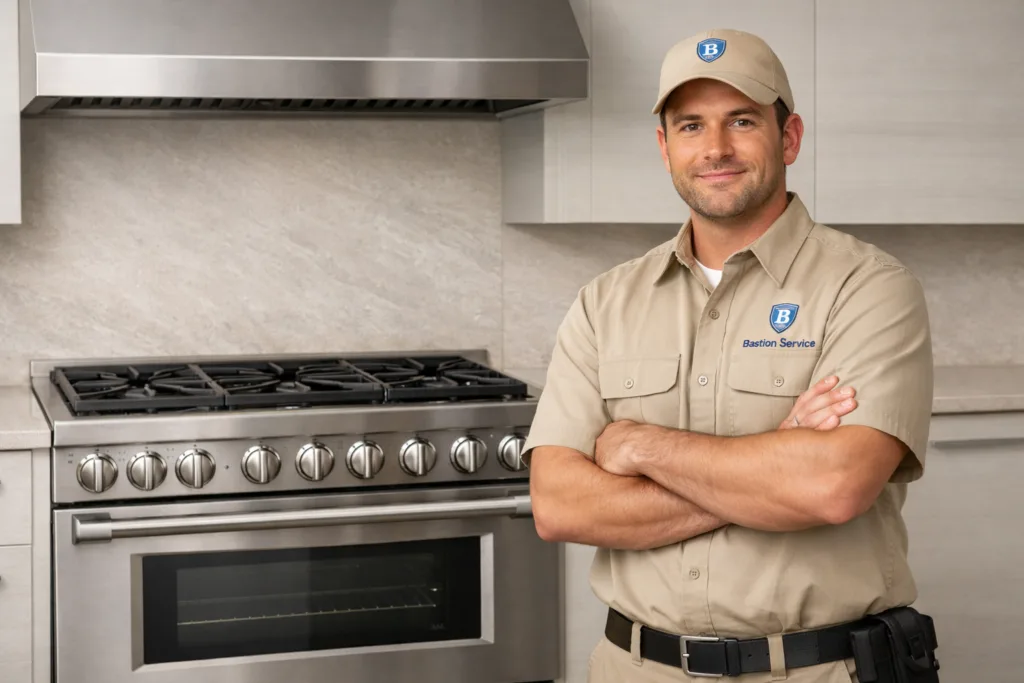
Cooking problems with a Monogram range often start small: one burner clicks longer than usual, the oven takes an extra ten minutes to preheat, or baking results become less predictable from one meal to the next. Those early symptoms usually point to a specific failed part or system, but the right repair depends on how the problem shows up in actual use.
In Hawthorne homes, range issues tend to affect one of three areas: surface cooking performance, oven heating performance, or the electronic controls that manage both. Looking at the symptom pattern first helps separate a minor burner issue from a sensor, ignition, or control failure that needs closer attention.
Common Monogram range problems in Hawthorne homes
Burners that click, ignite slowly, or will not light
Gas burner trouble is one of the most common complaints. A burner may spark repeatedly without lighting, light only after several tries, or keep clicking after the flame is already on. In many cases, the problem is related to burner cap alignment, clogged ports, moisture around the igniter, a weak ignition component, or a fault in the spark system.
If the burner does light but the flame is uneven, too low, or inconsistent around the ring, that can affect pan heating and make normal cooking frustrating. When the same burner keeps acting up even after cleaning, the issue usually needs a closer inspection rather than more trial and error.
Oven not heating correctly
An oven that stays cool, heats too slowly, overshoots the set temperature, or cooks unevenly can have several different causes. Depending on the model, the fault may involve the bake system, broil system, temperature sensor, convection components, or the electronic control managing the heat cycle.
Uneven baking is especially easy to dismiss at first, but repeated undercooked centers, overbrowned edges, or inconsistent results from rack to rack often signal that the oven is no longer regulating heat the way it should. That matters not just for baking, but also for roasting and longer cooking cycles where temperature stability is important.
Display and control problems
Monogram ranges with electronic controls can also develop issues that look random at first. The display may go blank, buttons may stop responding, settings may change unexpectedly, or the oven may fail to start even though power is present. These symptoms can be caused by a failing control board, interface problem, damaged connection, or power-related fault inside the appliance.
Because control symptoms can overlap with heating and ignition complaints, replacing parts without testing can quickly become expensive. A control-related issue should be narrowed down carefully before any major repair decision is made.
What specific symptoms may be telling you
Homeowners usually want to know whether the problem sounds simple or serious. While only testing can confirm the cause, a few symptom patterns are especially useful as starting points:
- Burner sparks but never lights: often points to clogged burner ports, poor cap positioning, ignition trouble, or a gas delivery issue affecting that burner.
- Burner keeps clicking after ignition: may indicate moisture, debris, switch issues, or an ignition component that is not reading the flame condition correctly.
- Oven takes much longer to preheat: can suggest a weak heating circuit, sensor problem, or control issue.
- Food cooks faster on one side: may indicate uneven heat distribution, convection trouble, or inaccurate temperature regulation.
- Oven temperature seems too high or too low: often points to a sensor or control problem rather than a simple setting adjustment.
- Display flickers, resets, or stops responding: can suggest an electrical or electronic control fault that should not be ignored.
These patterns do not replace diagnosis, but they do help explain why two ranges with the “same” complaint may need very different repairs.
When the problem is more than routine wear
Some range issues are mostly inconvenient. Others are a sign that continued use is a bad idea until the appliance is checked. If a burner will not regulate properly, the oven overheats, the control panel behaves erratically, or ignition becomes unreliable, it is better to stop using the range and schedule service.
That is especially true when the symptom is getting worse. A burner that occasionally misfires can turn into a burner that will not light at all. An oven with mild temperature drift can become inaccurate enough to affect nearly every meal. Electrical and control faults can also spread their effects to other functions if left alone.
Signs you should not wait
- The same burner fails repeatedly after cleaning and reassembly
- The oven is consistently underheating or overheating
- Ignition takes multiple attempts on a regular basis
- The control panel loses power or becomes unresponsive
- The range works intermittently instead of consistently
- Error behavior appears along with heating or ignition problems
Repair or replace?
Many Monogram range problems are repairable when the fault is isolated to a burner component, igniter, sensor, heating element, switch, or a specific control-related part. In those situations, repair is often the more sensible option if the rest of the appliance is in solid condition.
Replacement becomes a more serious conversation when several major systems are failing together, when the same expensive issue keeps returning, or when the appliance has developed broader reliability problems beyond a single repair. Age alone does not decide the issue. The more important question is whether one repair is likely to restore stable daily use or whether the range is starting to stack one failure on top of another.
For many households in Hawthorne, the best decision comes down to three things: the exact failed component, the condition of related systems, and whether the repair will return the appliance to consistent cooking performance.
What a service visit should help you understand
A worthwhile service call should do more than confirm that the range is “not working right.” It should identify whether the problem is tied to ignition, burner performance, oven heating, sensing, user interface response, or internal electrical control. Once that is clear, it becomes much easier to decide whether the repair is straightforward, whether additional parts may be involved, and what kind of result to expect afterward.
If your Monogram range is no longer heating evenly, one or more burners are unreliable, or the controls are not responding the way they should, symptom-based testing is the fastest way to move from guesswork to a repair plan that actually fits the appliance.