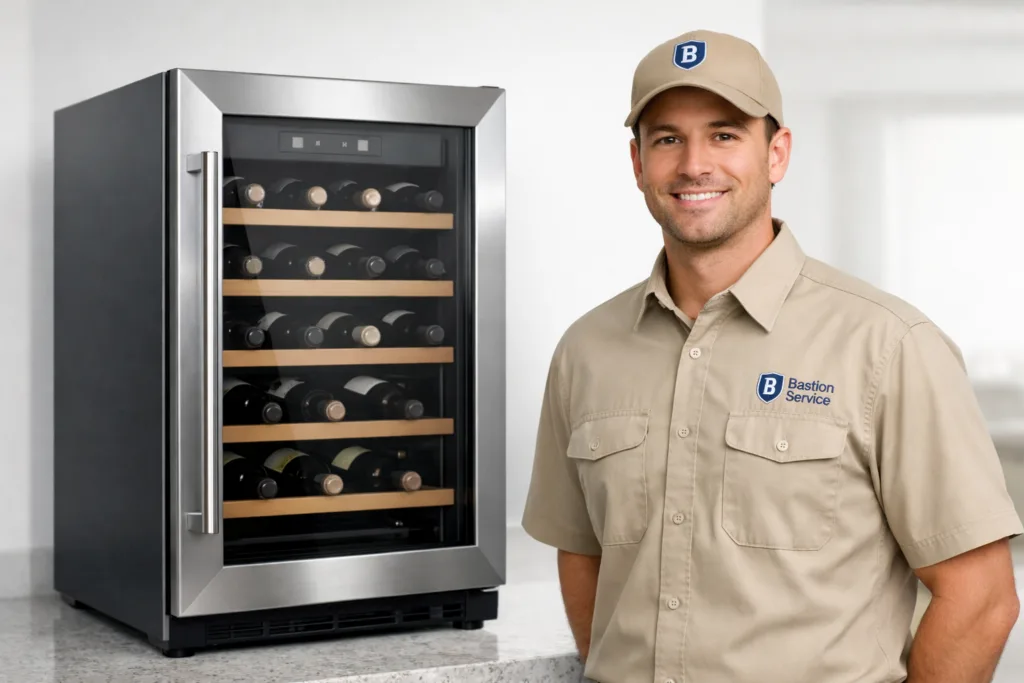
Temperature instability is usually the first sign that something in a Summit wine cooler is no longer working as intended. In many homes, the problem starts subtly: bottles feel warmer than expected, the unit seems to run longer than usual, or moisture begins appearing where it did not before. Because several different faults can create the same symptom, the best repair path depends on how the cooler is behaving over time, not just on whether it is cold or warm at one moment.
Common Summit wine cooler problems in Marina del Rey homes
Wine coolers often show warning signs before they fail completely. Paying attention to those changes can help prevent spoilage, cabinet moisture damage, and avoidable wear on major components.
Not cooling enough
If the display is set correctly but the cabinet is not reaching the expected temperature, the cause may be airflow restriction, a failing evaporator fan, a temperature sensor issue, a control fault, or a refrigeration-system problem. In some cases, the cooler still runs and lights up normally, which can make the issue seem minor even while internal temperatures drift upward.
This symptom is especially important when the difference between the set temperature and actual temperature keeps widening. That pattern can help distinguish a control or sensing problem from a true loss of cooling performance.
Temperature swings or overcooling
A unit that alternates between too warm and too cold is not maintaining a stable storage environment. Bottles near the back wall may become overly chilled, while other areas stay noticeably warmer. These inconsistencies can point to sensor trouble, thermostat problems, fan issues, or irregular control-board operation.
Even if the cooler still seems partly functional, unstable cycling is worth addressing early. A wine cooler does not need to be completely dead to be underperforming.
Condensation or water buildup
Water inside the cabinet or around the base can come from a worn door gasket, poor door alignment, drainage issues, or uneven internal temperatures that encourage condensation. In Marina del Rey homes, normal household humidity can make a small sealing problem more noticeable, especially when the door is opened often.
Light moisture may not seem urgent, but standing water should not be ignored. Over time it can affect surrounding finishes, promote odors, and signal an airflow or sealing problem that also affects cooling.
Fan noise, buzzing, or rattling
New sounds often provide useful clues. A scraping or ticking noise may suggest fan blade interference. Rattling can come from loose panels or vibration against cabinetry. Buzzing may indicate compressor strain or an electrical issue during startup.
Not every noise points to a major repair, but a change in sound should be taken seriously when it appears alongside warmer temperatures, longer run times, or control irregularities.
Constant running or short cycling
If the cooler rarely shuts off, it may be struggling to remove heat because of dirty coils, poor ventilation, door leakage, sensor problems, or sealed-system weakness. If it starts and stops repeatedly within short intervals, the issue may involve starting components, controls, or electrical faults.
Either pattern can increase wear. A system that runs nonstop is working harder than it should, while repeated short starts can be hard on the compressor and related components.
Why symptom patterns matter
Two Summit wine coolers can show the same complaint for completely different reasons. A warm cabinet might be caused by a fan motor, a sensor, restricted airflow, a failed control, or a sealed-system issue. Condensation might come from a gasket problem rather than a drain issue. A unit that appears dead may have a power supply problem instead of a failed compressor.
That is why symptom-based evaluation matters. Looking at temperature behavior, cycle timing, noise changes, moisture patterns, and control response helps narrow the problem to the correct system. This reduces unnecessary part replacement and helps determine whether the appliance is a strong candidate for repair.
Built-in installation can affect performance
Many residential wine coolers are installed in cabinetry or tight kitchen spaces. When ventilation is limited, heat removal becomes harder and cooling complaints can appear worse. A built-in Summit unit may also be more sensitive to fan problems, blocked airflow, or door alignment changes because there is less room for heat to dissipate.
Installation conditions do not automatically mean the cooler is defective, but they do matter when evaluating why the unit is running hot, running constantly, or collecting moisture. Access limitations can also affect the repair approach.
When to schedule service
It is smart to schedule Summit Wine Cooler Repair in Marina del Rey when you notice any of the following:
- The cabinet stays warmer than the set temperature
- Temperature swings become frequent or unpredictable
- Water appears inside the cooler or around the base
- The controls stop responding normally
- The fan becomes noisy or the unit starts making new sounds
- The cooler runs almost constantly or starts short cycling
Waiting too long can turn a manageable issue into a larger repair. A struggling fan motor, bad seal, or sensor fault can force other components to work harder and may lead to wider cooling problems.
Repair versus replacement
Whether repair makes sense depends on the type of failure, the age of the unit, and its overall condition. Problems involving fans, sensors, thermostatic controls, door seals, and some electrical components are often more straightforward to address. If the cooler has repeated cooling failures, advanced wear, or a major sealed-system problem, replacement may be the better long-term option.
The most useful decision is one based on findings rather than assumptions. A cooler that seems beyond saving may only need one targeted repair, while another that still runs could be nearing the point where continued repairs no longer make sense.
What to note before the appointment
Before service, it helps to gather a few details about how the cooler has been behaving. Useful observations include:
- The set temperature and the actual temperature if measured
- Whether the issue is constant or comes and goes
- Any recent fan noise, buzzing, clicking, or rattling
- Whether moisture is inside the cabinet or outside near the floor
- Whether the unit is built-in or freestanding
- Any display errors or unresponsive controls
These details can help narrow the likely cause more quickly and make it easier to determine whether the issue is related to controls, airflow, sealing, or the cooling system itself.
Protecting the cooler and the collection
A wine cooler works best when it can hold a consistent environment without excess noise, moisture, or long run times. When those basics change, the appliance is telling you something is off. Addressing the problem early can help protect both the unit and the bottles stored inside.
For homeowners in Marina del Rey, the right next step is a practical repair plan based on the actual symptom pattern, appliance condition, and likely repair path rather than guesswork.