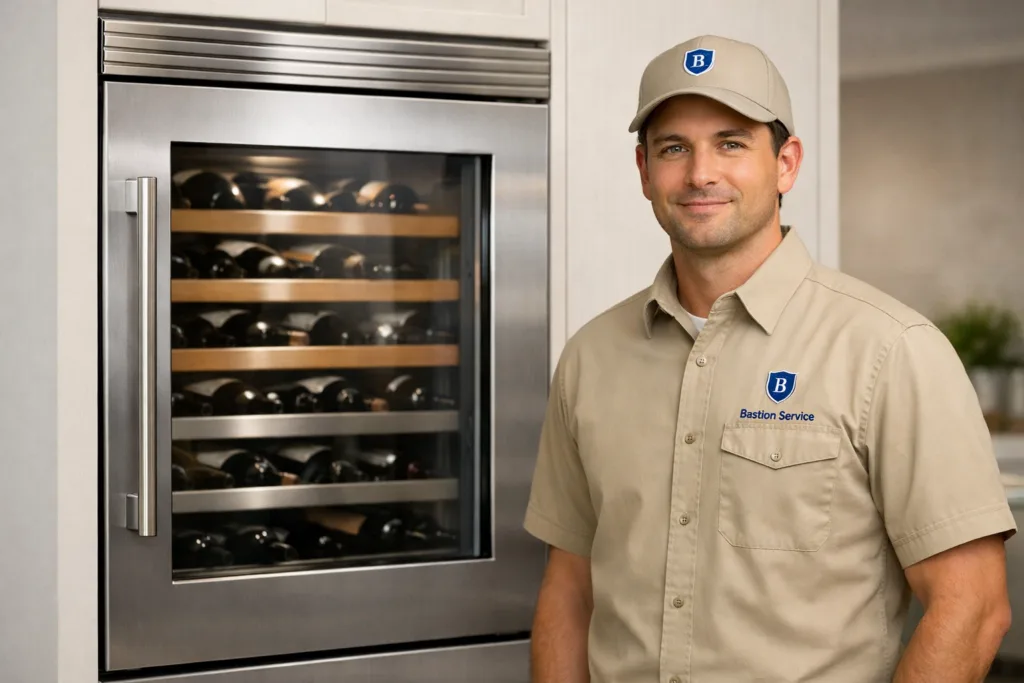
Wine coolers usually give warning signs before they fail completely. If your Sub-Zero unit is running warm, collecting moisture, making new noises, or cycling in a way that seems off, the smartest next step is to narrow down the cause by symptom rather than assume a specific part has failed. That approach helps protect both the appliance and the bottles stored inside it.
Common Sub-Zero wine cooler problems in Marina del Rey homes
Most household wine cooler issues fall into a few recognizable patterns: unstable temperature, excess condensation, fan or compressor noise, poor door sealing, or controls that do not respond correctly. In a residential setting, these problems often show up gradually at first, then become more obvious as cooling performance slips.
Temperature swings or a cabinet that feels too warm
If the cooler cannot hold a steady temperature, the issue may involve airflow, condenser buildup, a weak evaporator fan, sensor trouble, a thermostat or control fault, or warm air leaking in around the door gasket. Some units also develop sealed-system or compressor-related problems that cause slow cooling or uneven temperatures inside the cabinet.
Because wine storage depends on consistency, even mild fluctuations matter. A unit that drifts several degrees during the day may still appear to be operating, but it is no longer doing the job it was designed to do.
Condensation, interior moisture, or frost
Water droplets on walls, damp shelves, fogging near the door, or frost in specific areas usually point to one of a few issues: a poor door seal, a drainage problem, warm air intrusion, or uneven evaporator performance. Moisture should not be dismissed as cosmetic. Repeated condensation can affect labels, wood shelving, interior finishes, and nearby cabinetry if it continues long enough.
Frost buildup is also useful as a clue. A small amount in the wrong area can suggest an airflow issue or a control problem rather than a simple temperature setting mistake.
Fan noise, rattling, clicking, or nonstop running
A Sub-Zero wine cooler should have a fairly consistent sound profile. If it starts buzzing, rattling, clicking repeatedly, or running much longer than usual, that change often means something mechanical or airflow-related needs attention. Fan motors, mounting components, vibration points, and compressor operation are all worth checking when noise changes appear alongside cooling complaints.
Continuous running is especially important to notice. Even if the cabinet still feels somewhat cool, the system may be struggling to reach or maintain the target temperature, which can increase wear over time.
Door not sealing or closing correctly
A door that does not close flush, pops open slightly, or shows visible gasket wear can create larger cooling problems than many homeowners expect. Even a small air leak can lead to temperature drift, moisture buildup, longer run times, and interior hot spots. If bottles near the front feel warmer or condensation forms near the opening, the seal should be inspected.
Control or display issues
If the controls are unresponsive, the display behaves inconsistently, or settings change without improving performance, the problem may be electrical or board-related rather than purely mechanical. When control issues are paired with poor cooling, it is important to determine whether the system is receiving bad input from a sensor or failing to execute the correct cooling cycle.
How symptoms help narrow down the repair
Two wine coolers can show the same symptom for completely different reasons. A warm cabinet could come from dirty condenser areas, weak airflow, a faulty sensor, a bad seal, or a more serious sealed-system fault. Condensation could be caused by humid air entering through the door, a drainage issue, or cooling imbalance inside the cabinet. That is why symptom-based troubleshooting matters.
Useful service should identify whether the problem is:
- An airflow issue
- A control or sensor issue
- A door seal or closure problem
- A drainage or moisture-management problem
- A fan, compressor, or sealed-system concern
Once the failure pattern is clear, it becomes much easier to decide whether repair is straightforward, urgent, or no longer cost-effective.
Signs the unit should not keep running
Some wine cooler problems are inconvenient but manageable for a short time. Others are a sign that continued operation could make things worse. It is usually best to stop using the unit and arrange service if you notice any of the following:
- The cabinet is no longer cooling at all
- The temperature keeps climbing despite setting changes
- The compressor or fan sounds strained, loud, or irregular
- Water is repeatedly leaking onto the floor
- Frost is building quickly or spreading unusually
- The appliance is short cycling or overheating
Running a struggling wine cooler nonstop can add stress to components that are already near failure. In built-in installations, ongoing heat or moisture can also affect surrounding finishes.
What homeowners should check before scheduling repair
Before assuming a major breakdown, there are a few simple things worth noticing:
- Whether the door is fully closing and sealing on all sides
- Whether the unit has become noisier than usual
- Whether condensation appears mainly near the door or throughout the cabinet
- Whether temperature drift is constant or happens in cycles
- Whether shelves or bottle placement are restricting airflow inside
These observations can help describe the problem more accurately and may speed up the repair process. They also help separate a minor use-related issue from a component failure that needs service.
Repair or replacement: what usually makes sense
Many Sub-Zero wine cooler issues are repairable when the fault is isolated to serviceable components such as fans, controls, sensors, gaskets, or drainage-related parts. Repair often makes sense when the cabinet is structurally sound, the problem is contained, and the unit has not had a long history of repeated failures.
Replacement becomes a more serious consideration when the cooler has major sealed-system trouble, extensive wear, or multiple issues at the same time. Age matters, but condition matters more. A well-kept unit with one confirmed failure is a very different situation from an older cooler with cooling loss, moisture problems, and recurring electrical issues.
For most homeowners in Marina del Rey, the best decision comes down to three questions:
- What exactly failed?
- How involved is the repair?
- Does the overall condition of the wine cooler justify fixing it?
What a focused service visit should cover
A proper visit for a Sub-Zero wine cooler should go beyond listening to a symptom and guessing at a part. It should include temperature performance checks, airflow review, door and gasket inspection, moisture pattern assessment, and evaluation of whether the issue is mechanical, electrical, or sealed-system related.
The goal is to leave you with a practical repair plan based on the exact symptom pattern, not a vague recommendation. That may mean proceeding with repair, stopping use until the unit is fixed, or deciding that replacement is the better long-term choice.
Why early attention usually leads to better outcomes
Wine coolers rarely improve on their own. A mild temperature drift can turn into a full no-cool condition. A little condensation can become recurring moisture damage. A new rattle can become a more expensive mechanical repair if the unit keeps running under strain.
In Marina del Rey homes, addressing these signs early usually gives homeowners more options. It can preserve stored wine, reduce the chance of secondary damage, and make the difference between a manageable repair and a larger appliance decision.