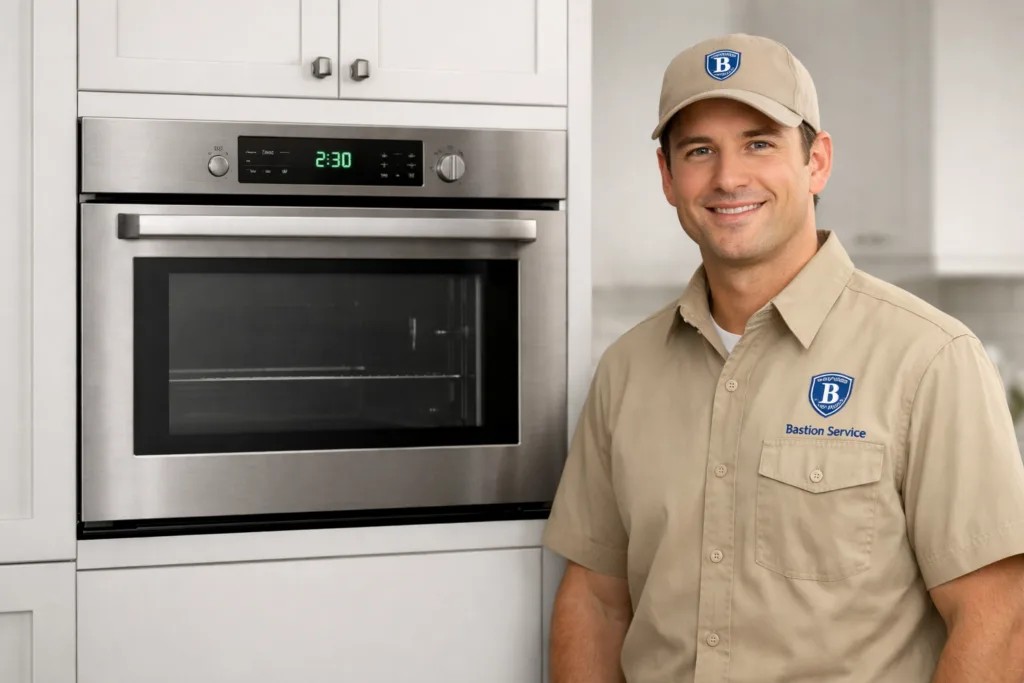
Cooking problems often show up gradually. A Samsung oven may start taking longer to preheat, brown unevenly, or miss the set temperature by enough to affect everyday meals. In many cases, the symptom is more useful than the assumption, because the same complaint can come from a heating component, a sensor problem, a control fault, poor door sealing, or an electrical issue.
Common Samsung oven symptoms in Brentwood homes
Most homeowners notice oven trouble in regular use rather than during a complete failure. Cookies bake unevenly, casseroles need extra time, or the oven appears to be on without delivering consistent heat. Paying attention to exactly how the problem happens can make the repair path much clearer.
Oven not heating at all
If the oven will not heat, the cause can differ depending on the model and fuel type. On electric Samsung ovens, failed bake or broil elements, sensor faults, relay problems, or wiring issues are common possibilities. On gas models, ignition problems can prevent proper heating even when the display and controls seem normal. A unit that powers on but produces no heat usually needs component testing rather than guesswork.
Slow preheat
Slow preheating is easy to dismiss at first, but it often points to a developing issue. One heating circuit may be weak, the sensor may be reading inaccurately, or the control may not be cycling heat correctly. If preheat times have stretched noticeably, the oven may still be functioning, but not at full performance.
Uneven baking
When food is overdone on one side and undercooked on the other, the problem may involve temperature cycling, airflow, convection performance, or heat loss at the door. Uneven baking can also show up as a top rack and bottom rack cooking at very different rates. This is especially frustrating because the oven still appears usable, yet results become unreliable.
Temperature swings
Some Samsung ovens heat up, cool down too far, then overcorrect. That pattern can lead to recipes that suddenly stop turning out the way they used to. Temperature swings may be tied to a sensor drifting out of range, a failing control relay, or an issue with how the oven is maintaining temperature after preheat.
Overheating
An oven running hotter than the selected setting should be checked promptly. Overheating can ruin food, stress internal parts, and create additional wear if it continues. If the cavity feels far hotter than expected, or dishes are burning much faster than normal, the sensor and control system are often worth evaluating first.
Display or control problems
Touch panel issues, flashing error codes, resetting clocks, and buttons that do not respond can all affect oven operation. In some cases, the heating problem is actually secondary to a control or communication fault. If the interface behaves unpredictably, the oven should not be assumed to be operating normally just because it turns on.
Why the symptom pattern matters
A useful service call starts with what the oven is actually doing in the kitchen. An oven that never reaches temperature is different from one that reaches temperature and then drops off. An oven that fails only during bake is not the same as one that has problems on both bake and broil. A unit that works for twenty minutes and then shuts down points in a different direction than one that will not start heating in the first place.
Those details help narrow down whether the issue is most likely in the heating circuit, temperature sensing, electronic control, wiring, ignition system, or door sealing. For homeowners in Brentwood, that means less time spent chasing the wrong repair and a better sense of whether the appliance is worth fixing.
Signs the oven should not keep being used
Some problems are inconvenient. Others are a sign to stop using the appliance until it is checked. Continued operation is not a good idea if the oven:
- Smells like hot wiring or burning insulation
- Sparks or trips the breaker
- Shuts off unpredictably during cooking
- Runs far above the set temperature
- Shows recurring error codes tied to heating or control faults
- Has delayed ignition or inconsistent ignition on a gas model
Even without an obvious safety concern, repeated use with a failing sensor, weak element, or unstable control can put extra stress on related parts. A smaller repair can become more involved if the original problem is left in place too long.
What often causes these issues on Samsung ovens
Samsung oven problems are not all caused by the same type of failure. Depending on the symptom, the repair may involve one or more of the following:
- Bake or broil element failure on electric models
- Igniter problems on gas models
- Temperature sensor drift or failure
- Control board or relay faults
- Wiring or terminal issues affected by repeated heat exposure
- Door gasket wear or a door that no longer seals correctly
- Convection fan or airflow-related problems on convection models
This is why part-swapping based only on the most obvious symptom can be expensive and ineffective. Similar cooking complaints can come from very different failures.
When repair usually makes sense
Repair is often a reasonable choice when the oven is otherwise in solid condition and the problem appears limited to a specific serviceable component. That may include a failed heating element, an igniter, a sensor, a door seal, or a more isolated control-related issue. If the appliance has been working well overall and the fault is recent, repair is often the simpler path.
For many households in Brentwood, the decision also depends on how often the oven is used. If it is part of daily meal prep, restoring normal temperature performance can be more practical than trying to work around a problem that keeps affecting cook times and results.
When replacement may be the better option
Replacement becomes more worth considering when there are multiple problems at once, a long repair history, signs of broader electrical deterioration, or repeated control failures that suggest the issue is not isolated. If the unit has become unreliable in several ways rather than one, the cost-benefit picture can change.
The goal is not to push repair or replacement in every case. It is to look at the exact symptom, the likely failed parts, and the overall condition of the appliance before deciding what makes the most sense for the household.
Helpful details to note before service
If you are arranging Samsung oven repair in Brentwood, a few observations can make the visit more productive. Try to note:
- Whether the oven is electric or gas
- Whether the issue affects bake, broil, or both
- If the oven fails during preheat or later in the cooking cycle
- Any error code shown on the display
- Whether temperatures seem too low, too high, or unstable
- If the door does not close or seal as tightly as before
- Whether the breaker has tripped or the clock has reset
These details can help connect the complaint to the most likely systems involved and reduce unnecessary delays during diagnosis.
Practical guidance for Brentwood homeowners
If your Samsung oven is still technically running but no longer cooking accurately, it is usually better to address the issue before it turns into a complete no-heat failure. Small signs such as slow preheat, inconsistent browning, or sudden temperature swings are often the earliest clues that a component is weakening.
Bastion Service helps Brentwood homeowners evaluate Samsung oven problems based on real-world symptoms, appliance condition, and the likely repair path. That makes it easier to decide whether to move forward with repair, pause use for safety, or start considering replacement.