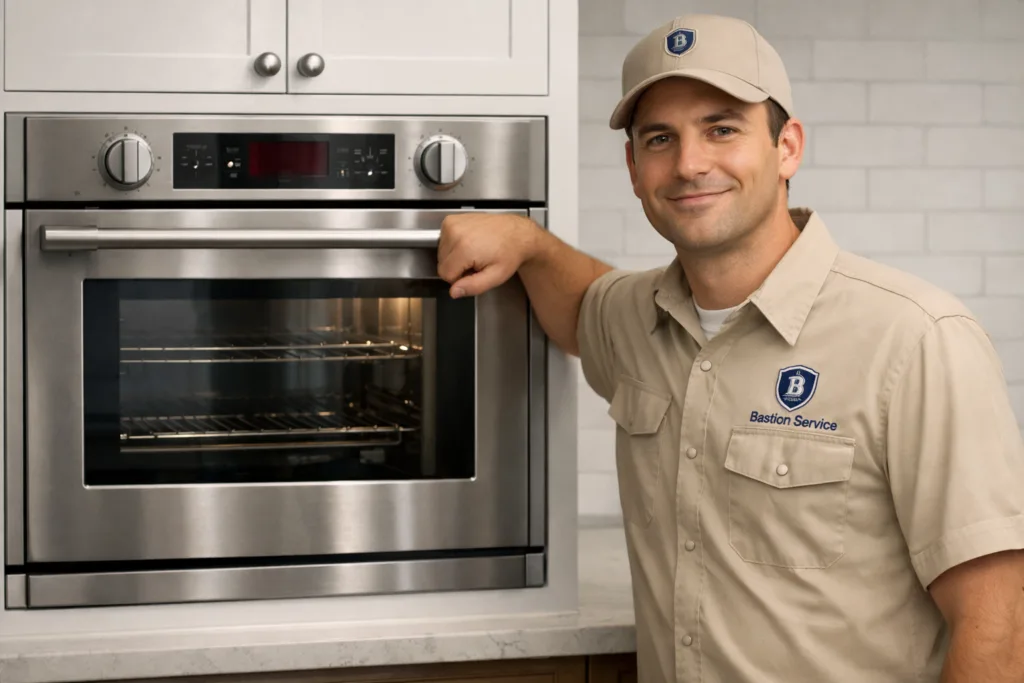
Cooking results usually reveal oven trouble before a complete breakdown does. A roast that needs an extra 20 minutes, a tray of cookies that browns unevenly, or an oven that seems to preheat forever can all point to component wear, sensor problems, airflow issues, or control faults. On a Wolf oven, those symptoms are worth checking sooner rather than later because small temperature errors can become more noticeable with everyday use.
Common Wolf oven symptoms homeowners notice in Brentwood
Most service calls begin with a pattern rather than a single failure. The oven may still turn on, light up, and appear normal, but performance at the rack level tells a different story. Paying attention to how the oven behaves across several cooking cycles can help narrow down the likely cause.
Not heating at all
If the oven powers on but never produces usable heat, the issue may involve the heating circuit, sensor feedback, ignition components on gas models, electronic controls, or incoming power. In some cases, the broil function works while bake does not, which can help isolate the fault to one part of the heating system. If nothing heats and the controls seem normal, electrical testing is usually needed to separate a failed component from a control or supply problem.
Slow preheat
Slow preheat often shows up gradually. Homeowners may first notice that weeknight meals are taking longer or that the oven takes far more time to reach a familiar setting. Possible causes include a weakening heating element, an igniter that no longer draws properly, inaccurate temperature sensing, or a convection-related issue that affects heat circulation. Slow preheat does not always mean the oven has stopped working, but it does usually mean something is no longer operating at full performance.
Uneven baking or hot spots
When one side of a dish finishes first, pans need to be rotated constantly, or the top browns faster than expected, the oven may be struggling to distribute heat consistently. That can happen with sensor drift, partial heating problems, a failing convection fan, or heat escaping through a worn gasket. Uneven baking is especially frustrating because the oven may still reach the set temperature on the display while actual cooking results remain inconsistent.
Temperature swings during a cycle
Some cycling is normal, but wide swings are not. If casseroles come out underdone in the center, baked goods rise poorly, or the oven seems too hot one day and too cool the next, it may not be regulating temperature correctly. A sensor that reads inaccurately, a control that mismanages cycling, or a component that cuts in and out can all create unstable cooking conditions.
Control panel or display issues
Unresponsive buttons, flickering displays, error codes, and random shutoffs often point to electronic problems rather than a simple heating failure. These symptoms can be intermittent at first, which makes them easy to dismiss, but intermittent control issues usually become more disruptive over time. If settings change unexpectedly or the oven cancels cycles on its own, it is smart to stop relying on it for longer cooking jobs.
Door, hinge, and seal problems
A door that does not close firmly can affect preheat speed, cooking consistency, and overall efficiency. Heat loss around the perimeter may come from a damaged gasket, worn hinges, or misalignment that developed gradually. In many homes, this symptom shows up as longer bake times and a kitchen that feels hotter than usual while the oven is on.
What different symptoms can mean
One reason oven diagnosis matters is that similar symptoms can come from very different failures. An oven that runs cool might have a weak heating component, but it could also be reading temperature incorrectly. A unit that appears dead may have a control issue rather than a failed element. Looking at the full symptom pattern helps avoid replacing parts that are not actually causing the problem.
- No heat: often tied to heating components, ignition issues, controls, wiring, or power supply problems.
- Long cook times: may suggest reduced heat output, sensor inaccuracy, poor seal, or airflow trouble.
- Uneven browning: can indicate convection problems, partial heating, rack-position sensitivity, or heat leakage.
- Intermittent shutdowns: may involve overheating protection, control faults, loose connections, or unstable electrical behavior.
- Error codes or display faults: commonly point to control, communication, or sensor-related issues.
Signs the problem is getting worse
Oven issues rarely improve on their own. In many cases, the warning signs simply become easier to notice. What starts as an occasional underbaked meal can turn into repeated temperature inconsistency. A slightly slow preheat can become a no-heat condition. A display that glitches once a week can progress to a control that will not accept commands at all.
Homeowners in Brentwood should pay closer attention if they notice repeated recalculating of cooking times, a need to set the oven hotter than usual to get normal results, or behavior that changes from one cycle to the next. Those patterns often mean the problem is no longer minor wear but an active fault affecting performance.
When to stop using the oven and schedule service
Some problems are inconvenient; others raise safety concerns. It is best to stop using the oven if it trips the breaker, produces a burning smell, shuts off mid-cycle repeatedly, or shows visible signs of overheating. A gas oven that gives off a persistent gas odor should not be treated as a routine cooking issue.
Even without a safety event, service is worth scheduling when the oven no longer delivers predictable cooking results. If meals have become a guessing game, the appliance is no longer doing its job well enough for daily household use.
Repair or replacement: what usually matters most
Many Wolf oven problems are repairable when the appliance is otherwise in solid condition and the failure is limited to a specific part or system. The decision becomes harder when there are multiple overlapping issues, repeat control problems, or overall wear that suggests the next repair may not be the last. The most useful factors are usually the oven’s condition, service history, the type of failure involved, and whether the repair is likely to restore stable cooking performance instead of only temporary operation.
For homeowners deciding what to do next, the most practical repair guidance comes from understanding not just whether the oven can be made to run again, but whether it can return to consistent everyday use.
What a service visit should help you understand
A worthwhile service appointment should clarify three things: what is failing, how that failure connects to the symptoms you are seeing at home, and whether the recommended repair makes sense for the condition of the oven. That matters whether the complaint is no heat, uneven baking, slow preheat, control trouble, or a door that no longer seals properly.
For households in Brentwood, the goal is not simply to get the oven powered back on. It is to restore dependable cooking performance so temperatures, timing, and results feel normal again.