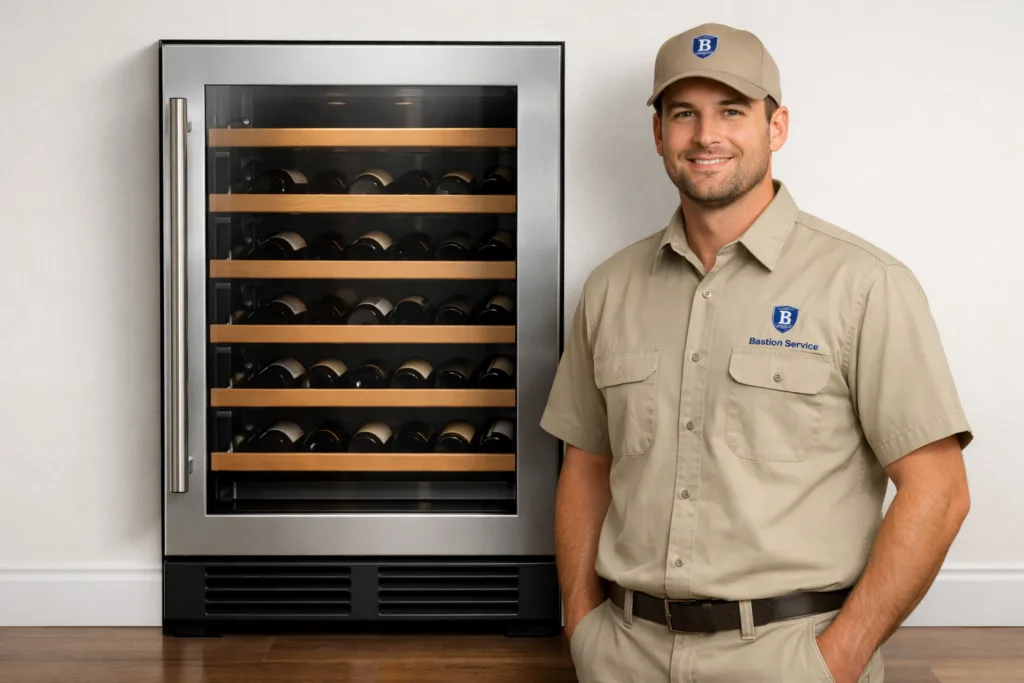
Temperature swings, excess moisture, or new noise from a Perlick wine cooler can affect both the appliance and the bottles stored inside it. When those symptoms show up in a Beverly Hills home, the most useful next step is to match the behavior of the unit to the likely system involved, because cooling problems, frost, leaks, and control issues do not all come from the same source.
Start with what the wine cooler is actually doing
A wine cooler may seem to have one simple problem, such as “not cooling,” but the pattern behind that complaint matters. A cabinet that starts cold and then warms up points to a different repair path than a cabinet that never cools properly at all. The same is true for a unit that runs almost constantly compared with one that cycles off too quickly and leaves the interior uneven.
Useful diagnosis usually begins with a few basic questions:
- Is the entire cabinet warm, or only certain shelves?
- Is the display reading believable compared with the actual interior temperature?
- Has the problem been steady, or does it come and go?
- Are there signs of condensation, frost, or water collecting?
- Did the noise level change at the same time the cooling changed?
Those details help separate airflow issues from sensor faults, door-seal problems, drainage trouble, fan failure, or more serious sealed-system concerns.
Common Perlick wine cooler symptoms and what they may mean
Not cooling enough
If the cabinet feels warmer than the setting suggests, the problem may involve restricted condenser airflow, a weak fan, inaccurate temperature sensing, a control issue, or declining compressor performance. In some cases, warm air is entering through a gasket that is no longer sealing tightly, especially if you also notice moisture or longer run times.
This symptom is important to address early because a wine cooler can appear to be working while still holding bottles above the intended storage range.
Too cold or freezing bottles
Overcooling can be just as damaging as undercooling. A Perlick wine cooler that freezes contents or develops frost may be misreading cabinet temperature, failing to regulate airflow properly, or responding incorrectly through the control system. If cold spots are concentrated near vents or rear panels, that often points to an airflow or sensing problem rather than a complete cooling-system failure.
Condensation on shelves, walls, or glass
Visible moisture inside the cabinet usually means warm room air is entering or humid air is not being managed correctly. Door gasket wear, alignment issues, frequent warm-air intrusion, or a drainage problem can all contribute. Condensation should not be dismissed as cosmetic, because repeated moisture can affect labels, shelving, and nearby cabinetry.
Water inside the unit or around the base
A small amount of moisture can turn into a repeat leak if the drain path is blocked, the cabinet is not level, or condensation is forming faster than the system can handle it. If the area has been wiped dry more than once and the water keeps returning, there is usually an underlying cause that needs repair rather than cleanup alone.
Fan noise, buzzing, rattling, or clicking
Not all noise means a major failure, but changes in sound are often useful clues. A rattling panel, worn fan motor, vibration issue, or compressor strain can all alter how the unit sounds. If the wine cooler has become louder while also struggling to hold temperature, those symptoms together typically point to more than a minor adjustment.
Running constantly or cycling oddly
A unit that rarely shuts off may be trying to overcome airflow restriction, warm-air leakage, dirty heat-exchange surfaces, or declining cooling efficiency. Short cycling can indicate a control, sensor, or electrical issue. Either pattern can increase wear on components and still leave storage conditions unstable.
Why temperature instability matters in a wine cooler
Wine storage depends on consistency. Even when bottles do not feel obviously warm, repeated fluctuations can create conditions that are less stable than intended. A cabinet that drifts a few degrees high, drops too low overnight, or cools unevenly from top to bottom may still appear functional while failing at its main job.
That is why symptoms like “it eventually cools” or “the display looks normal most of the time” should not always be treated as harmless. If the interior conditions do not match the settings reliably, the issue is worth evaluating before it becomes a larger repair.
What homeowners can notice before service
Without taking the appliance apart, there are a few practical observations that can help narrow the issue:
- Check whether the door closes evenly without resistance or rebound.
- Look for moisture beads, frost patches, or damp bottle labels.
- Listen for fan noise that starts, stops, or scrapes unusually.
- Notice whether the sidewalls or nearby surfaces feel warmer than usual.
- Pay attention to whether the problem worsens during longer run periods.
These observations do not replace service, but they do help describe the symptom pattern more accurately and can make the repair path more straightforward.
When service is usually the smart next step
It makes sense to schedule service when the wine cooler no longer maintains a stable temperature, develops recurring condensation, leaks, starts freezing contents, or begins making new sounds. Service is also appropriate when the controls appear normal but the actual performance is not. A responsive display does not always mean the rest of the system is operating correctly.
Waiting can sometimes turn an intermittent issue into a more expensive one. A fan that is weakening, a gasket that is leaking air, or a control problem that causes long run times may place additional stress on the cooling system if the appliance continues struggling day after day.
Repair versus replacement for a Perlick wine cooler
Many Perlick wine cooler problems are worth repairing when the fault is tied to components such as fans, sensors, controls, drains, seals, or accessible electrical parts. Those issues can often be evaluated in a focused way and compared against the condition of the rest of the appliance.
Replacement becomes a more serious consideration when the unit has extensive wear, recurring sealed-system trouble, compressor failure combined with age, or a history of repeat breakdowns. For built-in installations in Beverly Hills homes, that decision often includes cabinet fit, finish continuity, and whether keeping the current installation intact has value.
The right choice depends on more than whether the appliance turns on. It depends on whether it can return to stable, predictable operation with a sensible repair path.
What a service visit should help you understand
A worthwhile service visit should explain whether the issue is primarily related to airflow, controls, sensing, drainage, sealing, or the cooling system itself. That gives you a practical basis for deciding whether to proceed with repair now, limit use of the wine cooler until parts are addressed, or begin planning for replacement.
For homeowners in Beverly Hills, the goal is not just to make the unit run again. It is to restore reliable storage conditions and avoid guesswork, repeat failures, or unnecessary parts replacement when the symptom pattern already points in a clearer direction.