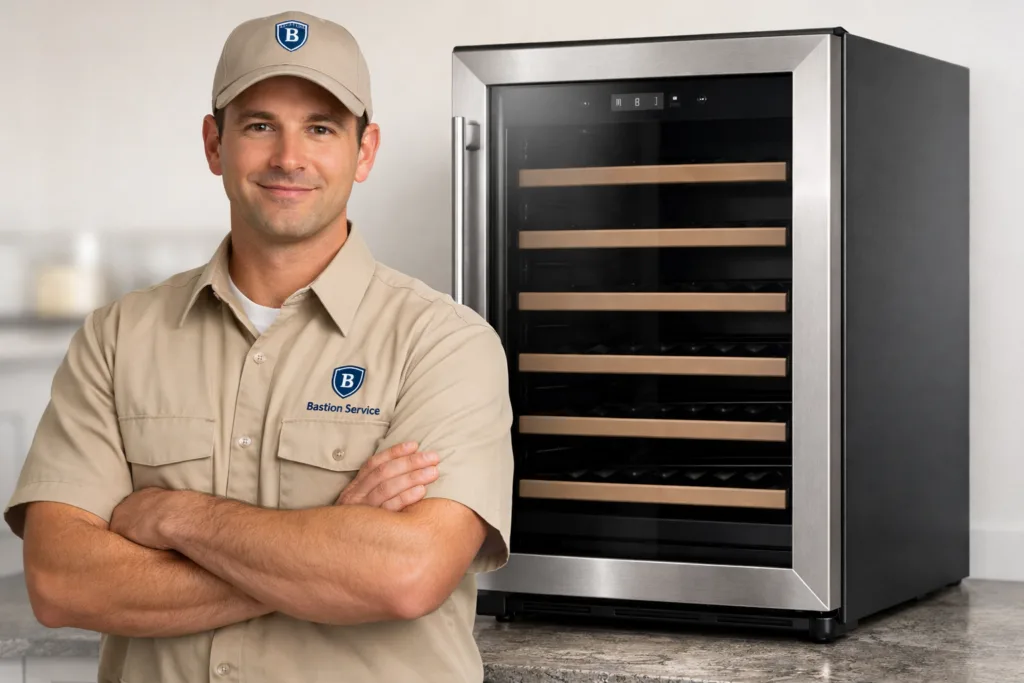
An EdgeStar wine cooler that stops holding temperature, starts frosting over, or begins making unusual noise can put a collection at risk faster than many homeowners expect. Similar symptoms can come from very different causes, including a sensor problem, restricted airflow, a worn door gasket, fan failure, drainage trouble, or a cooling-system fault. Identifying which pattern you are seeing is the best way to decide whether the problem is minor, urgent, or no longer economical to fix.
Common EdgeStar wine cooler symptoms and what they often mean
Most issues show up in a small number of ways: the cabinet feels warm, temperatures swing up and down, condensation forms on the glass or shelves, frost develops inside, the controls behave unpredictably, or the unit becomes louder than normal. Those symptoms matter because they help narrow down the likely repair path before parts are replaced unnecessarily.
For example, a unit that still powers on but struggles to cool may point to airflow loss, dirty condenser components, a weak evaporator fan, or a compressor-related problem. A cooler with water inside the cabinet may have a clogged drain, frequent warm-air intrusion, or a sealing issue around the door. If the display works but the temperature inside does not match the setting, control or sensor accuracy becomes a more likely concern.
Temperature problems homeowners notice first
Not cooling enough
If bottles feel warmer than expected, the issue may not be the temperature setting itself. EdgeStar wine coolers can lose cooling performance when vents are blocked, the fan is not moving air properly, the condenser is struggling to shed heat, or the sealed system is underperforming. A unit that runs for long stretches without reaching the target temperature usually needs attention sooner rather than later.
This is especially important when the cooler seems to be working constantly. Prolonged runtime can increase wear and make a smaller issue become a larger one. If the cabinet is warm but the controls appear normal, the problem is often deeper than a simple reset.
Too cold or freezing inside
Overcooling is just as important as undercooling. When an EdgeStar wine cooler starts dropping below the set temperature, homeowners may notice cold spots, icy patches, or bottles stored in one area becoming much colder than those in another. That can be caused by a faulty sensor, thermostat problem, or control issue that causes the unit to cycle incorrectly.
Freezing conditions inside a wine cooler should not be ignored. Even if the unit seems to recover on its own, inconsistent cycling usually points to a component that is no longer reading or responding the way it should.
Moisture, frost, and door-seal issues
Condensation on glass, shelves, or around the door
Visible moisture often means warm air is getting into the cabinet or cold air is not being managed properly once it is inside. A worn gasket, a door that is slightly out of alignment, or repeated long door openings can all contribute. In some cases, the cooler may still cool, but it will run longer and less efficiently while condensation continues to build.
When moisture appears regularly, it is worth checking whether the door closes evenly and whether anything inside is preventing a full seal. If those basics look normal, the next step is usually to inspect the gasket condition and the way the unit is handling internal airflow.
Water collecting inside or under the unit
Water under a wine cooler does not always mean a major leak. It can come from drainage blockage, excess internal condensation, or a door-seal problem that allows humid air to enter and condense repeatedly. Left alone, that moisture can affect nearby flooring and create corrosion or odor issues inside the cabinet.
If the leak appears near the front, the door and gasket are often worth evaluating. If water is forming inside first and then escaping, the drainage path may be the more likely cause.
Frost on the back wall or around vents
Frost usually indicates an airflow or temperature-management problem rather than a random cold spell inside the appliance. A fan that is not circulating properly, a sensor reading incorrectly, or repeated moisture intrusion can all lead to ice buildup. Once frost starts collecting, cooling performance often becomes less stable, not more.
Homeowners in Beverly Hills often notice that frost and poor cooling show up together. That combination usually means the cooler is working harder while delivering less consistent storage conditions.
Unusual sounds that should not be dismissed
All wine coolers make some operational noise, but new sounds are more important than normal background hum. Repeated clicking, louder buzzing, rattling, or fan noise that was not there before can point to a developing problem. Sometimes the cause is simple, such as vibration against cabinetry or a fan blade obstruction. Other times, the sound is tied to a start component, motor wear, or strain in the cooling system.
A useful way to think about noise is to ask two questions:
- Is the sound new or significantly louder than before?
- Is it happening along with temperature changes, condensation, or nonstop running?
If the answer to either is yes, the sound is less likely to be harmless.
Control and display problems
When the display flashes, buttons stop responding, temperatures reset, or the cooler powers on and off unpredictably, the problem may involve the control board, user interface, sensor feedback, or electrical supply to the appliance. Intermittent behavior can be frustrating because the unit may appear normal during part of the day and fail later.
These problems are worth documenting before service. If you notice the display reading one temperature while the cabinet clearly feels warmer, or if settings do not hold after being adjusted, that pattern can help narrow the fault more quickly.
When continued use can make the problem worse
Some wine cooler issues are mostly inconvenient at first, but others can worsen with continued operation. Running nonstop, repeated frost buildup, rising interior temperatures, and fan-related noise are all signs that the unit may be under strain. The longer it struggles, the greater the chance of additional wear on related components.
It usually makes sense to stop waiting and schedule service when you notice:
- Temperature swings that keep returning
- The cabinet staying warm despite normal settings
- Heavy condensation or water leakage
- Frost that returns after being cleared
- Persistent clicking, buzzing, or loud fan noise
- Controls that fail to respond or keep resetting
Repair or replace: what usually drives the decision
The right choice depends on what has actually failed, not just on the symptom. Many EdgeStar wine cooler problems are sensible to repair when the cabinet, shelves, door, and overall structure are still in good condition. Issues involving fans, sensors, controls, drains, gaskets, and start components are often more manageable than homeowners assume.
Replacement becomes more likely when the cooler has multiple failures at once, a major sealed-system problem, or a long history of recurring performance issues. Age matters, but condition matters more. A proper diagnosis gives a realistic picture of whether the repair is straightforward, whether reliability is likely to return, and whether the cost still makes sense for the unit you have.
What to note before an appointment
A few observations can make a service visit more efficient. It helps to note whether the cooler is warm all the time or only at certain times, whether the display matches the actual cabinet feel, and whether the issue began after a power interruption, cleaning, or movement of the appliance. If the unit is leaking, notice where the water first appears. If it is noisy, try to identify whether the sound is a buzz, click, rattle, or fan-like whir.
You can also check for simple loading problems, such as bottles pressed against internal vents or a door that does not close fully because of shelf interference. Those easy observations do not replace hands-on testing, but they can help separate a usage issue from a component failure.
EdgeStar wine cooler repair for Beverly Hills households
For homeowners in Beverly Hills, the most useful approach is symptom-based evaluation rather than guessing from one visible sign alone. A warmer cabinet, a noisy fan, and condensation on the glass may all come from one root issue, or they may indicate several smaller ones working together. Understanding that difference helps avoid wasted time and helps determine whether repair is the right next step for the appliance in its current condition.