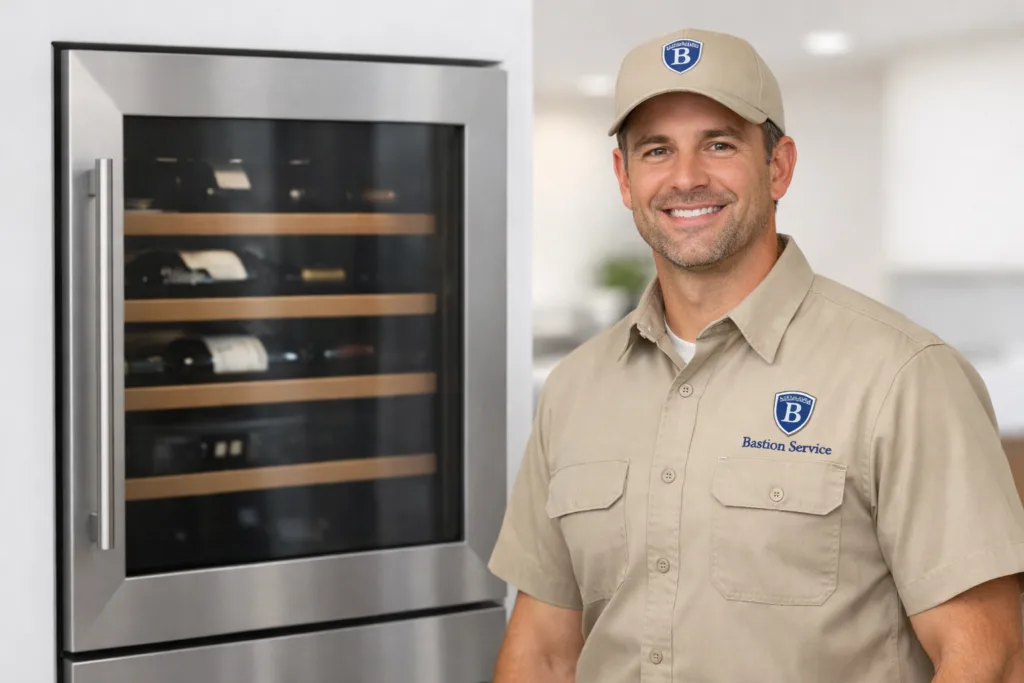
Wine coolers are designed to hold a narrow temperature range with steady airflow and humidity control. When a Miele unit starts drifting warmer, cooling unevenly, or collecting moisture, the problem often builds gradually before it becomes obvious. Catching the pattern early can help protect both the appliance and the bottles stored inside.
Signs your Miele wine cooler needs attention
Some issues are immediate, such as a cabinet that is no longer cool or a display that stops responding. Others are subtle, including longer run times, a slight change in fan sound, or condensation appearing around the door gasket. In Brentwood homes, built-in placement can make these symptoms easy to miss until storage conditions are already unstable.
- Cabinet temperature feels warmer or colder than the setting
- One zone or shelf area cools differently from another
- Fan noise, rattling, humming, or repeated clicking becomes noticeable
- Water appears under the unit or moisture collects inside
- Interior lights, controls, or alerts behave inconsistently
- The unit runs constantly or seems to stop cycling normally
Common symptom patterns and likely causes
Not cooling enough
If the cabinet is no longer holding the proper storage temperature, the cause may be as simple as restricted airflow or as serious as a sealed-system problem. A weak evaporator fan, faulty sensor, failing start components, control issue, or poor door sealing can all reduce cooling performance. In some cases, the unit still runs but never quite reaches the set temperature.
This matters because wine storage problems are not always obvious right away. A cooler that is only slightly warm can still cause long-term temperature fluctuation that affects consistency over time.
Too cold or freezing in spots
A wine cooler that overcools can point to a thermostat or sensor issue, a control fault, or airflow imbalance inside the cabinet. If bottles near one area feel much colder than the rest, that usually suggests a regulation problem rather than a general cooling failure. Overcooling should not be ignored, especially when a dual-zone unit no longer maintains separation between sections.
Temperature swings
When the temperature rises and falls more than normal, the issue may involve sensors, control response, fan operation, or door sealing. Frequent door openings can contribute, but recurring swings without a clear usage reason usually indicate that the appliance is struggling to regulate itself. This is one of the most important symptoms to address because it can happen even while the unit appears to be working.
Fan noise or unusual sounds
Miele wine coolers normally produce some operating sound, but new or changing noises deserve attention. A buzzing or vibration may come from mounting or panel contact. A clicking sound can suggest start-relay trouble or repeated attempts to begin a cooling cycle. A scraping or uneven airflow noise may point to a fan motor issue or frost interfering with movement.
If the sound is persistent, louder than before, or tied to worsening cooling performance, it is usually a sign that the unit needs service rather than observation alone.
Condensation, water, or interior moisture
Moisture around the door, droplets on shelves, or water under the appliance can come from several different faults. Common causes include a clogged drain path, a compromised gasket, humidity imbalance, or temperature instability inside the cabinet. In a built-in installation, moisture can also affect surrounding cabinetry if left unresolved.
When condensation keeps returning after surfaces are wiped down, it usually means the source problem is still active.
Controls, display, or lighting problems
If the interface stops responding, settings reset unexpectedly, lights fail, or an alert remains on, the fault may involve the user interface, control board, wiring, or a sensor feeding incorrect information to the controls. On a wine cooler, electronic issues often show up as cooling complaints first, because the temperature system depends on accurate sensor and board communication.
Why built-in wine coolers need symptom-based diagnosis
A built-in Miele wine cooler can show the same outward symptom from several very different causes. For example, “not cooling” might come from a control problem, poor ventilation, fan failure, start-component trouble, or a sealed-system issue. “Condensation” might point to a gasket problem, drain issue, or temperature imbalance. That is why a symptom-based evaluation is more useful than assuming the most visible part is the failed part.
A proper diagnosis should determine whether the issue is isolated to a replaceable component or whether it points to a larger refrigeration problem that changes the repair decision.
When to stop using the unit and schedule service
Some problems allow limited short-term use, while others should be addressed immediately. If the cabinet is clearly warm, the compressor is repeatedly trying to start, the exterior feels unusually hot, or moisture is spreading outside the appliance, continued operation can increase damage.
It makes sense to schedule service promptly when:
- The wine cooler is no longer maintaining stable storage conditions
- Cooling performance has been gradually declining
- You hear unfamiliar clicking, humming, or fan noise
- Condensation keeps returning or water collects below the unit
- Error alerts or control problems do not clear with normal resetting
Repair or replace?
The answer depends on the actual failure, the age of the appliance, overall condition, and parts availability. Many wine cooler problems are repairable when they involve fans, sensors, controls, drains, seals, or other accessible electrical components. A different conversation is needed when the problem involves major cooling-system failure, multiple faults at once, or repair cost that no longer fits the condition of the unit.
For homeowners in Brentwood, the most useful approach is to base that decision on confirmed findings rather than symptoms alone. A unit that seems “dead” may have a repairable control or start issue, while a unit that still cools somewhat may have a deeper refrigeration problem developing in the background.
What to expect from a useful service visit
A good service call should do more than name a symptom. It should identify the failing part or system, explain how that fault connects to the behavior you have noticed, and outline whether repair is reasonable. That includes clarifying whether the issue is urgent, whether continued operation risks more damage, and whether the repair path makes sense for the age and condition of the appliance.
For a Miele wine cooler in Brentwood, that kind of practical repair guidance helps you make a better decision without guessing, unnecessary parts replacement, or waiting until a smaller problem turns into a complete loss of cooling.