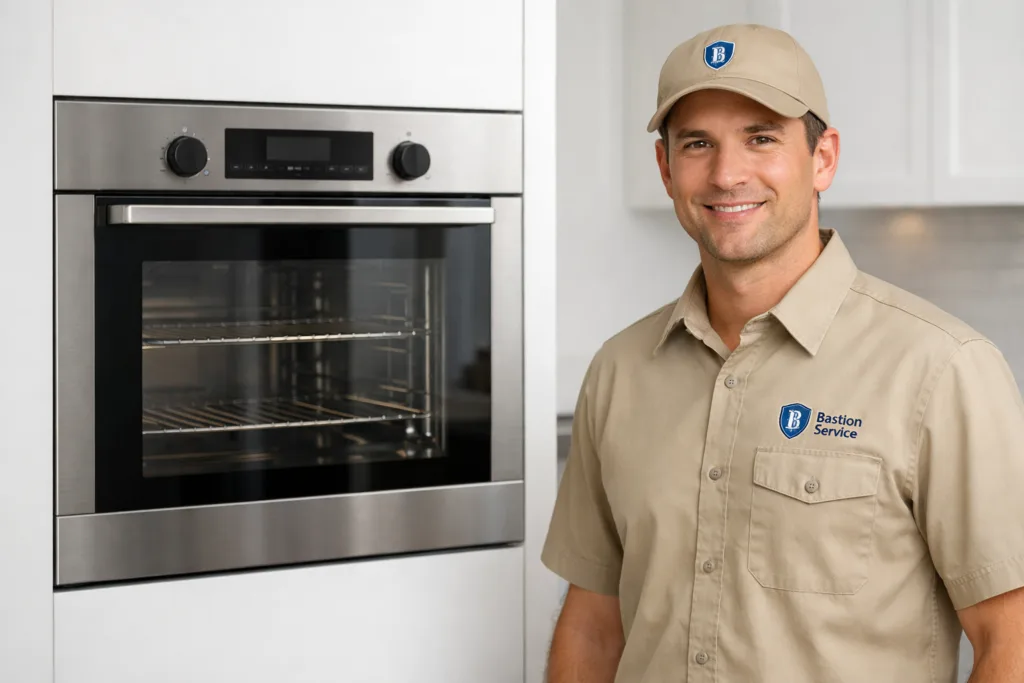
Miele ovens are built for precise cooking, but that precision depends on several systems working together. When baking results change, preheat slows down, or the controls start acting oddly, the most useful next step is to match the symptom to the most likely cause instead of guessing at parts.
What usually goes wrong with a Miele oven
Most oven problems fall into a few categories: heating failures, temperature regulation issues, control and display faults, or door and latch problems. A single symptom can point to more than one cause, which is why the pattern matters. For example, an oven that never heats at all is a different repair path from one that heats sometimes, overshoots the set temperature, or loses heat midway through cooking.
In Playa Vista homes, the most common complaints tend to be practical ones that interrupt daily use: dinner taking twice as long, baked goods browning unevenly, a broiler that stops working, or an oven that looks powered on but does not cook correctly.
Common symptoms and what they can mean
Oven will not heat
If the display turns on but the cavity stays cold, the issue may involve a failed heating element, temperature sensor, relay, wiring fault, or electronic control problem. On some Miele models, the oven can appear normal at the panel while the heating circuit is not operating at all.
This symptom is especially important to address when the oven starts a cycle but never gets warm enough to cook food safely. If both bake and broil performance are affected, the source may be different than a single-element failure.
Uneven baking
When cookies brown more on one side, casseroles stay cold in the center, or one rack cooks faster than another, the problem is not always the recipe. Uneven baking can come from weak heat output, a drifting sensor, convection fan issues, or heat escaping around the door seal.
If the results have changed noticeably from how the oven used to perform, that shift often points to a repairable fault rather than normal variation.
Slow preheat
A slow preheat cycle is one of the clearest signs that something is no longer working efficiently. The oven may eventually reach temperature, but delayed heating usually means one component is underperforming. That can affect both cooking times and final texture, especially for breads, roasting, and anything that depends on stable early heat.
When preheat has gone from normal to noticeably sluggish, it is worth having the oven checked before the problem develops into a complete heating failure.
Temperature swings or inaccurate cooking temperature
If food burns at familiar settings or comes out undercooked even after extra time, the actual cavity temperature may not match the number on the display. Possible causes include sensor problems, control faults, calibration drift, or irregular cycling from a weak heating circuit.
Homeowners often notice this first with baking, where small temperature differences become obvious. Roasting problems can show up too, especially when cooking times become unreliable from one use to the next.
Broiler not working
A broiler issue may appear as no heat from the upper element, weak browning, or a cycle that starts and then stops. Depending on the model, the problem may be tied to the broil element, control output, temperature feedback, or a broader power issue affecting oven functions.
If the bake function still works, that does not necessarily rule out a more involved repair. Broil problems should still be tested carefully rather than treated as a simple element replacement every time.
Display errors or unresponsive controls
Flashing codes, frozen controls, touch inputs that do not respond, or cycles that cancel unexpectedly usually point to an electronic issue. Sometimes the fault is in the user interface; in other cases, it involves communication between components, power delivery, or a main control failure.
Intermittent behavior matters here. If the oven works normally one day and then becomes erratic the next, that pattern can help narrow down whether the issue is with the control system itself or something feeding incorrect information to it.
Door not closing properly
A door that does not seal tightly can cause heat loss, longer cooking times, and uneven results. Worn hinges, a damaged gasket, alignment issues, or latch trouble can all affect how the oven performs. Even a small gap can interfere with temperature stability during longer cooking cycles.
If you feel excess heat escaping near the front, or the door needs extra pressure to stay closed, that is worth addressing before it leads to larger performance complaints.
Self-clean or lock issues
When the oven gets stuck in a locked state, will not begin a self-clean cycle, or does not unlock properly afterward, the cause may involve the latch motor, switch, control, or heat-related stress on supporting parts. These problems can also overlap with display and control faults, so the full symptom pattern matters.
Signs the problem is getting worse
Some oven issues stay stable for a while, but others tend to progress. It is smart to stop repeated testing and schedule service if you notice any of the following:
- The oven shuts off in the middle of cooking
- Preheat times keep getting longer
- The temperature is increasingly inconsistent
- The unit trips power during operation
- You smell overheating or electrical odor
- The display flickers, resets, or shows recurring faults
These symptoms can move beyond cooking inconvenience and start affecting controls, wiring, or safe operation.
What homeowners can check before scheduling repair
There are a few simple observations that can help narrow down the issue:
- Whether the oven fails in all modes or only in bake, broil, or convection
- Whether the problem happens every time or only intermittently
- Whether the display stays normal while cooking performance drops
- Whether the door closes evenly and seals well
- Whether the issue started after a power interruption or error message
It is best not to keep running test cycles if the oven smells hot, behaves unpredictably, or struggles to regulate temperature. Those details are useful, but repeated operation under fault conditions can make the repair path more expensive.
Repair or replace?
For many Playa Vista households, repair is a reasonable choice when the problem is isolated and the rest of the oven is in good shape. A single failed sensor, heating component, latch part, or control-related issue may be worth correcting if the appliance has otherwise been performing well.
Replacement becomes more likely when several major systems are failing at once, the unit has a long history of recurring problems, or the repair cost approaches the value of keeping the current oven. Age alone is not the only factor; overall condition and the exact failure matter more.
When service makes sense
If your Miele oven is no longer heating properly, is cooking unpredictably, or is showing control-related faults, service is usually the right next step. A practical repair plan starts with identifying whether the problem is in the heating system, temperature sensing, door function, power path, or electronic controls.
For homeowners in Playa Vista, that symptom-based approach is the best way to decide whether the oven needs a targeted repair, a larger parts replacement, or a replacement conversation instead of continued trial and error.