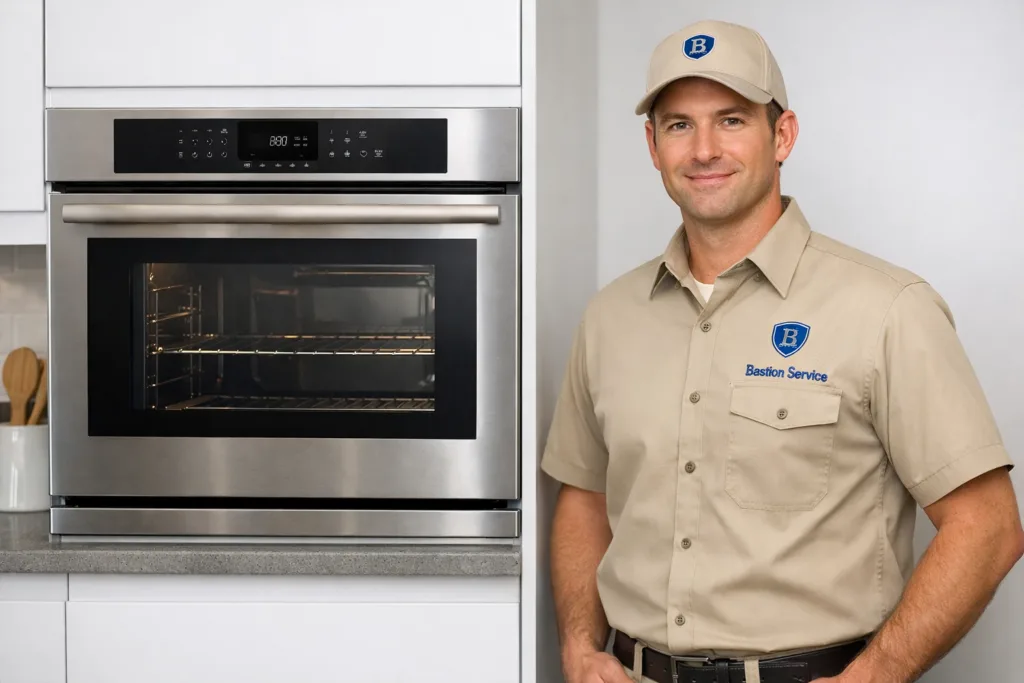
Electrolux ovens can fail in ways that look similar at first but come from very different causes. An oven that will not preheat, one that runs too hot, and one that shuts off during cooking may all involve different components and different repair paths. For homeowners in Playa Vista, the most useful starting point is to match the symptom to the likely system involved before deciding whether repair makes sense.
Common Electrolux oven problems in Playa Vista homes
Most oven issues become obvious during everyday cooking. Dinner takes longer than expected, baked goods come out unevenly, or the control panel responds while the oven cavity stays cool. In Electrolux models, those symptoms may involve the bake element, broil element, temperature sensor, convection fan, igniter on gas units, control board, door latch system, or internal wiring.
Oven not heating at all
If the oven appears to start but never heats, the cause may be a failed element, a weak or non-functioning igniter, a blown thermal protection component, or an electronic control problem. On some units, bake may fail while broil still works, which is a useful clue because it helps narrow the problem to a specific heating circuit rather than the entire appliance.
Slow preheat
Slow preheat is often mistaken for normal aging, but it usually signals a part that is no longer performing correctly. A bake element can weaken, a gas igniter can draw insufficient current, or a sensor can misread cavity temperature and confuse the control. When preheat gets noticeably longer, cooking results usually become less predictable as well.
Uneven baking and hot spots
If one rack browns faster than another, the back of the oven cooks more aggressively than the front, or food remains underdone in the center, the oven may not be distributing or regulating heat properly. That can point to a partially failed element, a fan issue in convection models, temperature sensor drift, or a control problem that cycles heat incorrectly.
Temperature swings
All ovens cycle somewhat, but wide swings that affect results are a sign of trouble. Homeowners may notice food burning on top while staying pale underneath, recipes requiring far more time than expected, or repeated overcooking even when the set temperature seems correct. In many cases, this comes down to inaccurate sensing or poor heat cycling rather than a complete no-heat failure.
Display works but cooking functions do not
A working display does not mean the oven is fully operational. If the panel lights up, buttons respond, and settings can be selected but bake or broil never starts, the failure may be deeper in the control system. Relay issues, a failed control board, a door lock circuit problem, or wiring faults can all leave the interface functional while cooking modes remain disabled.
Door and latch problems
When the door will not close securely, will not unlock, or feels misaligned, the oven can become difficult or unsafe to use. Heat retention suffers when the seal is compromised, and self-clean-related latch failures can leave the unit stuck in a locked or error state. These issues are especially disruptive because the heating system itself may still be usable, but access and safe operation are not.
What different symptoms can mean
Symptom patterns matter because they help separate a straightforward repair from a more involved one. A few examples can make that clearer:
- Broil works, bake does not: often points to the bake circuit, bake element, igniter, or related wiring.
- Preheat starts but never reaches temperature: may involve a weak heating component, sensor issue, or control fault.
- Oven heats, then shuts off mid-cycle: can suggest overheating protection, failing electronics, or unstable power delivery inside the unit.
- Error code after self-clean: often involves latch components, fuses, or heat-stressed controls.
- Breaker trips during use: may indicate a shorted element, damaged wiring, or another electrical fault that should not be ignored.
Why guessing at parts often wastes time
With modern Electrolux ovens, several failures can create the same kitchen symptom. Replacing a sensor when the real issue is the control board, or replacing a board when the actual problem is a heating component, adds cost without solving the problem. This is why symptom-based testing matters. It identifies whether the failure is isolated, whether the oven is affecting multiple systems, and whether the expected repair is likely to restore normal performance.
That distinction matters even more on an appliance that still powers on. Partial failures can make an oven seem close to working when its temperature performance is already too unreliable for daily use. A targeted diagnosis gives homeowners a better sense of repair scope and helps avoid unnecessary part swapping.
When to stop using the oven
Some Electrolux oven problems are inconvenient, while others are reasons to stop using the appliance until it is checked. Continued operation is not a good idea if you notice any of the following:
- Repeated breaker trips
- Sparking or burning smells
- Delayed ignition on a gas model
- A persistent gas odor
- The oven shutting off during cooking without explanation
- A door that will not latch or close properly
- Error codes that return immediately after reset
If a gas-equipped oven has a strong or lingering gas smell, do not keep testing it. Leave the appliance off and follow appropriate gas safety steps before arranging repair. Even without an active odor, inconsistent ignition should be addressed before regular use continues.
Repair or replace: what usually matters most
For many households in Playa Vista, the decision is not simply whether the oven can be made to run again. The better question is whether the repair is likely to restore consistent, everyday cooking performance without stacking additional issues soon after. A single failed element, igniter, sensor, or latch component is often a practical repair. Multiple electronic faults, repeated heat-related failures, or visible wear affecting the door and cavity can shift the balance toward replacement.
Age also matters, but age alone does not decide the outcome. A well-kept oven with one specific failure can still be worth repairing. On the other hand, a unit with ongoing temperature instability, control trouble, and prior repairs may no longer be the best candidate for additional work.
What homeowners can check before service
A few observations can make the service visit more productive. You do not need to disassemble anything, but it helps to note what the oven is doing and when the problem appears.
- Does the issue affect bake, broil, convection, or every mode?
- How long does preheat take compared with normal?
- Are there any error codes on the display?
- Did the issue begin after self-clean, a power outage, or a breaker trip?
- Does the oven heat briefly and then stop?
- Is the problem constant, or does it come and go?
These details can help connect the symptom to the likely failure point and clarify whether the problem is mechanical, electrical, or control-related.
Electrolux-specific oven issues homeowners often notice
Electrolux ovens are known for precise cooking features, which means small faults can become noticeable quickly. Homeowners often first realize something is wrong when recipes they know well no longer come out the same way. A roast takes much longer, a sheet pan meal browns unevenly, or the oven signals preheat completion before the cavity is actually ready. Because these models rely on accurate temperature feedback and control timing, even a modest component failure can affect results across multiple cooking cycles.
Another common pattern is a problem that seems to appear after a high-heat cycle. If the oven behaves differently after self-clean, that timing is worth mentioning. Heat stress can expose weak components that had been functioning just well enough before the cycle.
Getting back to reliable daily cooking
An oven does not need to fail completely to disrupt the kitchen. Inconsistent heat, long preheat times, and unreliable controls can make normal meal preparation frustrating long before the appliance stops working altogether. The most useful repair path is the one based on the exact symptom pattern, the condition of the unit, and whether the likely fix restores dependable performance rather than only partial function.
For homeowners in Playa Vista, that approach leads to better decisions about Electrolux oven repair and helps separate a repairable issue from a problem that no longer makes sense to chase.