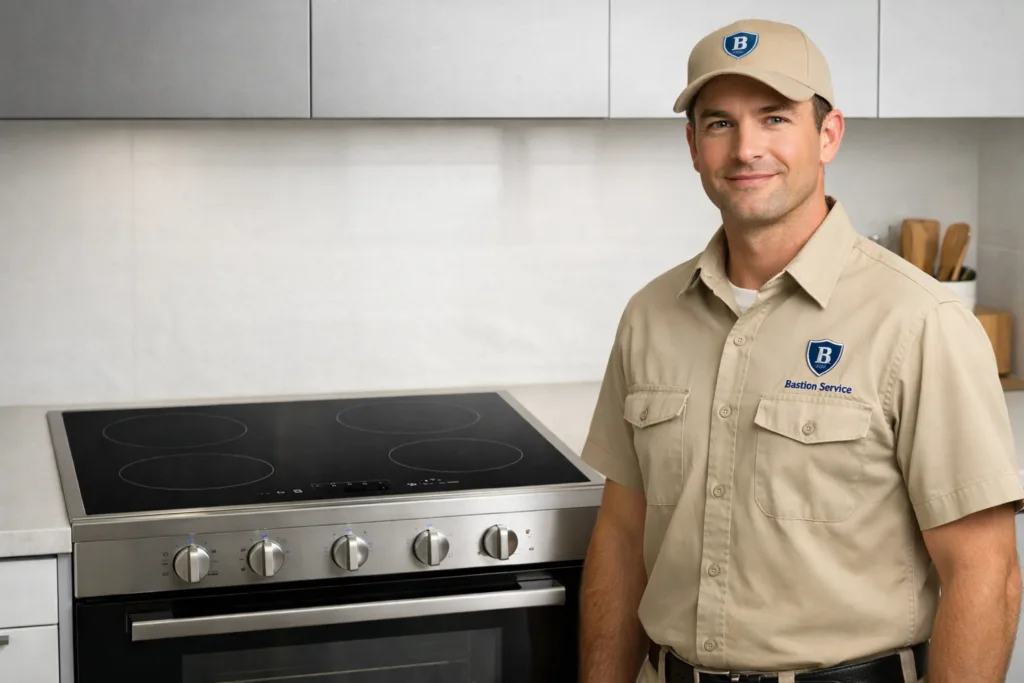
Cooktop problems can interrupt everything from quick breakfasts to full family meals, and the right next step depends on the exact symptom. With Miele models, a burner that will not ignite, a surface that heats unevenly, or controls that behave erratically can each point to very different failures. That is why it helps to look at the pattern of the problem before assuming a part needs to be replaced.
How Miele cooktop problems are usually narrowed down
A useful service evaluation starts with a few basic questions. Is the issue limited to one burner, or does it affect the whole cooktop? Did the problem begin suddenly, or has performance been declining over time? Is the symptom tied to heat output, ignition, touch controls, or visible surface damage?
Those details matter because one visible symptom can have several possible causes. For example, a burner that does not heat may involve a failed element, a control issue, wiring damage, or a sensor problem. Repeated clicking on a gas unit may be related to moisture, burner cap alignment, an ignition switch, or a spark module. Sorting that out early helps avoid unnecessary part replacement and gives homeowners a better idea of whether repair is practical.
Common Miele cooktop symptoms and what they may mean
One burner is not working
If only one burner is affected, the problem is often isolated to that burner’s components rather than the full appliance. On gas cooktops, that may include the igniter, burner head, cap alignment, or related switch parts. On electric or induction models, the issue may involve the element, coil, sensor, or the channel that controls that cooking zone.
If the burner occasionally works and then stops, intermittent wiring or a failing control component may be involved. If it never responds at all, the fault may be more direct and easier to isolate.
Multiple burners stopped heating
When several burners fail at the same time, the problem is less likely to be a simple single-burner part. In many cases, the cause may involve incoming power, internal distribution, a shared control system, or a broader electrical fault inside the unit. On induction cooktops, widespread failure can also involve communication or power-management issues.
This kind of symptom usually calls for prompt inspection because continued attempts to operate the cooktop may not restore function and can make the situation harder to evaluate.
Clicking that does not stop
On gas Miele cooktops, constant clicking is one of the most common complaints. Sometimes the cause is simple, such as moisture after cleaning or a burner cap that is slightly out of position. In other cases, the clicking continues because the ignition system is not sensing normal operation.
If drying the area and checking burner alignment do not solve the issue, the problem may be in the ignition switch assembly or spark module. Clicking that continues after the burner is lit, or clicking that starts on its own, should not be ignored.
Uneven flame or unstable heat
Gas burners should produce a steady, even flame. If the flame looks weak, irregular, or inconsistent, the cause may be blocked burner ports, improper burner seating, or ignition-related wear. For electric and induction cooktops, unstable heat often shows up as slow heating, cycling that feels excessive, or poor temperature control during normal cooking.
Because Miele cooking systems are designed for precise performance, even mild inconsistency can be a sign that a component is beginning to fail.
Touch controls do not respond correctly
If touch controls are slow to respond, activate the wrong zone, flash unexpectedly, or stop responding during use, the problem may involve the user interface, a control board, moisture intrusion, or a communication fault between internal components. With premium appliances, control issues can affect both usability and safety functions, so it is best not to dismiss them as a temporary glitch if they keep coming back.
Error codes or automatic shutdowns
Miele cooktops may shut down or display fault indications when the appliance detects an unsafe or abnormal condition. On induction units, that might involve pan detection, overheating, cooling concerns, or electronic communication problems. On electric and gas models with advanced controls, shutdowns can also be triggered by sensor or board faults.
If power-cycling clears the issue once but the same error returns, the cooktop likely needs service rather than repeated resets.
Cracked glass or impact damage
Visible damage to a glass cooktop surface should be taken seriously. Even a crack that looks minor can affect safe operation and may expose internal components to spills, heat, or moisture. In most cases, a damaged glass surface means the cooktop should stay out of use until it is properly assessed.
When to stop using the cooktop
Some cooktop problems are limited to convenience, while others create safety concerns. It is smart to stop using the appliance if you notice:
- Recurring breaker trips
- Burners overheating or failing to regulate heat
- Controls that activate unpredictably
- Repeated ignition failure
- Visible cracks or impact damage
- Burning smells, sparking, or signs of electrical arcing
If a gas cooktop is involved and there is a strong or persistent gas smell, do not treat that as a normal repair appointment issue. Stop using the appliance and follow appropriate gas safety steps before arranging appliance service.
Repair or replacement: what usually makes sense
For many households in Santa Monica, repair is the better option when the cooktop is otherwise in solid condition and the failure can be traced to a defined component. Ignition parts, switches, elements, certain sensors, and some control-related issues are often worth repairing when the rest of the appliance is performing well.
Replacement may make more sense when the cooktop has severe surface damage, multiple active faults, recurring electronic problems, or repair costs that begin to approach the value of the unit. Age alone does not decide the answer, but overall condition and parts involved usually do.
Why Miele-specific experience matters
Miele cooktops are not built like basic entry-level units. Burner layouts, control logic, induction behavior, and fault handling can vary by model, and symptoms that seem obvious are not always caused by the part homeowners expect. A repair approach that works on a standard cooktop may miss the real cause on a Miele appliance.
That is especially important when a cooktop powers on but does not perform correctly. In those cases, the issue may not be visible from the outside, and accurate model-based testing matters more than guesswork.
What to check before scheduling service
Before your appointment, it helps to make note of a few details:
- Whether the problem affects one burner or several
- Whether the issue is constant or intermittent
- Any error code, flashing light, or unusual display behavior
- Whether the problem started after cleaning, a power interruption, or an impact
- Whether the unit clicks, hums, trips power, or shuts off on its own
Those observations can help speed up diagnosis and give a clearer picture of whether the failure is likely mechanical, electrical, or control-related.
What homeowners in Santa Monica often want to know first
Most people are not looking for a complicated explanation. They usually want to know three things: is the cooktop safe to use, what likely failed, and is the repair worth doing. The answer depends on symptoms, model type, and condition of the appliance as a whole, but getting specific about what the cooktop is doing is the fastest way to reach a sensible repair plan.
If your Miele cooktop has started showing signs of burner failure, ignition trouble, uneven heating, or control problems, addressing it early often prevents added wear and helps keep the repair path simpler.