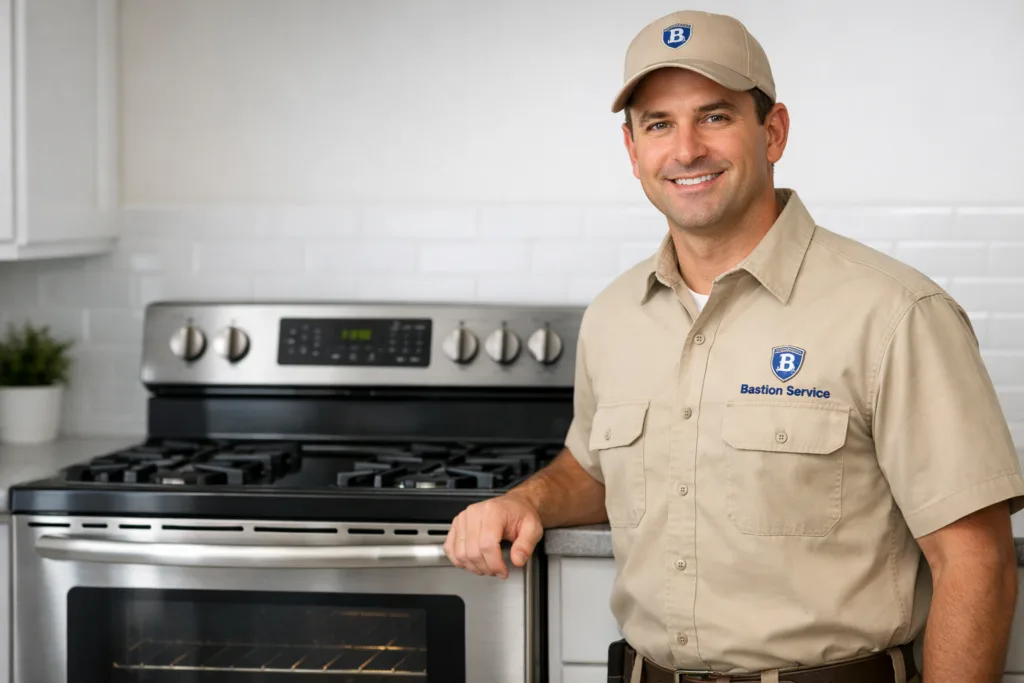
Cooking problems rarely start with a completely dead oven. More often, a Kenmore oven begins showing smaller warning signs first: preheat takes longer than it used to, baked dishes finish unevenly, the display acts strangely, or the temperature seems to drift from one meal to the next. Those symptoms usually point to a specific failure in the heating, sensing, ignition, or control system, and identifying that pattern is the fastest way to understand what repair makes sense.
Common Kenmore oven problems homeowners notice first
Most oven failures become obvious during everyday cooking. A roast that takes too long, a pizza that burns on the bottom, or a batch of cookies that comes out uneven can all signal that the oven is no longer regulating heat correctly.
Not heating at all
If the oven powers on but never gets hot, the cause can differ by model type. On electric Kenmore ovens, a failed bake or broil element, damaged wiring, or a control problem may be preventing heat production. On gas models, a weak igniter is one of the most common reasons the oven will not light properly. In some cases, the display appears normal while the heating system never fully engages.
This kind of symptom is important to address quickly because repeated attempts to force a cooking cycle can put additional stress on working components.
Slow preheating
A slow preheat often feels minor at first, but it is one of the clearest signs that something is changing inside the oven. A weakened igniter, partially failing element, inaccurate sensor, or relay issue can all cause the unit to take much longer to reach the selected setting. Food may still cook, but results become less predictable and total cook times increase.
Uneven baking or hot spots
When one rack browns faster than another or the back of the oven cooks differently from the front, heat is not circulating or cycling the way it should. Depending on the model, the problem may involve the convection system, element performance, sensor readings, or door seal condition. Homeowners often compensate by rotating pans or lowering the set temperature, but that only works for so long before the inconsistency becomes too disruptive.
Temperature swings
An oven that runs too hot, too cool, or fluctuates noticeably during cooking may have trouble reading or maintaining temperature. A defective sensor, failing electronic control, or intermittent heating component can all create this issue. If recipes that used to be reliable suddenly need frequent adjustments, the oven may no longer be holding a stable temperature range.
Control and display issues
Some Kenmore oven problems begin at the keypad or display rather than the heating system. Buttons may stop responding, settings may change unexpectedly, error codes may appear, or the display may go blank intermittently. These symptoms can be tied to the control board, touch panel, ribbon connections, or power supply problems within the appliance.
What different symptoms often indicate
One reason oven repair should be based on the exact symptom pattern is that similar complaints can come from very different parts. “Not heating” does not always mean the same repair, and “running hot” does not automatically mean a bad sensor.
- Oven turns on but does not bake: possible bake element, igniter, relay, or wiring fault
- Broiler works but bake does not: often points to the bake side of the heating system
- Takes too long to reach temperature: may involve a weakening igniter, element, or temperature feedback issue
- Food burns despite normal settings: possible sensor drift or control board misreading
- Error codes appear repeatedly: may indicate sensor, latch, communication, or electronic control issues
- Oven shuts off during use: possible overheating protection, unstable control operation, or electrical interruption
That is why a symptom-based explanation is more useful than guessing from a single visible part.
Signs the problem may be getting worse
Some oven issues stay manageable for a short time, but there are warning signs that usually mean the failure is progressing.
- Preheat time keeps increasing from week to week
- The oven needs a higher setting to cook normally
- Food quality varies even when using the same recipes
- The display resets, flickers, or stops responding during use
- Error codes return after clearing
- The oven cycles on and off in an unusual way
- There is a persistent burning smell not related to food spills
When these patterns show up, continued use often leads to more inconvenience and may complicate the repair path.
When to stop using the oven
Some symptoms are inconvenient. Others raise a safety concern and should not be ignored. Stop using the oven if you notice visible sparking, signs of overheating near the control area, repeated breaker trips, delayed ignition on a gas model, or a strong electrical or burning odor that does not clear. The same applies if the door lock system malfunctions during a cleaning cycle or the oven will not shut off normally.
For households in Del Rey, these are the situations where prompt service matters most, not just for cooking performance but for safe operation in the home.
Repairs that are often straightforward versus problems that are more involved
Some Kenmore oven repairs are relatively contained once the failed component is confirmed. Heating elements, igniters, sensors, certain door parts, and some switches are often more direct repairs when the rest of the appliance is in good condition.
Other cases require more evaluation. Intermittent temperature issues, communication errors, repeated shutdowns, and control failures can involve multiple components at once. A problem that seems like a simple sensor complaint may actually be tied to the board, wiring, or a heat-related connection issue that only appears after the oven warms up.
This is also where age and overall condition matter. If the oven has had several recent issues, shows visible wear, or has a major electronic failure on top of heating problems, repair may be less attractive than it would be for an otherwise solid unit.
Repair or replace: how Del Rey homeowners usually decide
For a residential oven, the decision is usually less about the name of the failed part and more about the total picture. Many homeowners choose repair when the problem is isolated, the oven still fits the kitchen well, and performance has otherwise been reliable. Repair becomes harder to justify when multiple systems are failing, the appliance has a long history of problems, or the current issue suggests extensive electronic or wiring-related work.
A balanced decision usually considers:
- The age of the Kenmore oven
- Whether the problem is isolated or part of a pattern
- How the oven has been performing overall
- The condition of controls, door components, and interior surfaces
- Whether the repair addresses the root cause or only one layer of the problem
Why model-specific diagnosis matters on Kenmore ovens
Kenmore ovens span many model designs, fuel types, and control layouts, so the same symptom can lead to different repair paths depending on the unit in your kitchen. A gas wall oven with ignition trouble behaves differently from an electric range oven with a weak bake element, even if the complaint from the homeowner sounds similar. Model-specific diagnosis helps avoid replacing common parts that are not actually causing the failure.
It also helps explain why one oven may still heat a little while another with a similar complaint does nothing at all. The way the appliance is wired, how it senses temperature, and how its controls manage cycling all affect the final diagnosis.
What to check before scheduling service
There are a few simple observations that can help make the service visit more productive. You do not need to disassemble anything, but it helps to note:
- Whether the oven is gas or electric
- If the display is working normally
- Whether broil works even when bake does not
- If the issue happens every time or only after the oven has been running a while
- Any recent error codes
- Whether the problem started suddenly or gradually
Those details often make it easier to separate a heating problem from a sensor, control, ignition, or power-related issue.
A focused approach to Kenmore oven repair in Del Rey
When a household oven starts missing temperatures, heating unevenly, or refusing to start a normal bake cycle, the most useful next step is to match the repair to the actual failure rather than the broad symptom alone. For Del Rey homeowners, that means paying attention to how the issue behaves, stopping use when safety concerns appear, and choosing service based on the condition of the oven as a whole.
Kenmore oven repair in Del Rey is usually most worthwhile when the problem is identified early, before a slow preheat turns into a complete heating failure or a control issue begins affecting every cooking cycle. A targeted repair can restore normal performance, reduce wasted cooking time, and help you decide confidently whether keeping the appliance in service is the right choice.