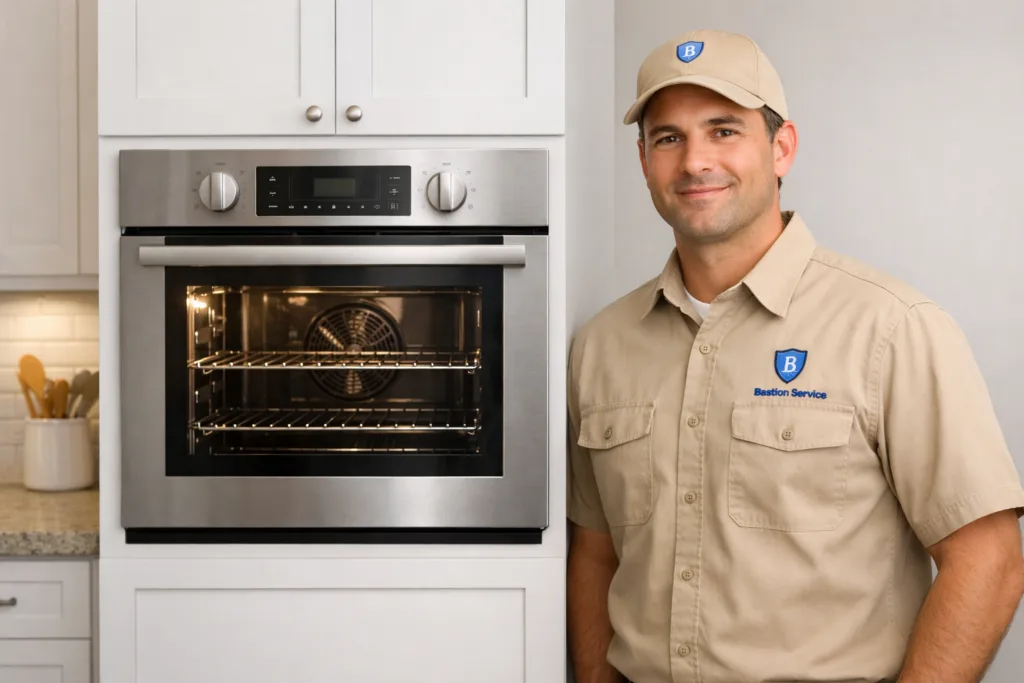
Oven problems tend to show up in ways that disrupt ordinary cooking fast: preheat drags on, one rack browns faster than another, or the control responds but the cavity never gets properly hot. With a Blomberg oven, those symptoms can come from several different sources, so the most useful next step is to match the repair plan to the way the problem actually appears in daily use.
Start with the symptom pattern
Two ovens can seem to have the same issue while needing completely different repairs. An oven that is fully dead points in one direction, while an oven that powers on but heats weakly points in another. In Del Rey homes, the details matter: whether the problem happens every cycle, only during preheat, only on bake, or only after the oven has been running for a while.
On many Blomberg ovens, performance complaints are commonly tied to the bake element, broil element, igniter on gas models, temperature sensor, electronic control, wiring, or door seal. That is why guessing based on one symptom alone often leads to wasted time and unnecessary parts.
Common Blomberg oven problems and what they often mean
Oven will not heat at all
If the display works but the oven does not produce heat, the failure may still be serious. Electric models may have a problem with a heating element, power supply issue, control fault, or sensor circuit problem. Gas models may have an igniter that no longer draws enough current to open the gas valve correctly. In both cases, the oven can look functional from the outside while failing at the heating stage.
Slow preheat
Slow preheat is one of the most common complaints because it can develop gradually. Meals start taking longer, recipes become less predictable, and homeowners often adapt without realizing the oven is underperforming. A weakened bake or broil element, an aging igniter, inaccurate temperature feedback, or control issues can all stretch preheat times.
Because many ovens use both upper and lower heat during preheat, a problem with one component can affect the whole process even if the oven still eventually gets warm.
Uneven baking
If the top of a dish cooks faster than the bottom, or one side of a tray finishes before the other, the cause may be more than simple rack placement. Uneven heat distribution can point to a partially failed element, sensor drift, a door that does not seal well, or inconsistent cycling from the control system. Homeowners often notice this first with cookies, sheet-pan meals, or casseroles that used to come out evenly.
Temperature swings
Some cycling is normal, but wide swings are not. If food alternates between undercooked and overdone even when settings stay the same, the oven may be misreading cavity temperature or responding poorly to the sensor input. This can also happen when relays or controls do not regulate heating components consistently.
Oven shuts off during cooking
An oven that stops mid-cycle can indicate overheating protection, an electronic control issue, unstable electrical connection, or a problem triggered by heat buildup over time. Intermittent faults are especially frustrating because the oven may appear normal during a quick check and then fail during a full baking cycle.
Error codes or unresponsive controls
Error codes can be helpful clues, but they do not automatically identify the failed part. A code may point toward a sensor, latch, keypad, or communication problem between components. If buttons stop responding, settings reset on their own, or the display behaves erratically, the issue may be in the interface or the main control system rather than the heating hardware itself.
Door not closing properly
A door that sags, pops open slightly, or leaks heat around the edges can make an otherwise repairable oven seem much worse than it is. Damaged hinges, worn springs, or a compressed gasket can lead to long cook times, hot spots, and poor temperature stability. Even a small sealing problem can noticeably affect baking results.
Signs the problem should not be ignored
Some oven issues are mostly inconvenient. Others can create safety concerns or lead to more expensive damage if the appliance keeps being used. It is a good idea to stop and arrange service if your Blomberg oven shows any of the following:
- No heat, intermittent heat, or failed preheat
- Repeated burning smell not caused by normal food residue
- Tripped breakers when bake or broil is started
- Visible sparking, arcing, or signs of overheated wiring
- Recurring error messages that return after resetting the oven
- Controls that freeze, restart, or stop responding during use
- Door latch or hinge issues that prevent proper closing
If a gas model has a strong gas odor, stop using it right away and follow gas safety procedures before seeking appliance repair.
How these issues affect everyday cooking
Not every oven fault looks dramatic. Many start as quality-of-life problems that slowly get worse. A weak element may still cook dinner, but only after adding ten or fifteen minutes. A drifting sensor may not ruin every dish, but it can make baking unreliable. A loose hinge may not stop operation, yet it can waste heat and force the oven to work harder on every cycle.
For households in Del Rey that cook regularly, these smaller failures matter. They lead to inconsistent meals, extra monitoring, and frustration with recipes that used to be routine. Addressing the source early can prevent additional wear on other components.
Repair or replace: what usually makes sense
The answer depends less on the brand name alone and more on the specific failed part and the oven’s overall condition. Many single-component problems, such as a failed igniter, sensor, heating element, hinge, or gasket, are often reasonable to repair when the rest of the oven is in solid shape.
Replacement becomes more worth considering when the oven has multiple active problems, a history of repeat failures, severe control issues, or repair costs that approach the value of keeping the current appliance. Age, part availability, and visible wear all matter when making that decision.
For homeowners trying to decide, the useful question is not just whether the oven can be repaired, but whether that repair is likely to restore stable everyday performance without leading into another major issue soon after.
Helpful checks before scheduling service
You do not need to diagnose the oven yourself, but a few observations can make the problem easier to pinpoint:
- Does the issue happen on bake, broil, or both?
- Does the oven fail before preheat completes, or after it has been running for a while?
- Are foods coming out undercooked, overcooked, or unevenly cooked?
- Is there an error code on the display?
- Has the breaker tripped recently?
- Does the oven door close firmly and seal evenly?
- Did the problem begin suddenly, or has performance been declining over time?
These details often help separate a heating problem from a control issue, a sensor problem, or a door-related heat loss problem.
What to expect from a targeted oven diagnosis
A useful diagnosis should answer more than whether the oven turns on. It should identify which system is failing, whether the fault is isolated or part of a larger wear pattern, and whether repair is a sensible investment for the appliance as it sits today. That is especially important with temperature complaints, because poor baking results can come from several different causes that look similar from the outside.
For Blomberg oven repair in Del Rey, symptom-based testing is usually the difference between a short-lived guess and a repair that actually restores consistent cooking performance. When the underlying fault is identified correctly, homeowners can make a more confident decision about next steps and get back to using the kitchen normally.