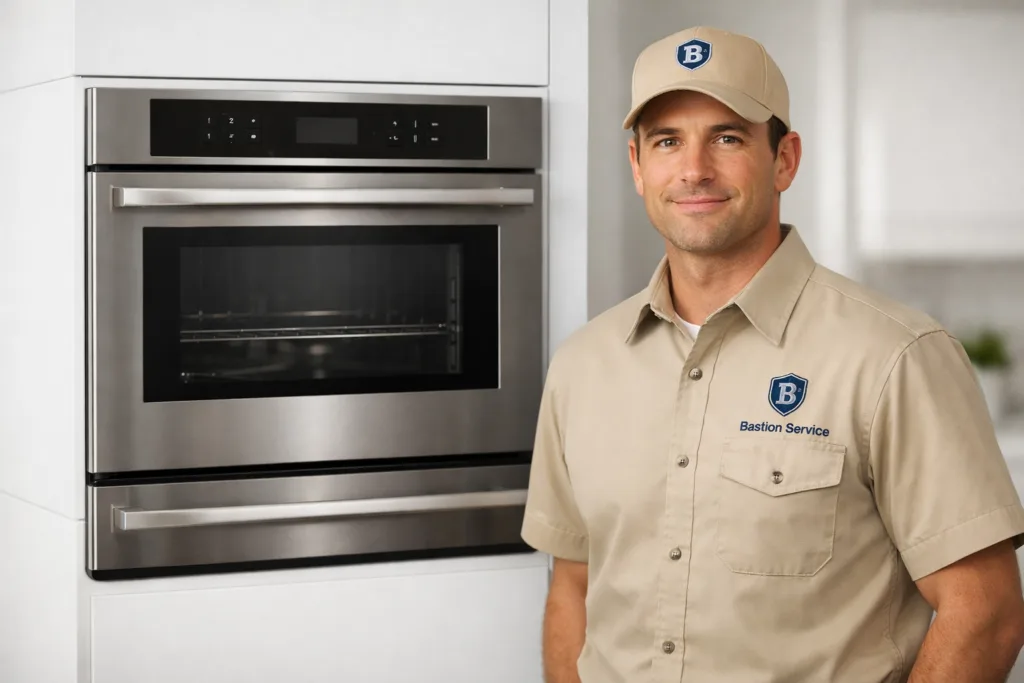
Wall ovens usually give warning signs before they fail completely. Maybe preheat starts taking much longer than it used to, cookies brown unevenly, the display begins flashing, or the door lock acts up after a self-clean cycle. With JennAir models, those symptoms can come from very different causes, so it helps to look at the pattern of behavior instead of assuming one part is bad.
Common JennAir wall oven symptoms
Most service calls for built-in ovens fall into a handful of symptom groups. The important detail is how the problem shows up in daily use. An oven that never heats is different from one that heats weakly, cycles erratically, or stops halfway through baking.
Oven not heating at all
If the display comes on but the oven cavity stays cold, the problem may involve the bake element, broil element, temperature sensor, control board, relay function, or incoming power. On some units, one part of the heating circuit fails while the rest of the oven appears normal, which can make the problem seem confusing at first.
Homeowners often notice this when food remains raw long after the expected cook time or when preheat never completes. In a double wall oven, one cavity may work while the other does not, which can point to a more isolated component failure rather than a full power issue.
Slow preheat or weak heating
A JennAir wall oven that eventually heats but takes too long to get there may have a weakening element, inaccurate sensor readings, relay trouble, or reduced heating output on one side of the circuit. This symptom often shows up gradually. At first, dinner just takes longer. Later, the oven struggles to reach the selected temperature at all.
Slow preheat is worth checking sooner rather than later because extended strain on electrical and control components can lead to broader failure if the oven keeps being used heavily.
Uneven baking and temperature swings
If one rack cooks faster than another, the back of a dish burns while the center stays underdone, or recipes suddenly become unreliable, the issue may be poor temperature regulation rather than a complete heating failure. Possible causes include sensor drift, calibration problems, convection fan issues, weak element performance, or control problems that cause overshooting and undershooting.
This is one of the most frustrating wall oven problems because the appliance still seems usable, but results become inconsistent. For households in Mar Vista that rely on the oven regularly, those inconsistencies usually mean the problem is already advanced enough to justify service.
Error codes, beeping, and control issues
Error codes can be helpful, but they do not identify the failed part with certainty. A fault code may relate to the sensor circuit, keypad, door lock system, electronic control, or wiring. If the panel freezes, resets, beeps unexpectedly, or stops responding mid-cycle, the issue usually involves more than a simple settings problem.
Intermittent control faults are especially common to misread. An oven may work normally for days and then fail during preheat or shut off during use. That kind of pattern usually points to an electrical or control-side issue that needs testing.
Door latch and self-clean problems
When the door will not close properly, will not unlock, or begins acting up after self-clean, the cause may be the latch assembly, hinges, switch, control logic, or heat stress affecting nearby components. A lock problem can take the oven out of service even when the heating system itself is still functional.
If the door feels misaligned, the latch motor continues cycling, or the unit stays locked after cooling down, it is best not to force it. Extra force can damage the latch, trim, or door assembly.
What these symptoms often point to
JennAir wall ovens combine high-heat components with electronic controls, so symptoms often overlap. The same complaint can come from very different failures.
- No heat: element failure, sensor fault, relay issue, control problem, or power supply trouble
- Long cook times: partial heating loss, weak element output, sensor inaccuracy, or poor regulation
- Uneven results: airflow problems, fan trouble, calibration drift, or inconsistent cycling
- Dead or erratic display: control board, keypad, communication issue, or wiring fault
- Locked door: latch motor, switch, control fault, or post-self-clean heat damage
That is why replacing parts based on guesswork can get expensive quickly. A bake element may look like the obvious answer, but the actual problem may be that the control is not sending proper voltage to it.
Signs the oven should not keep being used
Some problems are inconvenient but manageable for a short time. Others are signs to stop using the appliance until it has been checked. You should discontinue normal operation if you notice:
- burning smells that are not related to ordinary cooking residue
- visible sparking or arcing
- repeated breaker trips
- overheating around the control area
- shutoffs in the middle of a cycle
- a door that will not unlock or latch correctly
These conditions can lead to further component damage and can make a smaller repair turn into a larger one.
Why symptom pattern matters in diagnosis
What the oven does, when it does it, and whether the fault is constant or intermittent all help narrow the repair path. For example, an oven that fails every time it preheats is different from one that only shuts down after thirty minutes. A cavity that runs cool by a small margin is different from one that swings widely above and below the set temperature.
That detail matters because wall ovens are built in and often paired with cabinetry, trim, and dedicated electrical connections. The right diagnosis helps avoid unnecessary part replacement and gives a clearer picture of whether the appliance is a good repair candidate.
Repair or replacement: how to think about it
Many JennAir wall oven problems are repairable, especially when the issue is limited to a sensor, element, fan motor, latch component, or a single control-related fault. Replacement becomes more likely when there are multiple major failures, severe heat damage, recurring electronic issues, or repair costs that no longer make sense for the age and condition of the unit.
For homeowners in Mar Vista, the practical questions are usually straightforward:
- Is the problem isolated or part of a larger pattern?
- Has the oven been reliable until recently?
- Are cooking results likely to return to normal after repair?
- Does the appliance still fit the household’s needs and kitchen layout?
Built-in replacement can involve more planning than freestanding appliance replacement, so repair is often worth serious consideration when the fault is well defined and the oven is otherwise in solid condition.
When to schedule service
It is time to schedule JennAir wall oven service when the oven no longer heats properly, cannot hold temperature, preheats far too slowly, shows recurring errors, or has a door or control problem that affects normal use. Even if the oven still works part of the time, inconsistent performance usually means the issue is progressing.
A targeted visit is especially helpful when the symptom has become repeatable. If the same fault appears every time you bake, broil, use convection, or run self-clean, that repeat pattern usually provides the best starting point for accurate testing.
JennAir wall oven repair for Mar Vista households
In-home wall oven problems are rarely just about inconvenience. They interrupt meal routines, make cooking unpredictable, and can leave a built-in appliance sitting unusable in the middle of the kitchen. Bastion Service helps Mar Vista homeowners evaluate the actual fault, the condition of the oven, and the most sensible next step based on how the appliance is behaving now.
Whether the issue is no heat, uneven baking, temperature fluctuation, a control fault, or a lock problem, the most useful approach is one that matches the repair path to the real symptom pattern rather than guessing from the surface complaint alone.