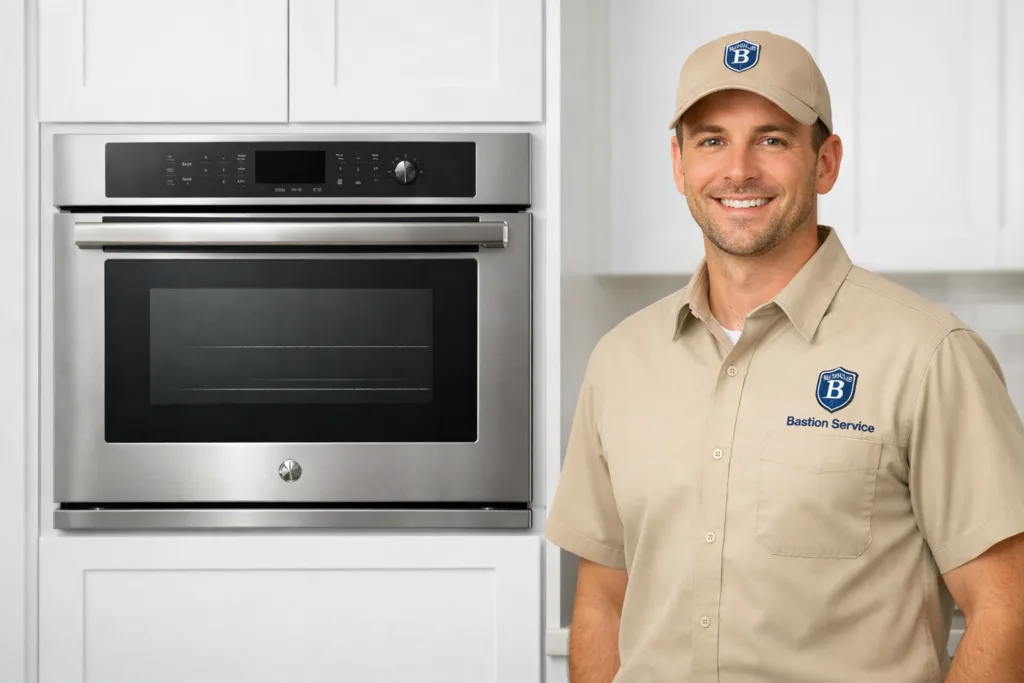
Built-in wall ovens can show the same symptom for several different reasons, so it helps to look at how the problem appears in daily use. A GE unit that still powers on but will not heat, preheats very slowly, or bakes inconsistently may have a failed heating component, a sensor problem, a control fault, or a door-related issue affecting operation. Sorting that out early usually prevents wasted time and unnecessary parts replacement.
How GE wall oven problems usually show up
Many homeowners first notice a change in cooking results rather than a total failure. Cookies may brown unevenly, casseroles may need extra time, or the oven may say it is preheated before the cavity is actually ready. On a built-in appliance, these smaller warning signs matter because they often point to parts that are weakening rather than completely failed.
GE wall ovens rely on several systems working together: heating elements, temperature sensing, electronic controls, wiring, cooling or convection fans on some models, and door or latch components. When one part starts underperforming, the oven can still run while producing unreliable results.
Common symptoms and what they may indicate
Oven will not heat at all
If the display, clock, or interior light still works but the oven cavity stays cold, the problem may involve the bake element, broil element, thermal protection component, oven sensor, relay on the control board, or a power-supply issue. In some homes, a wall oven can appear to have power while still lacking the full electrical supply needed for heating.
Slow preheating
An oven that eventually reaches temperature but takes much longer than normal often has one heating circuit that is not contributing enough heat. This can happen when an element is weak, a sensor is reading inaccurately, or the control is not cycling properly. Slow preheat is easy to ignore at first, but it often becomes more noticeable over time.
Uneven baking or roasting
When food repeatedly comes out too dark on one side, pale in the center, or inconsistent from rack to rack, temperature regulation is usually the concern. Possible causes include a drifting temperature sensor, a partially failed element, airflow problems on convection models, or a control issue that is not managing heat correctly. This is one of the more common reasons homeowners in Redondo Beach decide to have a built-in oven checked before the problem affects every meal.
Temperature swings
Some cycling is normal, but wide swings that affect results are not. If the oven seems much hotter or cooler than the setting, the cause may be calibration drift, a faulty sensor, a weak relay, or an element that is not responding consistently. These issues can be frustrating because the oven may work well on one day and poorly on the next.
Error codes, beeping, or a frozen control
Repeated fault codes usually point to a sensor reading problem, keypad failure, latch issue, or electronic control fault. Resetting the oven may clear the display temporarily, but recurring codes typically mean the underlying problem is still present. If the keypad becomes unresponsive or the screen behaves erratically, the issue may be deeper than a simple reset can solve.
Door will not lock or unlock
Door and latch problems often show up during or after a self-clean cycle. The latch motor, switch, alignment, or control logic may be preventing normal operation. Forcing the door open or shut can turn a smaller repair into a larger one, especially on a built-in unit with finished trim and surrounding cabinetry.
Oven shuts off during cooking
An oven that starts normally and then powers down may be overheating, losing a stable sensor signal, or experiencing a wiring or control failure. Intermittent shutdowns are especially disruptive because they can affect meal timing and make the appliance hard to trust for regular household cooking.
When to stop using the oven
Some symptoms should be treated as more than an inconvenience. Stop using the oven if it trips the breaker, smells like hot wiring or burning insulation, overheats badly, shuts off mid-cycle repeatedly, or shows persistent error codes tied to safety or temperature control. Continued use under those conditions can increase damage to components and make the final repair more involved.
If the problem is milder, such as longer preheat times or inconsistent baking, service is still worth considering before performance declines further. Catching a sensor or element problem early is often simpler than waiting until additional components are affected.
What makes wall oven repair different
Wall ovens are built into cabinetry, which changes both diagnosis and repair planning. Access can be tighter than with a freestanding range, and replacement decisions are often more complicated because cabinet fit, trim dimensions, and electrical setup all matter. For many Redondo Beach homeowners, that is why repair is often considered carefully before replacement, especially when the problem appears limited to a specific part or subsystem.
Double wall oven configurations add another layer. If only one cavity is affected, that detail can help narrow the issue much faster. Knowing whether bake, broil, convection, and self-clean functions are all affected or only one mode is misbehaving can also point toward the most likely failure area.
Repair or replace: how the decision usually works
Repair is often the sensible option when the failure is isolated to a serviceable part such as a heating element, temperature sensor, door latch component, fan motor, or certain control-related components. Replacement becomes more likely when there are multiple major failures, ongoing electronic issues, severe interior wear, or limited parts availability.
Age also matters, but it is not the only factor. A built-in GE wall oven that fits the kitchen well and has a repairable single-point failure may still be worth fixing, while a unit with several overlapping problems may not be. The most useful approach is a diagnosis based on the exact symptom pattern and the condition of the appliance as a whole.
Helpful details to note before service
A few observations can make troubleshooting more efficient:
- Whether the oven heats at all or stays completely cold
- Whether broil works when bake does not
- Whether the issue affects one cavity or both on a double wall oven
- Any error code shown on the display
- Whether the problem started after self-cleaning or a power interruption
- Whether the oven reaches the set temperature but cooks inconsistently
These details can help separate a heating failure from a sensing, control, latch, or power-related problem.
Service focused on the way the oven is actually failing
For GE wall oven repair in Redondo Beach, the most useful service approach is one that follows the symptom rather than assuming the cause. An oven that will not preheat, an oven with temperature swings, and an oven with control or latch issues may all seem similar from the outside, but they often require very different repairs. A focused evaluation helps homeowners understand what failed, what the repair path looks like, and whether restoring the unit is the practical next step.