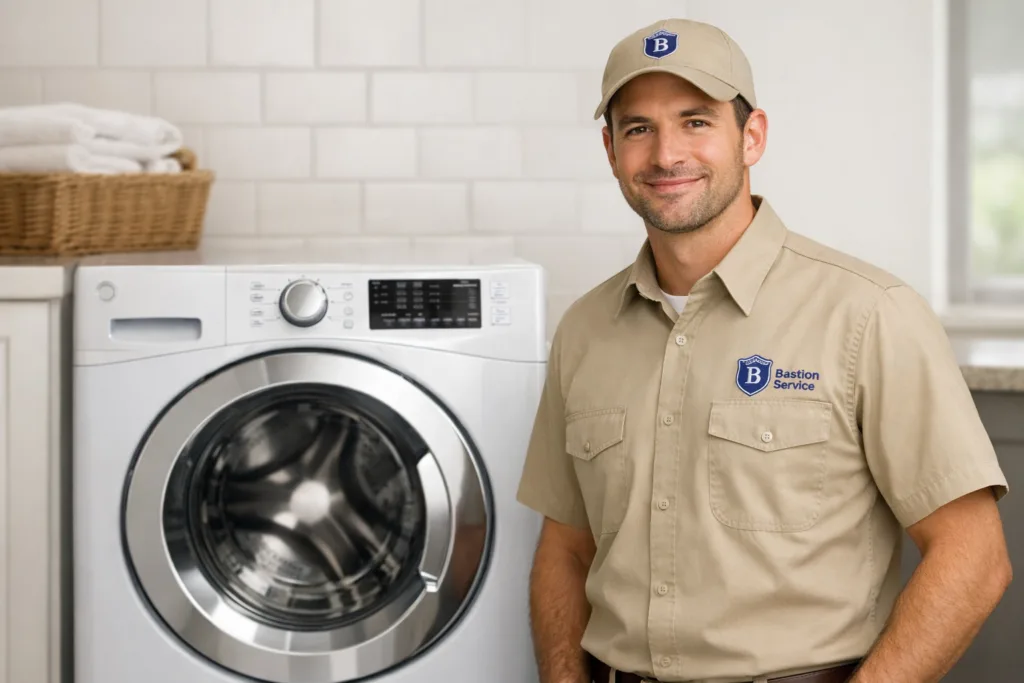
A washer problem rarely stays small for long. If your GE unit stops mid-cycle, leaves standing water, or starts leaking onto the floor, the smartest next step is to match the symptom to the most likely failure point. That helps avoid unnecessary part replacement and reduces the chance of added damage to clothing, flooring, or the machine itself.
Common GE washer symptoms and what they can mean
Washer will not start
If nothing happens when you press start, the issue may be as simple as a power interruption or as involved as a failed lid lock, door lock, user interface, or main control. Some GE washers also refuse to begin if they cannot confirm a locked door or proper cycle selection. When the display responds but the cycle never starts, that often points away from a basic power issue and more toward a sensing or control problem.
Fills with water but does not wash or spin
When the tub fills normally but the cycle does not advance, common causes include a faulty lid switch, worn drive components, motor trouble, actuator issues on some models, or a control fault. In practical terms, this symptom usually means the washer can begin the cycle but cannot transition into agitation or spin. If the machine hums, pauses, or shuts down after filling, continued attempts can put extra strain on the drive system.
Will not drain or leaves clothes soaking wet
A GE washer that finishes with water still in the tub often has a drain pump problem, a clog in the drain path, a kinked drain hose, or a control issue interrupting the drain-and-spin portion of the cycle. If clothes come out heavy and wet every time, the problem is usually not solved by rerunning the same load. Repeated poor draining can also lead to odor, residue, and added wear on the pump.
Leaks during fill, wash, or spin
Leaks do not always come from the same place. Water at the front of the washer may suggest a door boot or door sealing issue on a front-load model, while water underneath can point to a pump, hose, or tub-related problem. A leak that appears only during draining may narrow the cause further. Suds overflow can also mimic a mechanical leak, so the timing and location of the water matter.
Shaking, banging, or moving across the floor
Excessive vibration can come from an unbalanced load, but if it keeps happening, worn suspension parts, weak dampers, leveling problems, or basket support issues may be involved. A washer that bangs hard during spin is not just noisy. It can stress internal parts, loosen connections, and shorten the life of other components if the underlying cause is ignored.
Grinding, squealing, or a burning smell
Unusual mechanical noise usually means the washer should be stopped until it is checked. Grinding can point to bearings, pump obstructions, or drive wear. Squealing may be related to belt or motor strain on certain models. A burning smell raises more concern because it can signal electrical stress, a struggling motor, or friction from a failing moving part.
Why symptom-based repair matters on GE washers
Two GE washers can show the same complaint and still need very different repairs. A top-load machine that will not spin may have a different failure path than a front-load machine that locks but never drains. Control boards, pumps, lid and door locks, inlet valves, drive assemblies, and suspension parts can all create overlapping symptoms.
That is why the most useful service process starts with the behavior of the machine, not a guess about the part. In Redondo Beach homes, washer problems are easier to resolve when the repair path is based on what the unit actually does during fill, agitation, drain, and spin.
Signs the problem is getting worse
Some washer issues stay consistent for a while, but many get worse with repeated use. Watch for these changes:
- Drain time getting slower from one load to the next
- Spin cycles that stop early or never reach full speed
- New error codes after resets or power cycling
- Leaks spreading from occasional drips to visible puddles
- Vibration becoming louder or more violent over time
- Clothes coming out with detergent residue or poor rinse results
When symptoms escalate, the repair often becomes more involved. A struggling pump can fail completely, a suspension issue can affect nearby parts, and a small leak can eventually affect flooring or walls around the laundry area.
When to stop using the washer right away
Some conditions should not be pushed through “just one more cycle.” Stop using the washer if you notice any of the following:
- Water leaking onto the floor
- A burning smell or signs of overheating
- Harsh grinding or metal-on-metal sound
- The unit tripping power
- Violent shaking during spin
- The door or lid failing to lock properly during operation
These symptoms can lead to a larger repair or create a safety issue inside the home. Even if the washer still runs, it may not be safe or economical to keep using it until the fault is identified.
Poor cleaning results are also a repair clue
Not every washer problem is dramatic. Sometimes the first sign is simply laundry that does not come out as clean as it should. If your GE washer is leaving detergent residue, not rinsing thoroughly, or producing inconsistent wash performance, the cause may involve water fill problems, spray or circulation issues on certain models, drain trouble, or control-related cycle interruptions.
When poor results start appearing along with longer cycle times, partial spinning, or repeated pauses, those symptoms often connect to a mechanical or electrical fault rather than detergent choice alone.
Repair versus replacement
Many GE washer problems are worth repairing, especially when the failure is limited to a pump, lock assembly, inlet valve, suspension component, hose, or another targeted part. The decision gets more complicated when the washer has major bearing or tub damage, repeated electronic failures, or multiple worn components at the same time.
A good repair decision usually comes down to a few questions: what failed, whether other parts were affected, how likely the repair is to restore normal operation, and whether the cost makes sense for the washer’s overall condition. For homeowners in Redondo Beach, that straightforward assessment is often more useful than trying to judge the machine by age alone.
Helpful details to note before service
If you are arranging service, a few observations can make the visit more efficient. Try to note:
- Whether the washer fills, agitates, drains, and spins
- Whether the problem happens on every cycle or only certain settings
- Any error code shown on the display
- Whether leaking happens during fill, wash, drain, or spin
- What kind of noise you hear and when it starts
- Whether the door or lid locks and unlocks normally
These details help narrow down whether the issue is more likely tied to the drain system, drive components, suspension, controls, or a water supply problem.
What Redondo Beach homeowners can expect from a sensible repair approach
The best washer service is focused, not rushed. That means identifying the failed component, checking for related damage, and deciding whether the repair is likely to restore stable day-to-day performance. In many cases, that leads to a practical fix. In others, it helps you avoid sinking money into a machine with broader wear.
If your GE washer is stalling, leaking, failing to drain, or producing poor wash results, the key is not to keep guessing. A symptom-based evaluation gives you a clearer picture of the problem and a better basis for deciding what to do next in your Redondo Beach home.