
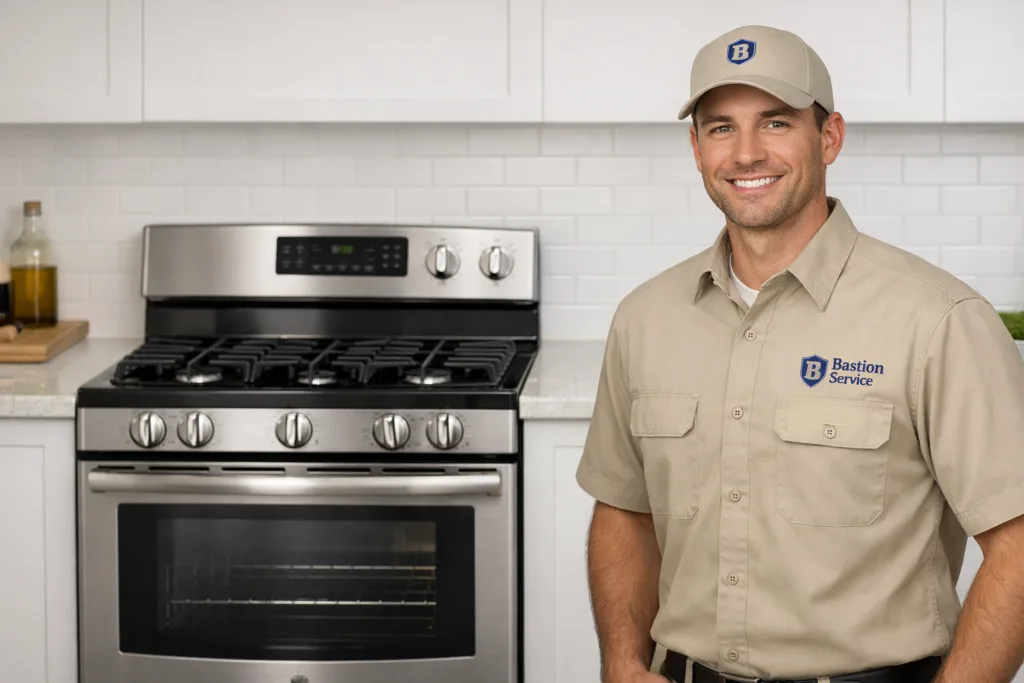





Cooking problems usually show up as patterns before they become complete failures. A GE range may still power on, light up, or partially heat while producing inconsistent results that make everyday meals harder than they should be. Paying attention to which function is failing, when it happens, and whether the issue affects the cooktop, oven, or both can help narrow down the likely cause.
Related GE and range service paths in Cheviot Hills include GE Appliance Repair in Cheviot Hills, Range Repair in Cheviot Hills, and GE Refrigerator Repair in Cheviot Hills.
Common GE range symptoms and what they often mean
Burners that will not ignite, click constantly, or light slowly
On gas ranges, burner trouble often starts with delayed ignition, repeated clicking, or a flame that looks weak or uneven. In some cases, food spills or moisture around the burner head interfere with ignition. In others, the spark system, ignition switch, or related components may be failing. If one burner acts up while the others work normally, the problem may be isolated. If multiple burners show the same symptom, the issue may involve a shared ignition or control problem.
Electric surface elements that stay cold or get too hot
On electric models, a burner that does not heat at all may have a failed element, damaged receptacle, or switch problem. A burner that only works on certain settings or runs hotter than expected can point to regulation trouble rather than a complete loss of power. This is especially frustrating when simmering becomes impossible or cookware heats unevenly.
Oven not heating, taking too long, or baking unevenly
If the oven struggles to preheat, never reaches the selected temperature, or cooks one dish faster than another, several different parts could be involved. On gas models, a weak igniter is a common reason the oven will not heat properly even though the range seems otherwise functional. On electric models, a failed bake or broil element may be responsible. Sensor and control issues can also cause temperature drift, overcooking, or extended bake times.
Broiler works but bake does not, or bake works but broil does not
This is a useful symptom because it helps narrow the fault. When one heating function still works and the other does not, the issue is often tied to the specific component used for that mode rather than the entire appliance. That may include an element, igniter, relay, or wiring problem.
Display problems, error codes, or unresponsive controls
Modern GE ranges often rely on electronic controls to manage timing, temperature, and cooking modes. If the panel resets, flashes an error, or stops responding, the cause may involve the control board, touch interface, wiring, or incoming power. A display issue can be cosmetic in some cases, but when it interferes with heating commands or oven operation, it becomes a functional repair problem.
Symptoms that should not be ignored
Some problems are inconvenient but manageable for a short time. Others are signs that the range should be taken out of use until it is checked. Stop using the affected function if you notice:
- constant clicking that does not stop after ignition
- a burner that sparks unpredictably
- an oven that overheats well beyond the set temperature
- a surface element that will not cycle down
- visible arcing, burning smells, or signs of melted wiring
- controls that turn functions on or off erratically
For gas models, any ongoing or strong gas odor should be treated as a safety issue first. Stop using the appliance and address the gas concern before scheduling repair.
Why the same cooking complaint can have different causes
Range symptoms can be misleading. “The oven is not heating” might mean a failed igniter, a bad sensor, a control problem, or an electrical supply issue. “The burner is not working” could be caused by a dirty burner head, a failed switch, a damaged element connection, or a wiring fault. That is why symptom-based diagnosis matters. Replacing parts based only on a general complaint often leads to wasted time and unnecessary cost.
In Cheviot Hills homes, this matters most when the appliance still works part of the time. Intermittent failures are often harder to interpret because they can seem to disappear during casual testing. Noting whether the problem happens every use, only after preheating, or only on one setting can make the repair path much clearer.
Repair or replace a GE range?
Many GE range problems are worth repairing when the unit is otherwise in good shape and the failure is limited to a serviceable component. Common examples include igniters, elements, sensors, switches, and some control-related parts. Repair is often the more sensible choice when the range fits your kitchen, has been reliable overall, and does not show signs of broad wear.
Replacement may make more sense when the appliance has multiple unrelated issues, repeated breakdowns, heavy cosmetic and functional wear, or a major repair cost that is hard to justify. The age of the range matters, but condition matters just as much. A well-kept unit with one clear fault is very different from a range with ongoing heating, control, and burner problems all at once.
What to check before service
If the appliance is safe to approach, a few observations can help speed up diagnosis:
- Does the cooktop work even though the oven does not?
- Is the problem limited to one burner or one oven function?
- Does the broiler still heat?
- Is the issue constant, or does it happen only sometimes?
- Did the symptom begin after a spill, self-clean cycle, or power interruption?
- Are there any error codes on the display?
You do not need to disassemble anything or test live electrical parts. A simple symptom history is usually more useful than guessing at components.
What homeowners in Cheviot Hills usually want from range service
Most households are not looking for a technical lecture. They want to know why the GE range is not performing correctly, whether the problem is repairable, and what the next step should be. That usually comes down to identifying the failed part or system, confirming whether the repair is reasonable, and restoring normal cooking without unnecessary replacement attempts.
For households in Cheviot Hills, the most helpful service experience is one that stays focused on the real symptom: ignition trouble, burner failure, oven temperature issues, clicking, or control problems. Once the fault is identified, it becomes much easier to decide whether to proceed with repair or move on from the appliance.


