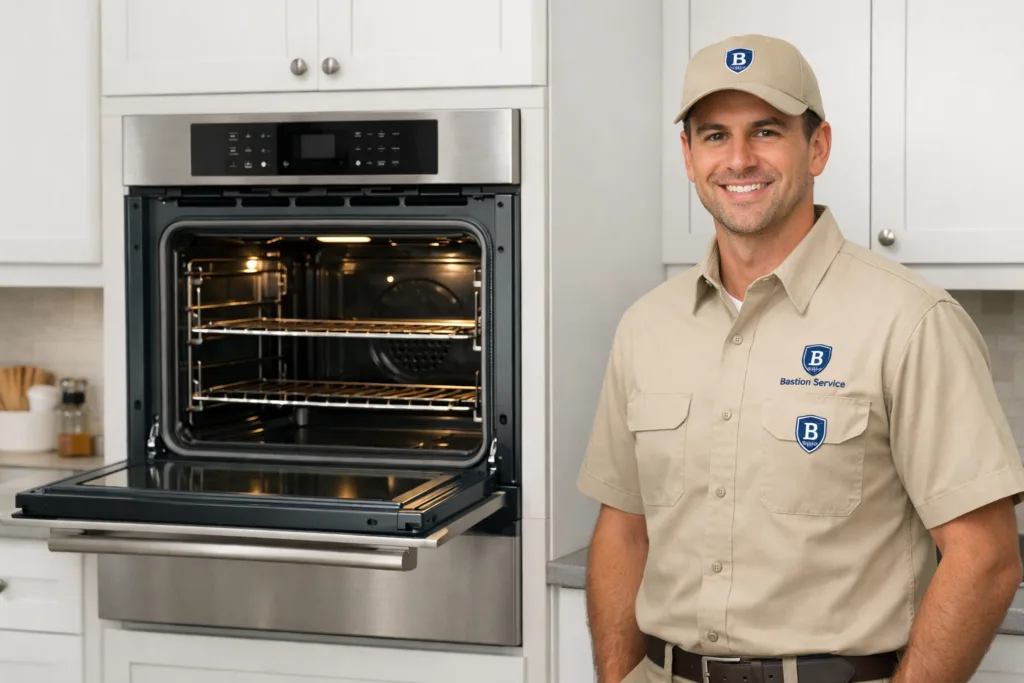
Wall oven problems often start subtly. You may notice longer preheat times, cookies browning unevenly, or a display that works one day and acts erratically the next. With Bosch models, those symptoms can come from different systems, so matching the repair approach to the actual fault matters more than guessing from the symptom alone.
What Bosch wall oven problems usually look like at home
Some failures are obvious, such as an oven that will not turn on or one that shuts off mid-cycle. Others build gradually and show up as cooking inconsistency. A household in Playa Vista may first notice that familiar recipes suddenly need extra time, casseroles come out unevenly heated, or the oven seems hot one day and cool the next.
Common signs that service is worth considering include:
- Little or no heat during bake or broil cycles
- Slow preheating compared with normal operation
- Temperature swings that affect baking results
- Hot spots, uneven browning, or unreliable convection performance
- Error codes, flashing displays, or touch controls that stop responding
- Door closing, locking, or self-clean related issues
- Power loss, breaker trips, or shutdowns while the oven is heating
Because these symptoms can overlap, a good diagnosis usually focuses on the heating system, temperature sensing, controls, door function, and incoming power rather than assuming one part is always to blame.
Not heating, underheating, or taking too long to preheat
If the oven appears to run but does not actually produce enough heat, the problem may involve a weakened bake element, a broil element that is not assisting as expected, a faulty temperature sensor, wiring damage, or a relay issue on the control board. In some cases, the unit may heat partially, which makes the problem harder to spot because the cavity gets warm without ever reaching the selected temperature correctly.
Typical household clues include:
- Food staying pale or undercooked even after the timer ends
- Preheat alerts arriving much later than normal
- Dishes needing repeated extra cook time
- Top browning without the center finishing properly
When this symptom continues, the oven can become unreliable for everyday meals, especially when timing matters. It is usually better to address weak heating early instead of pushing the oven through repeated long cycles.
Uneven baking and temperature inconsistency
Uneven baking does not always mean the oven is completely failing. Bosch wall ovens can still appear functional while drifting out of temperature accuracy. That can happen because of a sensor issue, convection fan trouble on applicable models, door seal wear, or control calibration problems.
If one rack cooks much faster than another, or if one side of a pan consistently browns before the other, the appliance may not be distributing or regulating heat the way it should. Homeowners in Playa Vista often notice this first with baked goods, roasted vegetables, or dishes that used to come out predictably.
Signs of temperature regulation trouble include:
- Meals alternating between overcooked and undercooked
- Recipes requiring constant adjustment
- Burnt edges with underdone centers
- Convection cycles that seem weaker or noisier than before
Error codes, display faults, and control issues
Modern Bosch wall ovens rely on electronic controls, sensors, and safety logic. When one of those systems stops communicating properly, the display may show an error code, flash unexpectedly, freeze, or reset during use. Buttons may become intermittent, or the control panel may stop responding altogether.
These symptoms can point to:
- Sensor faults
- Control board failures
- Door latch or lock problems
- Overheating protection events
- Electrical supply or connection issues
Repeated resets rarely solve a persistent electronic fault. If the same code returns, or the panel behaves unpredictably, testing the affected circuit is usually more useful than continuing to power cycle the oven.
Door, latch, and self-clean problems
A wall oven door has a bigger effect on performance than many homeowners expect. If the door does not close fully, heat can escape and force the oven to run longer while still cooking poorly. A damaged gasket, worn hinge, or latch problem can all lead to unstable temperature performance.
Self-clean complaints are also commonly tied to door and lock components. If the oven became unresponsive after a cleaning cycle, remained locked, or showed a latch-related error, the issue may involve the lock motor, switch, thermal protection, or the electronic control that manages the cleaning sequence.
Watch for symptoms such as:
- A door that needs to be pushed firmly to stay shut
- Visible gaps around the seal
- A lock that will not engage or release correctly
- Loss of oven function after self-clean use
Power loss, tripped breakers, and shutdowns during cooking
If the oven cuts off as it heats, trips the breaker, or loses power when both cooking elements are working hard, the issue may be electrical rather than mechanical. Heating circuits draw significant load, so loose connections, damaged wiring, failing components, or terminal block problems can cause intermittent shutdowns or complete loss of operation.
This is one symptom category where continued use is usually not wise. A shutdown that happens only occasionally can become a full no-power condition later, and repeated breaker trips should not be ignored as a minor inconvenience.
When repair is usually worth considering
Repair often makes sense when the problem is isolated to one main system, such as a heating element, sensor, fan motor, latch assembly, or a specific control-related fault on an otherwise solid oven. Many Bosch wall oven issues are meaningful but still limited in scope.
Replacement becomes more likely when the unit has multiple overlapping electrical and control failures, recurring problems that have already been repaired before, or broader wear that makes dependable operation unlikely. The practical question is not just whether the oven can be repaired, but whether the repair restores trustworthy everyday use.
How homeowners can describe the symptom more clearly
One of the most helpful things you can do before service is note exactly what the oven does and when it does it. Symptom patterns often reveal whether the problem is related to heating, sensing, controls, or power.
Useful details include:
- Whether the oven powers on normally
- If the issue affects bake, broil, convection, or all modes
- How long preheat now takes compared with before
- Whether an error code appears before or after heating starts
- If the problem began after self-cleaning, a power interruption, or a breaker trip
- Whether the fault is constant or intermittent
That kind of symptom history can make the service visit more efficient and helps separate a one-system failure from a broader performance problem.
What a service visit should help you decide
A useful appointment should do more than confirm that the oven is malfunctioning. It should identify which system has failed, explain how that failure connects to the cooking problem you are seeing, and clarify whether the repair path is sensible for the condition of the appliance.
For Bosch wall oven repair in Playa Vista, that usually means evaluating heating performance, temperature feedback, control response, door operation, and signs of electrical stress. Once the fault is narrowed down, it becomes much easier to decide whether repair is the right next step for your household.