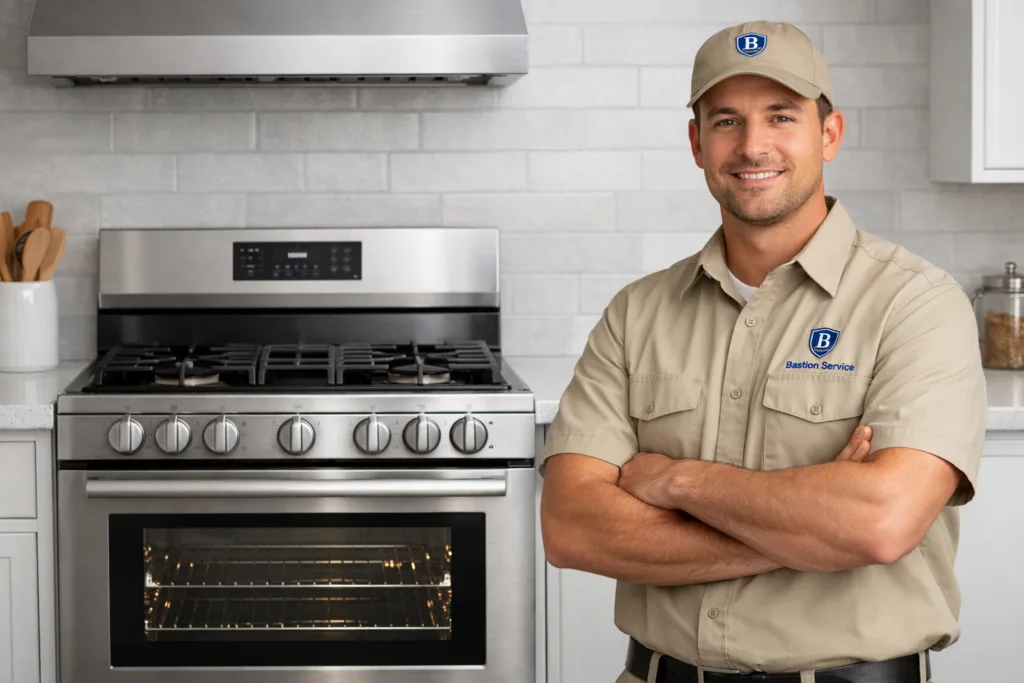
Range problems rarely stay small for long. A burner that starts clicking more often, an oven that needs extra time to preheat, or controls that work only part of the time can quickly turn routine cooking into guesswork. For Mar Vista homeowners, the most useful next step is understanding what the symptom is likely pointing to before deciding on a repair.
Common Blomberg range problems and what they may indicate
Many range issues sound similar at first, but they do not always come from the same failed part. A proper diagnosis usually begins with the specific behavior of the cooktop, oven, or controls.
Burners that click but do not light
On gas ranges, repeated clicking with no flame can be caused by several different issues, including a wet ignition area, misaligned burner cap, dirty burner ports, a worn spark switch, or a fault in the ignition system. If the burner eventually lights after several tries, the problem may still be developing and should not be ignored.
When the clicking continues after the burner is lit, that often points to an ignition switch or moisture-related issue. If the flame looks uneven or weak, the burner assembly may also need inspection and cleaning.
Oven not heating or heating too slowly
If the oven stays cold, takes too long to preheat, or never seems to reach the selected temperature, the cause may involve the igniter, heating element, temperature sensor, relay, or control board. Gas models often show slow preheat when the igniter is weakening. Electric models may heat partially if one element is failing but not completely open.
This type of problem often shows up first as undercooked food, longer bake times, or the need to raise the temperature higher than normal just to get acceptable results.
Uneven baking and temperature swings
When one side of a tray browns faster than the other, or dishes come out inconsistent from one use to the next, the issue may be related to sensor drift, weak heating output, convection fan trouble, or a door that is not sealing properly. In some cases, the range is technically heating, but not maintaining temperature evenly enough for reliable cooking.
Burners heating poorly or inconsistently
On electric ranges, a surface element that cycles too weakly, overheats, or does not respond correctly to the setting may indicate a problem with the element, receptacle, switch, or control. On gas models, inconsistent burner performance can come from restricted ports, ignition trouble, or gas flow problems within the burner assembly.
Display or controls not responding
If the keypad does not register commands, the display flickers, or the range seems to lose function intermittently, the fault may be in the touch panel, electronic control, wiring, or incoming power connection. Intermittent control issues are especially frustrating because they can appear and disappear before becoming a complete failure.
Symptoms that should not be ignored
Some problems are mainly inconvenient. Others should be addressed before regular use continues.
- Burners that release gas but do not ignite promptly
- Persistent clicking even when a burner is already lit
- Strong temperature inaccuracies that affect safe cooking
- Controls that turn functions on or off unpredictably
- Signs of scorching, sparking, or electrical odor
If there is a strong or persistent gas smell, stop using the range immediately. Leave the area if needed and contact the gas utility or emergency service before arranging appliance repair. Even without a gas odor, delayed ignition is a warning sign that should be checked soon.
What homeowners can notice before scheduling service
A few simple observations can make the repair path more accurate. You do not need to disassemble anything, but it helps to note exactly how the range is behaving.
- Does the problem affect one burner or all burners?
- Does the oven fail completely, or does it just run cooler than expected?
- Is the issue constant, or only after cleaning or heavy use?
- Does the display lose power, flash error behavior, or ignore inputs?
- Does the problem happen during preheat, baking, broiling, or all modes?
These details can help distinguish between an isolated part failure and a broader control or power problem.
When repair makes sense
Many Blomberg range issues are repairable when the fault is limited to components such as igniters, burner switches, sensors, heating elements, relays, or control interfaces. If the range is otherwise in solid condition and the failure is well defined, repair is often the better value.
Repair is especially worth considering when the appliance has been performing well overall and the current problem clearly centers on one cooking function rather than the entire range.
When replacement may be the better option
Replacement becomes more reasonable when the range has multiple major problems at once, has a history of repeated electronic failures, or shows broad wear across both the cooktop and oven. If several systems are breaking down together, the total repair path may no longer be practical.
Age alone does not decide the answer. What matters more is the condition of the appliance, the number of failing components, and whether the current problem is a single repair or part of a larger pattern.
How a useful Blomberg range diagnosis works
A good diagnosis goes beyond naming a likely part. It should connect the visible symptom with testing results and explain whether the repair is isolated, urgent, or part of a bigger issue. On a Blomberg range, that may include checking ignition performance, verifying oven temperature response, inspecting heating patterns, and confirming whether the controls are communicating correctly.
This matters most when the appliance still works some of the time. Intermittent faults can easily be misread, and replacing a part based only on the most obvious symptom can lead to repeat service if the underlying cause was elsewhere.
Blomberg range repair for everyday cooking in Mar Vista
In many Mar Vista homes, range trouble becomes a serious problem before the appliance fully stops working. A burner that only lights after repeated tries, an oven that bakes unevenly, or a control panel that responds inconsistently can all disrupt daily meals and make cooking less safe and less predictable.
The goal of service should be simple: identify the actual cause, explain the condition of the range in plain terms, and help the homeowner decide whether repair is the right next move. When that happens, it becomes much easier to restore normal kitchen use without unnecessary parts replacement or repeated guesswork.