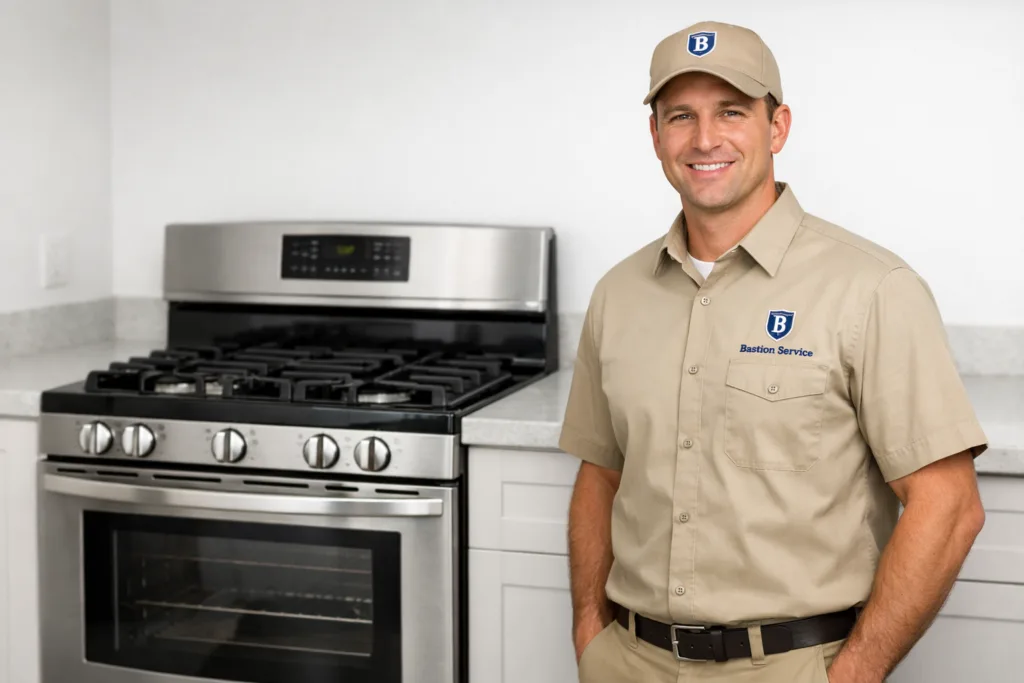
Range problems rarely stay neatly contained to one symptom. A burner that seems weak may have a switch or connection issue behind it, while an oven that bakes unevenly may be dealing with a sensor, igniter, element, or control fault. For Mar Vista homeowners, the most useful first step is identifying which system is failing before deciding whether a repair makes sense.
Signs your Kenmore range needs service
Some problems are obvious right away, while others build gradually over time. If cooking results have become inconsistent or daily use feels less predictable, the range is usually giving early warning signs.
- Surface burners do not heat, heat unevenly, or take too long to respond
- Gas burners click repeatedly or light only after several tries
- The oven takes longer than normal to preheat
- Food comes out undercooked, overcooked, or browned unevenly
- The temperature seems to drift during baking or roasting
- The display, keypad, or clock resets or stops responding
- Knobs feel loose, stuck, or no longer regulate heat correctly
These symptoms can point to very different repairs, even when they look similar from the outside.
Cooktop burner problems and what they often mean
Electric burners not heating properly
On electric Kenmore ranges, a burner that stays cool, heats only partway, or cuts in and out may involve the element, the receptacle it plugs into, the infinite switch, or wiring at the connection point. If one burner is acting up but the others work normally, the problem may be isolated. If several burners are inconsistent, the diagnosis may need to include broader electrical and control checks.
Gas burners clicking or lighting slowly
On gas models, constant clicking usually means the ignition system is not sensing or completing ignition as expected. Moisture, food debris, misaligned burner caps, a weak spark, or a worn ignition component can all create similar behavior. Slow lighting should not be ignored, especially if ignition has become less reliable over time.
Uneven flame or poor heat control
If a gas flame looks weak, irregular, or only partially lights around the burner, the issue may involve the burner head, cap placement, ignition, or gas delivery through the burner assembly. If heat is hard to regulate, the burner may not be responding normally to the control setting, which can make everyday cooking frustrating and unpredictable.
Oven heating issues that affect baking results
Oven not reaching the selected temperature
When the oven preheats slowly or never gets hot enough, likely causes can include a failing bake element on electric units, a weak igniter on gas units, a temperature sensor problem, or a control issue. Homeowners often first notice this when familiar recipes suddenly need more time or stop turning out the way they used to.
Oven overheats or cycles incorrectly
An oven that runs hotter than the setting can scorch food, dry out baked dishes, and create unreliable results across multiple racks. In these cases, the fault may be related to the sensor, thermostat calibration, relay behavior, or electronic control. Overheating is not just a cooking inconvenience; it can also place extra strain on internal parts.
Uneven baking from front to back or top to bottom
If one side of a pan browns faster than the other, or the top cooks much faster than the center, the oven may not be distributing heat properly. That can happen when an element is weak, the igniter is not fully opening the gas valve, or the oven is cycling off before reaching stable temperature. A symptom like uneven baking often tells more than a simple “not heating” complaint because it suggests partial operation rather than complete failure.
Control and power-related range problems
Modern ranges rely on switches, relays, sensors, and electronic controls to coordinate burner and oven performance. When the display goes blank, the clock resets, error codes appear, or settings stop responding, the issue may involve the control board, power supply, wiring connections, or a failed interface component.
Power-related faults can also look inconsistent. The range may work normally one day and fail the next, or one feature may respond while another does not. Because these problems can affect both the cooktop and oven, they usually need a full symptom review rather than a single-part guess.
When to stop using the range
Some issues allow limited use of unaffected cooking zones, but others should put normal cooking on pause until the problem is checked. Stop using the range if you notice:
- A persistent gas smell
- Delayed ignition followed by a sudden flare-up
- A burner that will not shut off correctly
- Sparking, visible wiring damage, or signs of overheating
- An oven that gets far hotter than the set temperature
- Repeated tripping of power while the appliance is in use
Continuing to use a range with ignition or heat-regulation problems can turn a smaller repair into a larger one.
Repair or replace a Kenmore range?
In many cases, repair is still the better option when the issue is limited to one system, such as a burner element, igniter, switch, sensor, or control-related part, and the rest of the appliance is in good condition. Replacement becomes more likely when the range has multiple active problems, visible wear across several components, or a history of recurring failures.
The decision is usually easiest after the exact fault is identified. A single failed part on an otherwise solid range is very different from a unit with ongoing ignition trouble, unstable temperature control, and electrical problems happening at the same time.
What a service visit should clarify
A useful diagnosis should do more than name a symptom. It should show whether the problem is isolated, what parts or systems are involved, and whether the repair path is reasonable for the condition of the appliance. On a Kenmore range, that may include checking burner operation, oven heat response, ignition behavior, controls, and key connection points.
For homeowners in Mar Vista, that matters because cooking problems tend to disrupt daily routines quickly. Whether the issue is a burner that no longer responds, an oven that cannot hold temperature, or controls that have become unreliable, the right repair starts with understanding why the range is failing in the first place.