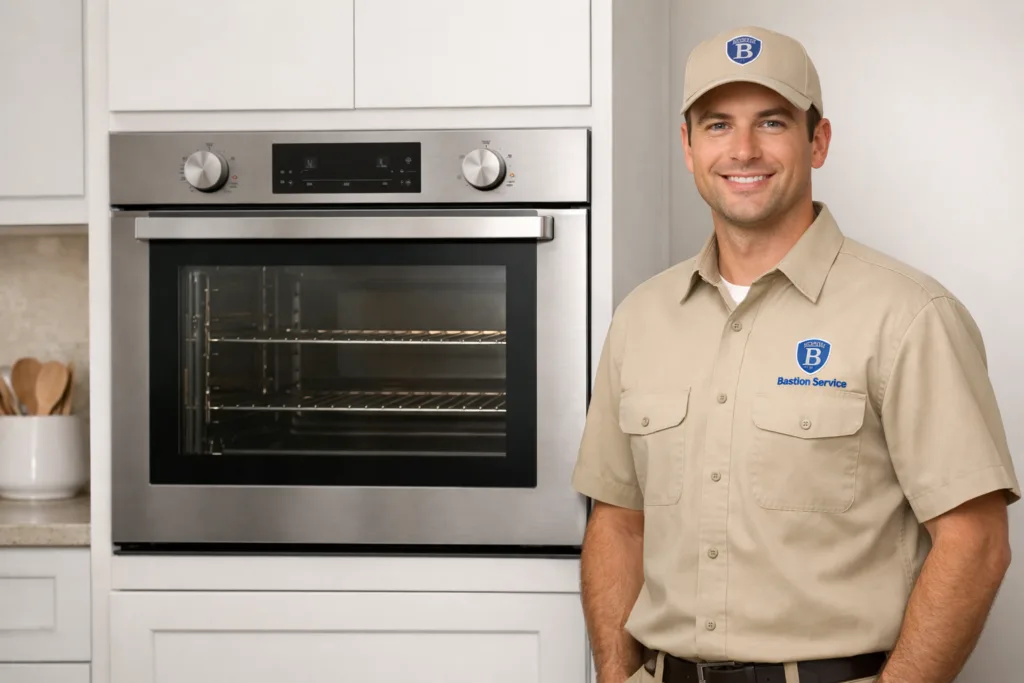
Cooking problems often show up before a complete breakdown. A Blomberg oven that takes too long to preheat, browns unevenly, or shuts off mid-cycle can usually be traced to a specific heating, sensing, door, or control issue. The important part is matching the repair to the actual symptom pattern instead of assuming every heating complaint has the same cause.
Common Blomberg oven issues seen in Mar Vista homes
Residential oven problems tend to fall into a few categories. Some affect heat production, some affect temperature accuracy, and others involve the controls or door assembly. Because several different faults can create similar cooking results, it helps to look at what the oven does from start to finish: how it preheats, whether it maintains temperature, how the controls respond, and whether the door seals correctly.
Not heating at all
If the oven appears to power on but never produces heat, the fault may be in the bake element, broil element, igniter, sensor circuit, wiring, relay, or electronic control. In some cases, the display works normally while the cooking cycle does not actually begin. That usually means the problem is deeper than a simple power issue.
Slow preheat
Long preheat times often point to partial heating rather than total heat loss. One heating component may be weak, the sensor may be reporting inaccurately, or the control may not be cycling heat correctly. Homeowners sometimes notice this first when weeknight meals take longer than expected or when the oven seems hot eventually but gets there very slowly.
Uneven baking
When one rack cooks faster than another, baked goods come out lopsided, or the bottom scorches before the center finishes, the oven may not be distributing or regulating heat properly. Weak elements, a drifting temperature sensor, calibration issues, or airflow problems can all create inconsistent results.
Temperature swings
All ovens cycle to maintain heat, but wide swings that affect cooking performance are a sign something is off. If food alternates between undercooked and overdone even on familiar settings, the sensor, control board, or heating circuit may not be responding accurately.
Controls not responding
A blank display, buttons that do not react, or settings that cancel unexpectedly can indicate a control problem, wiring issue, or power supply fault. If the oven starts only sometimes, the issue may be intermittent now but can become more obvious with continued use.
Door and seal problems
A door that does not close firmly allows heat to escape and can make preheating slower and baking less consistent. Worn hinges, a damaged gasket, or latch misalignment may seem minor at first, but they can affect both performance and energy use.
What specific symptoms can reveal
Looking at the full behavior of the oven often tells more than any single complaint. These patterns are especially helpful when deciding what to check first:
- The display works, but the oven stays cold: power is present, but the heating or ignition circuit may not be completing the cycle.
- Preheat starts normally, then stalls: a weak element, failing igniter, or temperature-sensing problem may be preventing the oven from reaching target heat.
- Broil works, but bake does not: one heating function may have failed while the other still operates.
- The oven overheats: the sensor, thermostat logic, or control relay may not be regulating temperature correctly.
- It works on one day and fails the next: intermittent wiring, relays, or electronic control faults are more likely than a simple one-time glitch.
- Error codes or persistent beeping appear: the oven may be detecting a sensor, latch, or communication issue that should be checked before regular use continues.
When uneven baking is more than a recipe problem
Many people first suspect cookware, rack position, or recipe timing when food comes out unevenly. Those factors matter, but repeated results with different dishes usually point back to the oven. If the same hot spot shows up every time, if the top cooks much faster than the bottom, or if familiar recipes suddenly need major adjustments, the appliance is likely no longer heating as intended.
In a household kitchen, that can turn ordinary meal prep into guesswork. Roasting, baking, and reheating all become less predictable, and the oven may continue to drift further out of spec if the underlying part continues to weaken.
Signs the oven should not keep being used
Some issues can wait a short time for service, but others call for stopping use right away. It is wise to discontinue operation if your Blomberg oven is:
- tripping the breaker
- overheating or burning food unusually fast
- showing recurring error codes
- starting inconsistently or shutting off during cooking
- producing smells that seem electrical rather than food-related
- failing to close or seal properly
If ignition behavior is delayed or abnormal on a gas model, do not keep testing it repeatedly. If there is a strong or persistent gas smell, stop using the oven and address the gas concern first before scheduling appliance repair.
Repair or replace: how the decision usually gets made
For many households in Mar Vista, repair makes sense when the problem is limited to one serviceable component or one clearly defined system. That can include items such as an igniter, heating element, sensor, gasket, hinge, or certain control-related parts. Replacement becomes more likely when the oven has multiple major failures at once, has a history of repeated breakdowns, or would require a costly repair relative to its overall condition.
The age of the unit matters, but age alone does not decide the issue. A well-kept Blomberg oven with one isolated fault can still be a good repair candidate. On the other hand, an oven with control problems, door issues, and unreliable heating at the same time may be nearing the point where replacement deserves consideration.
What to check before scheduling service
Before assuming the oven needs a major repair, it helps to note a few details:
- Does the display turn on normally?
- Does the oven fail in bake, broil, or both?
- Is preheat slow every time or only on certain settings?
- Are there any error codes?
- Does the door close fully and evenly?
- Has cooking performance changed gradually or all at once?
These details can make diagnosis faster and help separate a heating fault from a sensor, control, or door-related problem.
Why early attention usually helps
Oven problems rarely improve on their own. A weak heating component can become a complete no-heat condition, a sensor issue can turn into ongoing temperature inaccuracy, and a loose hinge or worn gasket can put more strain on the oven during every use. Addressing symptoms early often keeps the repair simpler and helps restore predictable cooking before the appliance becomes fully unusable.
Focused help for Blomberg oven problems in Mar Vista
When a Blomberg oven starts interrupting everyday cooking, the most useful next step is a service approach centered on the real-world symptom: not heating, uneven baking, slow preheat, temperature swings, or control failure. Bastion Service helps Mar Vista homeowners evaluate whether the issue is isolated, whether continued use is a bad idea, and whether the repair path makes sense for the condition of the appliance.