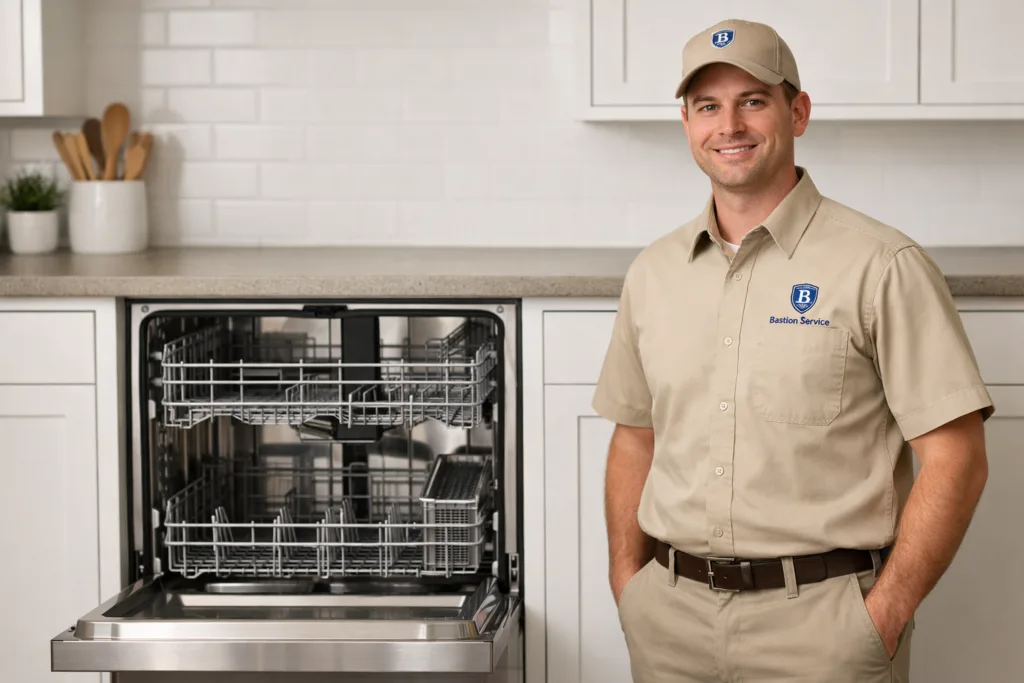
Dishwasher problems rarely stay isolated for long. A small drain issue can turn into odor and repeat wash failures, while a minor leak can affect flooring or the cabinet space around the appliance. With Blomberg units, the most useful starting point is to match the symptom to the part of the machine that is most likely failing rather than assuming every bad cycle means the same repair.
Common Blomberg Dishwasher Problems in Mar Vista Homes
Most service calls fall into a few symptom patterns. Understanding what each pattern can mean helps homeowners decide when basic cleaning may help and when the machine likely needs repair.
Standing water after the cycle ends
If water remains in the bottom of the tub, the problem may involve a clogged filter area, restricted drain hose, blocked sink connection, weak drain pump, or a control issue that is not sending the drain sequence correctly. When this happens more than once, it usually points to more than a one-time interruption. Continued use can leave dishes with residue and place extra strain on the pump.
Poor cleaning or gritty residue on dishes
When dishes come out dirty even though the cycle appears to complete, the issue may be low water fill, restricted spray arms, a circulation problem, detergent dispenser trouble, or water that never reaches proper wash temperature. Cloudiness and film are not always the result of detergent choice alone. If the machine has also started sounding different or taking longer to finish, the problem may be mechanical rather than routine maintenance.
Leaks from the door area or underneath the dishwasher
Water on the floor can come from a worn door gasket, lower door seal, loose hose connection, overfilling condition, cracked internal part, or sump-related failure beneath the unit. Even a slow leak matters because repeated moisture can damage nearby surfaces over time. If leaking appears more than once, it is usually best to stop running full cycles until the source is identified.
Dishwasher powers on but does not start
Lights on the panel do not always mean the dishwasher is ready to run. A failed latch, faulty interface, fill problem, drain condition, or electronic control issue can keep a cycle from starting. In some cases the unit may respond to buttons but never move into wash because one required condition has not been met.
New grinding, humming, or rattling sounds
Noise changes often point to debris in the pump area, spray arm interference, circulation motor wear, or drain pump trouble. A humming dishwasher that does not move water normally should not be ignored, especially if wash results also drop. Noise by itself does not confirm which part has failed, but it is a strong sign that the machine is no longer operating normally.
Cycles that run too long or stop midway
When a Blomberg dishwasher seems stuck in one stage, fails to finish, or shuts down before the dishes are done, the cause may involve heating faults, sensor problems, water intake issues, or an electronic control fault. Longer cycles can be easy to dismiss at first, but repeated timing problems usually mean the appliance is struggling to complete one of its required steps.
What These Symptoms Often Point To
Different failures can create similar results, which is why symptom-based explanations matter. Poor washing does not always mean a bad pump, and standing water does not always mean a blocked hose. A proper diagnosis separates user-correctable issues from true component failure.
- Drain complaints often relate to the pump, hose restriction, filter blockage, or sink-side drainage connection.
- Weak cleaning may be tied to circulation, spray arm blockage, low fill, detergent release, or heating performance.
- Leaks commonly involve seals, hoses, overfill conditions, or cracks in internal water-carrying parts.
- No-start conditions often involve the latch system, controls, fill sequence, or safety conditions that prevent operation.
- Intermittent shutdowns may point to control, heating, or sensor-related faults.
This is why replacing parts based on a guess often wastes time and money. Two machines with the same visible symptom can need very different repairs.
When to Stop Using the Dishwasher
Some issues allow limited short-term use, but others should be treated as stop-use problems. In most households, it is wise to pause operation if the dishwasher is leaking, leaving a large amount of standing water, tripping power, producing a burning smell, or making severe mechanical noise.
It also makes sense to stop using the unit when:
- The door does not seem to latch securely
- The dishwasher fills incorrectly
- The pump sounds strained or unusually loud
- The cycle repeatedly fails before completion
- Water appears under the appliance after each run
Using the machine in these conditions can turn a contained repair into added pump wear, electrical problems, or water damage around the installation area.
Simple Checks Homeowners Can Make First
Before assuming the dishwasher needs a major repair, a few basic checks may help clarify the problem. These steps do not replace service, but they can rule out obvious maintenance issues.
- Check for heavy debris in the filter area
- Look for spray arms blocked by utensils or buildup
- Confirm that dishes are not packed tightly enough to stop spray movement
- See whether the sink drain connection or air gap appears obstructed
- Inspect the door gasket area for visible damage or food residue
If the same symptom continues after those checks, the problem is more likely tied to a failing component or internal system fault than to loading or routine cleaning.
Why Blomberg Dishwasher Issues Should Be Diagnosed by Symptom Pattern
Blomberg dishwashers can show overlapping signs when something goes wrong. For example, a heating problem can cause poor cleaning, poor drying, and unusually long cycles. A circulation issue can look like a detergent problem. A drain fault can make the machine seem unresponsive at the start of the next cycle. The most effective repair path starts by confirming which function is failing first and which other symptoms are simply downstream effects.
That approach is especially helpful for homeowners in Mar Vista trying to decide whether repair is worthwhile. Once the actual failure is identified, it becomes easier to judge urgency, expected repair scope, and whether the rest of the machine appears sound.
Repair or Replace?
The answer depends on the condition of the appliance as a whole, not just the symptom that prompted the service call. Repair often makes sense when the dishwasher is otherwise in good shape and the issue is limited to one serviceable part such as a pump, valve, latch, seal, sensor, or control-related component.
Replacement becomes more likely when multiple systems are failing at once, the machine has a history of repeated problems, or a major repair is being considered on a unit already showing broader wear. For many Mar Vista households, the practical decision comes down to whether the dishwasher has one defined fault or several signs of overall decline.
Signs the Problem Is Getting Worse
Dishwasher issues often progress in stages. Catching those changes early can help prevent a more expensive breakdown.
- A small amount of leftover water turns into a tub that no longer drains at all
- Occasional cloudy dishes become consistent wash failure
- A light hum becomes loud pump noise or stalled operation
- An intermittent leak becomes visible water on every cycle
- Long cycles become aborted cycles or no-start conditions
When the symptom pattern is clearly worsening, waiting usually does not improve the outcome. It more often leads to repeat failed cycles and added stress on the same components.
What Homeowners Usually Want to Know First
Most people dealing with a malfunctioning dishwasher want quick answers to three questions: what is likely causing the issue, whether it is safe to keep using the machine, and whether the repair is worth doing. A focused diagnosis is what answers those questions without guesswork. That gives the homeowner a practical repair plan based on the actual condition of the appliance rather than on trial-and-error part replacement.