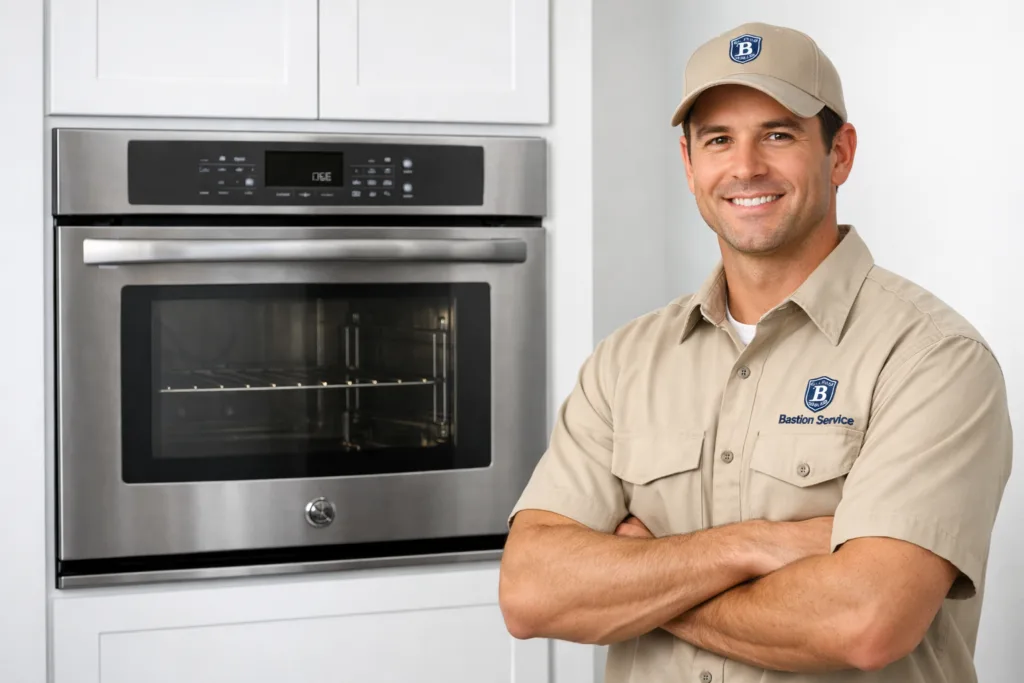
A GE oven that stops heating properly can throw off everything from weeknight meals to holiday cooking. The most useful place to start is with the symptom pattern itself, because “not cooking right” can point to several very different failures. In many Mar Vista homes, the difference between a straightforward repair and wasted parts comes down to whether the issue is isolated to heat production, temperature sensing, controls, or door-related heat loss.
Common GE oven problems in Mar Vista homes
Most oven complaints begin with a result in the kitchen: food takes too long, comes out unevenly, or does not cook through at all. Looking at how the oven behaves during preheat and throughout the cycle usually tells you much more than the complaint alone.
Oven will not heat
If the oven turns on but never reaches cooking temperature, the cause depends on the model type. On electric GE ovens, common causes include a failed bake element, broil element problem, wiring damage, thermal cutoff issue, or a control fault that is not sending power where it should. On gas models, a weak igniter is one of the most common reasons an oven will not light or will take far too long to do so.
A useful clue is whether the broiler still works. If broil heats but bake does not, the problem may be limited to the bake circuit. If neither function works, the issue may be broader and involve power supply, controls, or safety components.
Slow preheat
Slow preheat often starts subtly. At first, dinner is just running late. Later, the oven may need much more time than the display suggests. This can happen when an element is weak rather than fully failed, when a gas igniter is glowing but not strong enough to open the valve promptly, or when the sensor is feeding the control incorrect temperature information.
Homeowners sometimes adjust by adding extra cooking time, but that can hide a developing problem for weeks or months. If preheat has noticeably changed, it is worth treating that change as a real symptom rather than normal aging.
Uneven baking and hot spots
If cookies brown more on one side, casseroles are burnt on top and cold in the center, or one rack cooks much faster than another, the issue may involve weak heating, inaccurate sensing, or poor heat retention. A worn door gasket can let heat escape. A failing convection fan, where equipped, can affect airflow. In other cases, the oven cycles incorrectly and creates larger temperature swings than it should.
These problems are especially frustrating because the oven may still appear to be “working,” even while producing inconsistent results.
Temperature runs too hot or too cold
When a GE oven consistently overcooks or undercooks, the problem may be calibration-related, but it can also involve the sensor, control board relays, or intermittent heating behavior. If your recipes suddenly need major adjustments, that usually means the oven temperature is drifting from what the display shows.
- Food browns too fast on the outside
- Baked goods stay pale or collapse
- Preheat tone sounds early, but the cavity is still not ready
- Cooking times have become unreliable from one use to the next
Display and control issues
An unresponsive keypad, flashing display, random beeping, error codes, or settings that do not respond properly can point to a user interface issue, failing electronic control, or wiring problem. If the oven started acting up after a self-clean cycle, heat stress may have affected sensitive components around the control area or door-lock system.
In these cases, replacing parts by guesswork can become expensive quickly. Electronic symptoms usually need measured testing to determine whether the problem is in the panel, the board, the latch circuit, or a related harness connection.
Why the same symptom can have different causes
Two GE ovens can show identical kitchen results for very different mechanical reasons. An oven that does not reach 350 degrees may have a weak igniter, an inaccurate sensor, a failing relay, a damaged element, or a door seal that is no longer holding heat properly. That is why symptom-based diagnosis matters: the goal is not just to identify what seems wrong, but to confirm what actually failed.
This approach is especially helpful when the appliance still works part of the time. Intermittent problems are common with ovens, and they often show up as temperature swings, partial preheat, or occasional shutdowns mid-cycle.
Symptoms that should not be ignored
Some oven issues are inconvenient. Others can create safety concerns or lead to larger failures if they are left unresolved. It makes sense to stop and evaluate the unit if you notice any of the following:
- The oven trips the breaker when heating starts
- There is visible sparking or a damaged heating element
- The appliance shuts off during cooking
- The oven door will not unlock after use
- There is a burning smell that suggests overheated wiring
- The temperature climbs well above the setting
If you have a gas GE oven and notice a persistent gas odor, stop using it immediately. Leave the area if necessary and contact the gas utility or emergency service before arranging appliance repair.
When repair is usually worthwhile
Many GE oven problems are repairable when the failure is limited to a specific component such as an igniter, temperature sensor, heating element, latch assembly, switch, or related wiring issue. If the oven is otherwise in good condition and has been performing well up to this point, repair is often the sensible path.
Replacement becomes a more serious consideration when there are multiple active problems, repeated electronic failures, significant cavity wear, or a major control issue on an older appliance that already has declining reliability.
What to note before scheduling service
A few observations can make the repair process much more straightforward. Before service, it helps to note:
- Whether the oven is gas or electric
- Whether bake, broil, or both are affected
- Whether the problem is constant or intermittent
- Any error codes shown on the display
- Whether the issue began after self-cleaning, a power outage, or a breaker trip
- If the oven eventually heats, how long preheat is taking now compared with before
That kind of detail often helps narrow the likely fault before any parts are considered.
What Mar Vista homeowners usually want from an oven repair visit
Most people are not looking for a long technical breakdown. They want to know what failed, whether the oven is safe to keep using, and whether the repair makes financial sense. Bastion Service helps Mar Vista homeowners make that decision based on the specific GE oven symptom, the appliance condition, and the repair path that best fits the problem.
Whether the issue is no heat, uneven baking, temperature drift, slow preheat, or control trouble, the best next step is to evaluate the exact behavior of the oven and repair the confirmed cause rather than chasing the symptom.