
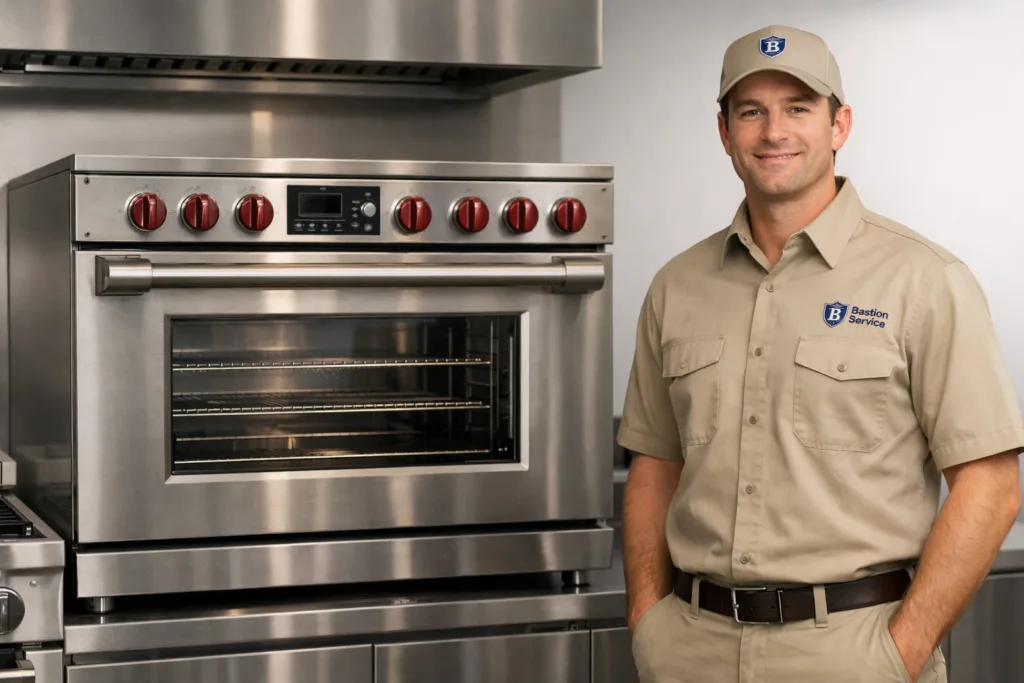




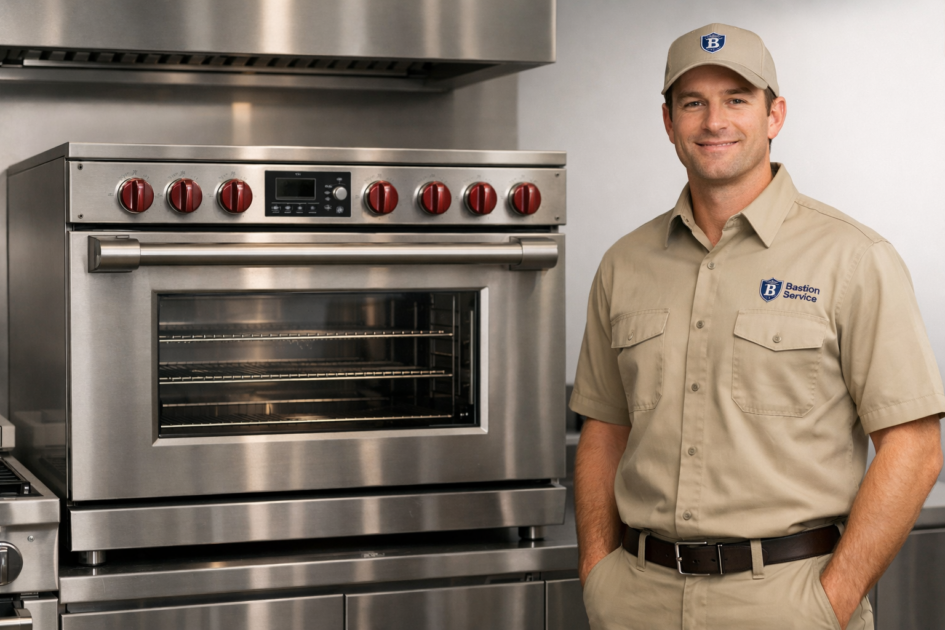
When a Wolf oven starts missing temperature, slowing production, or shutting down mid-shift, the next step should be a service visit built around the exact symptom pattern. In Venice, oven problems can affect ticket times, batch consistency, staff workflow, and safe operation, so it helps to identify whether the fault is tied to ignition, heat generation, temperature sensing, airflow, controls, or power before repair work moves forward. Bastion Service handles Wolf oven repair for businesses in Venice with a symptom-first approach that supports scheduling, parts planning, and downtime decisions.
Related commercial service paths in Venice include Wolf Commercial Repair in Venice, Commercial Oven Repair in Venice, and Wolf Range Repair in Venice.
What Wolf oven symptoms usually point to
Wolf ovens rarely fail in only one obvious way. A unit described as “not heating” may actually be heating too slowly, overshooting set temperature, losing heat under load, or cycling unevenly between racks. The most useful service call starts by narrowing down how the oven behaves during preheat, recovery, steady cooking, and shutdown.
Not reaching set temperature
If the oven struggles to get up to temperature or stalls below the selected setting, likely causes include a weak igniter, failing heating element, sensor drift, relay issues, control failure, or gas flow problems. In a busy kitchen, this often appears first as longer cook times, repeated staff adjustments, or products finishing later than expected.
Uneven baking or hot and cold spots
When one rack runs hot and another lags behind, the issue may involve airflow restrictions, convection fan problems, partial heat loss, calibration error, or a worn door gasket allowing heat to escape. The oven may still seem usable, but inconsistent cavity temperature usually means production quality is already being affected.
Slow preheat
Extended preheat times can signal declining ignition performance, weak electrical components, reduced gas heating response, or sensors that are no longer reading accurately. Slow preheat is often treated as a minor annoyance at first, but it commonly points to a problem that continues to worsen under daily use.
Temperature swings during operation
If the oven overshoots and drops repeatedly instead of holding a stable range, technicians may look at the temperature sensor, control board, relays, calibration, and heat retention. These swings often show up as inconsistent browning, uneven finishing, or the need to rotate pans more than normal.
Ignition delays or startup faults
Gas Wolf ovens with delayed ignition, failed startup attempts, or inconsistent flame establishment may have issues related to the igniter, flame sensing, gas valve behavior, or sequence control. Because startup faults can affect both reliability and safety, this is a symptom that should be evaluated promptly rather than worked around.
Display errors or unresponsive controls
When controls freeze, error codes appear, or settings do not respond correctly, the problem may involve the interface, board communication, wiring, incoming power, or a sensor feeding incorrect data to the control system. Proper testing matters here, because replacing parts based only on the displayed code can lead to unnecessary downtime and cost.
Why uneven heat and set-temperature problems happen
One of the most common service complaints is that a Wolf oven no longer heats evenly or no longer reaches the selected temperature with confidence. That symptom can come from several different sources, and each one affects repair planning differently.
- Sensor drift: The control system receives inaccurate temperature feedback and cycles heat incorrectly.
- Ignition or heating weakness: The oven produces heat, but not at the level needed for proper recovery and stable operation.
- Airflow problems: Convection performance drops, creating inconsistent heat distribution across the cavity.
- Door seal wear: Heat escapes faster than the oven can recover, especially during repeated loading.
- Control or relay faults: Heating components do not cycle as intended, leading to swings or underheating.
For kitchens in Venice, the key issue is not just whether the display shows the right number. It is whether the oven can actually hold working temperature during real production conditions, including repeated door openings, back-to-back batches, and peak-hour demand.
When continued use can lead to more downtime
Some oven issues leave room for limited short-term operation, but others tend to escalate if the unit stays in daily use without service. If the oven is overheating, dropping heat unexpectedly, showing ignition irregularities, tripping power, or shutting off under load, continued operation can increase wear on controls, sensors, wiring, and heating components.
Businesses in Venice often try to manage around an oven problem by adjusting cook times or shifting product placement, but that usually works only briefly. Once staff have to compensate for the equipment instead of relying on it, service should be scheduled before the problem expands into a larger interruption.
Signs the oven should be inspected soon
- Preheat is noticeably slower than normal
- Actual cooking results do not match the set temperature
- Products finish unevenly by rack or pan position
- The oven shuts off, resets, or loses heat mid-cycle
- Ignition is delayed, inconsistent, or fails intermittently
- Controls flash errors or stop responding reliably
- Heat loss is obvious around the door
How technicians narrow down the problem
Effective Wolf oven repair depends on confirming the failure, not guessing from one visible symptom. Service typically focuses on how the unit preheats, how it cycles at temperature, whether it recovers after the door opens, and whether the issue appears consistently or only under longer operating periods.
That process may involve checking temperature accuracy, verifying ignition performance, inspecting heating components, reviewing airflow and fan operation, evaluating door sealing, and testing the control system’s response. For operators, this matters because the repair path for a bad sensor is very different from the repair path for a failing board, weak igniter, or heat-loss problem.
Repair decisions: what usually makes sense
Many Wolf oven issues are repairable when the fault is isolated to components such as igniters, elements, sensors, relays, fans, switches, gaskets, wiring, or control-related parts. In those situations, repair is often the best way to restore stable operation without replacing an otherwise serviceable unit.
A replacement discussion becomes more likely when the oven has repeated major failures, severe structural wear, extensive electrical damage, or a repair scope that no longer aligns with the condition of the equipment and its role in daily production. The right decision depends on reliability, not just on whether the unit can be made to run again temporarily.
Preparing for a Wolf oven service visit
A little preparation can make service more efficient and help narrow down the fault faster. Before the appointment, it helps to note when the issue occurs, whether it appears during preheat or during cooking, whether the problem is consistent or intermittent, and whether staff have seen any error messages or unusual shutdown behavior.
Useful details include:
- How long preheat currently takes compared with normal operation
- Whether the problem affects all racks or only certain positions
- If temperature issues happen only during heavy production
- Any recent power interruptions, resets, or startup failures
- Whether staff notice odor, clicking, delayed ignition, or sudden heat loss
These observations can help connect the reported complaint to the actual operating failure and reduce delays in moving from diagnosis to repair.
Service that matches business needs in Venice
For restaurants, hotels, and other food-service businesses in Venice, Wolf oven service needs to support operational decisions, not just identify a bad part. If the unit is struggling with uneven heat, poor recovery, ignition trouble, or unstable controls, the most practical next step is to schedule a diagnosis that determines whether the oven can remain in limited use, what repair is needed, and how quickly the issue should be addressed to reduce further downtime.





