
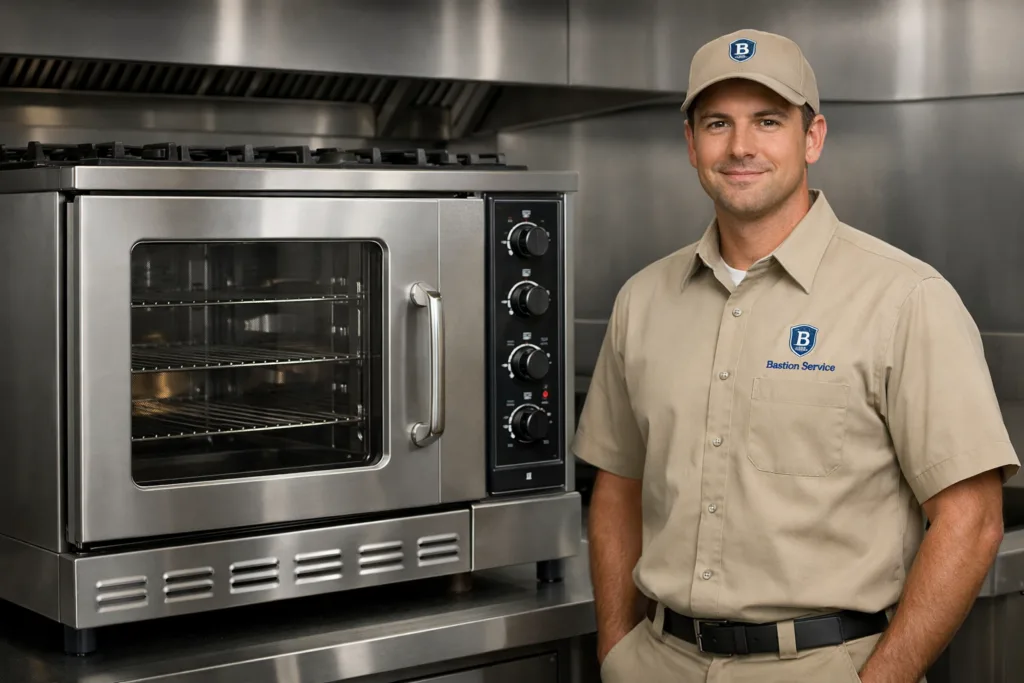




Oven problems tend to show up first in production: slower ticket times, inconsistent bake results, missed holding windows, or staff adjusting cook times to compensate for unstable heat. For businesses in Venice, the smartest next step is to schedule service when the pattern becomes repeatable, not after a full breakdown. Bastion Service works on Southbend ovens with a symptom-based approach that helps identify whether the problem is tied to ignition, temperature control, airflow, power, or component wear before repair decisions are made.
Related commercial service paths in Venice include Southbend Commercial Repair in Venice, Commercial Oven Repair in Venice, and Southbend Range Repair in Venice.
Common Southbend Oven Problems in Venice Kitchens
Southbend ovens are built for daily use, but heavy cycling, grease exposure, heat stress, and age can lead to recurring performance issues. The same outward symptom can come from more than one failing part, which is why the details of how the oven behaves matter.
Not heating or taking too long to preheat
If the oven does not heat at all, heats slowly, or stalls below the set temperature, the fault may involve the ignition system, burner operation, heating components, sensor readings, or the control side of the unit. In some cases, the oven starts normally but loses ground as the cavity heats up, which can point to a part that weakens under load rather than one that has failed completely.
In a busy kitchen, this usually appears as delayed prep, uneven batch timing, or repeated attempts to finish products that should have baked correctly the first time.
Uneven cooking, hot spots, or poor browning
When one rack cooks faster than another, one side of the cavity runs hotter, or finished product varies from batch to batch, airflow and temperature regulation are often part of the diagnosis. Worn door gaskets, fan issues on convection models, sensor drift, or burner problems can all affect heat distribution.
This kind of problem often gets written off as operator adjustment at first, but it usually leads to food waste, menu inconsistency, and avoidable labor loss if the oven keeps running in that condition.
Temperature swings during operation
A Southbend oven that overshoots, drops below target, or struggles to recover after the door opens can be difficult to manage during service. This may involve calibration issues, weak sensing components, control faults, or a heating system that is not cycling correctly. If staff members keep changing settings to chase the right result, the root issue is often already affecting normal output.
Ignition delays, startup trouble, or random shutdowns
If the oven starts intermittently, takes several tries to light, or shuts down during use, the cause may be connected to ignition components, gas delivery parts, safety circuits, or electrical faults. Intermittent symptoms are especially important because they can temporarily disappear between cycles, making the unit seem better than it is.
When shutdowns happen during production, the risk is not only downtime. Partial cooking, lost batches, and repeated restarts can disrupt the entire kitchen workflow.
Control panel or display problems
Unresponsive buttons, incorrect readings, flashing errors, or settings that do not hold can all indicate issues with the control board, wiring, sensor inputs, or power supply to the unit. Control problems affect more than convenience. They can make it difficult for staff to trust the oven, repeat recipes accurately, or maintain production pacing.
Why Symptom-Based Diagnosis Matters
Two ovens can show the same complaint and need very different repairs. An oven that seems to have a burner issue may actually be dealing with a sensor fault. A unit that appears to have a bad control may be reacting to unstable input from another component. Replacing parts based on assumptions can add cost without solving the problem.
A thorough service evaluation helps determine:
- whether the failure is isolated or part of a broader wear pattern
- whether the oven is safe to continue using before repair
- whether calibration, part replacement, or a deeper repair is required
- whether related components may have been affected by the original fault
- whether repair is likely to restore stable day-to-day performance
For Venice businesses, that matters because oven downtime affects prep flow, staffing, timing, and product consistency across the day.
Signs You Should Schedule Service Soon
It is better to schedule repair when the oven becomes unreliable than to wait for a complete loss of heat. Early service can reduce the chance of a more disruptive failure during a busy shift.
- slow preheat or poor temperature recovery
- food finishing too early or too late at normal settings
- inconsistent results between racks or batches
- ignition that becomes delayed or inconsistent
- shutdowns in the middle of a cook cycle
- controls that freeze, reset, or respond inconsistently
- heat escaping around the door or a door that will not seal properly
- burning odors linked to overheating or electrical components
If a gas oven has a persistent or strong gas smell, stop using it and address the gas safety issue immediately before arranging routine appliance repair.
When Continued Use Can Make Repairs More Expensive
Some ovens continue operating in a reduced state long enough that teams work around the issue instead of addressing it. That can be costly. An oven with poor airflow may overwork heating components. A unit with unstable ignition may put more stress on related parts. Temperature regulation problems can cause repeated cycling that increases wear elsewhere in the system.
Even when the oven still turns on, unstable performance can create hidden losses through wasted product, repeated cooking, slower output, and staff time spent compensating for equipment that no longer responds predictably.
Repair or Replace?
Whether a Southbend oven should be repaired or replaced depends on more than age alone. The better question is whether the current problem is isolated and repairable, or whether the unit has entered a pattern of recurring faults that keeps interrupting operations.
Repair is often the right move when the oven is structurally sound, the failure can be traced to a defined cause, and the rest of the unit remains in good working condition. Replacement becomes more likely when heat regulation, controls, ignition, and overall reliability have all started slipping at the same time, or when repeated service events are stacking up without restoring stable performance.
For a business in Venice, reliability matters more than a temporary restart. If the oven cannot hold temperature, recover properly, or run through normal production without repeated intervention, the real cost is felt in daily operations.
How to Prepare for a Southbend Oven Service Visit
Good repair decisions start with useful information from the operator. If possible, note whether the problem happens during preheat, after the cavity gets hot, only during heavy use, or only on certain settings. It also helps to identify whether the issue is constant or intermittent.
Before service, try to gather:
- the model information from the data tag if accessible
- the main symptom staff members are seeing most often
- whether the problem affects every cycle or only some cycles
- any recent shutdowns, error messages, or ignition delays
- whether food quality or cook times have noticeably changed
That kind of detail can make diagnosis faster and help narrow the likely cause of the failure.
Service-Focused Next Steps for Venice Businesses
When a Southbend oven starts missing temperature, shutting down, or producing uneven results, the goal is not just to get heat back for the moment. The priority is to identify the fault accurately, understand how it affects uptime, and schedule the repair path that best supports normal kitchen operations. For businesses in Venice, acting early on recurring oven symptoms is often the best way to limit disruption and return the equipment to stable, usable performance.


