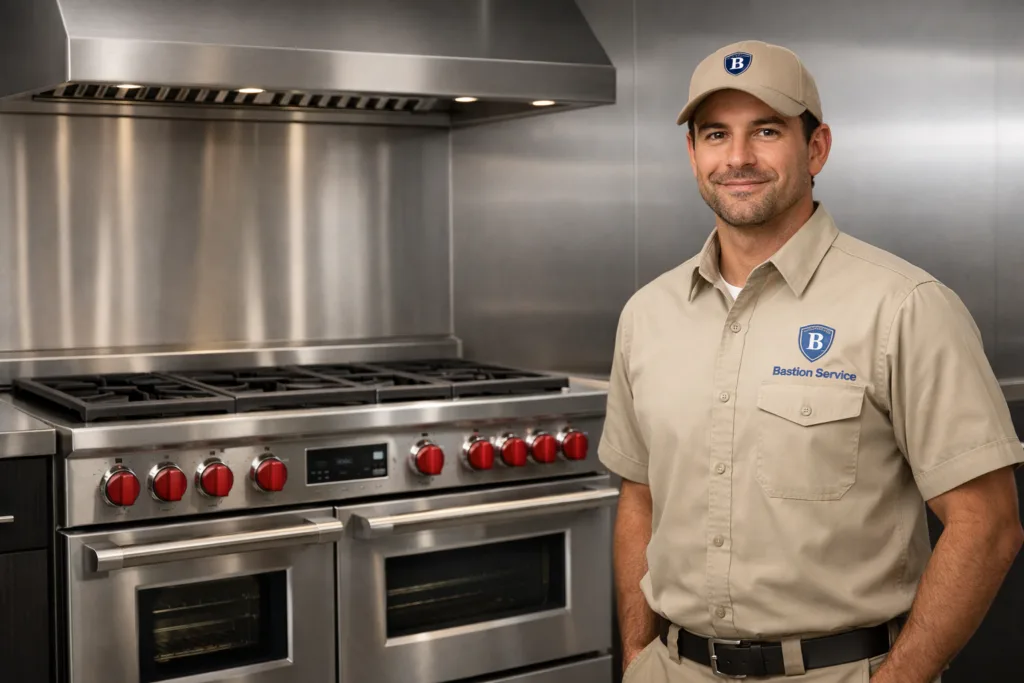




When a Wolf oven, range, or fryer begins missing temperature targets, failing to ignite, or dropping out during service, the right next step is to have the symptom pattern evaluated before the problem turns into a larger outage. For businesses in Venice, cooking equipment trouble can affect ticket times, food consistency, staffing flow, and daily output much faster than it appears on the surface. Bastion Service provides repair support focused on diagnosis, scheduling, downtime impact, and the most sensible path back to stable operation.
For specific equipment paths in Venice, review Wolf Oven Repair in Venice, Wolf Range Repair in Venice, and Wolf Fryer Repair in Venice.
What Wolf cooking equipment problems usually need repair attention?
Most business-use cooking equipment gives warnings before a full shutdown. Those warnings matter because they help narrow down whether the problem is tied to heating components, ignition parts, controls, sensors, gas-related operation, or a combination of faults developing under load.
Common repair-triggering symptoms include:
- Ovens that preheat slowly, run hot, run cold, or cook unevenly
- Ranges with burners that click, light late, fail to stay lit, or produce weak flame
- Fryers that recover heat too slowly, drift away from set temperature, or shut down during active use
- Controls that stop responding, lose settings, or behave inconsistently during service
- Equipment that needs repeated restarts to finish a shift
- Unexpected shutdowns that interrupt production without warning
These issues are more than minor annoyances in a working kitchen. Once staff start adjusting procedures to compensate for one unit, the repair problem is already affecting operations.
Heating and temperature issues that affect output
Temperature-related faults are among the most disruptive problems on Wolf cooking equipment because they often show up first as inconsistent results rather than complete failure. An oven may finish one batch correctly and the next one unevenly. A fryer may reach heat but take too long to recover between loads. A range may hold a pan at one setting one day and behave differently the next.
Oven symptoms
Slow preheat, uneven cooking, inaccurate temperature, and failure to maintain heat often point to problems involving sensors, controls, ignition-related heating behavior, or other components that are no longer responding correctly under repeated use. In a business setting, these issues usually show up as wasted product, longer cook cycles, or inconsistent quality across batches.
Range symptoms
With ranges, unstable burner heat can interfere with timing across the line. If one burner runs weak, another flares unevenly, or heat output changes under load, staff may begin shifting pans around to compensate. That kind of workaround often signals a repair need rather than a training or workflow problem.
Fryer symptoms
On fryers, heat recovery and temperature control are especially important. If oil temperature falls too far during use or recovery takes longer than normal, speed and consistency suffer immediately. A fryer that appears to be heating but cannot maintain normal operating rhythm often needs service before it becomes a full production bottleneck.
Ignition problems and startup failures
Delayed ignition, intermittent startup, clicking without normal ignition, and burners that fail to light reliably are all signs that the equipment should be checked promptly. These symptoms can involve igniters, flame sensing, switches, valves, or control-related problems. In active kitchen use, repeated attempts to start the equipment can complicate the original issue and make the downtime harder to plan around.
Ignition trouble is especially disruptive because it creates uncertainty. A unit that works only after several tries is not functioning normally, even if it eventually starts. For Venice businesses trying to keep service moving, that uncertainty can be just as damaging as a complete outage.
Burner, flame, and heat-delivery performance problems
Weak flame, uneven burner output, hot spots, and burners that drop out during use can all change how food is prepared from one station to the next. These symptoms may come from burner assemblies, contamination, valve issues, ignition hardware, or controls that are no longer regulating correctly.
What matters from a repair standpoint is that flame-related problems are not interchangeable. Two units may both show “poor burner performance,” but one may need attention at the burner level while another may be reacting to a deeper control or response issue. That is why symptom-based diagnosis matters before parts decisions are made.
Control faults and unexpected shutdowns
If a Wolf unit powers on inconsistently, loses settings, stops mid-cycle, or behaves erratically during use, the problem may involve controls, limit devices, wiring, switches, or heat-related component failure. Shutdown complaints are often the most urgent because they interrupt workflow without giving staff a reliable pattern to plan around.
In business kitchens, unpredictable shutdowns create more than lost time. They can force last-minute station changes, reduce menu capacity, and pull staff away from normal service tasks. If the equipment has begun restarting only after cooling down, after multiple attempts, or at random points in the day, it is usually time to schedule repair rather than keep testing it during production.
Equipment-specific service considerations
Wolf oven repair concerns
Ovens often show problems through slow preheat, uneven results, drifting temperature, or controls that stop responding during longer cook cycles. When output quality changes from batch to batch, the service question is not only whether the unit still heats, but whether it can hold reliable operating conditions over time. If the oven is affecting timing or consistency, repair planning should start before the issue becomes a full outage.
Wolf range repair concerns
Range calls commonly involve burner ignition failures, inconsistent flame, poor heating response, or controls that do not react as expected. Because ranges are used continuously in many kitchens, small burner problems can quickly grow into workflow delays. If staff are avoiding certain burners, relighting them repeatedly, or changing station assignments because of one unit, the equipment is already affecting productivity.
Wolf fryer repair concerns
Fryer issues often appear as slow recovery, failure to reach target temperature, temperature drift, intermittent shutdown, or ignition trouble. These symptoms can overlap, which is why a fryer that seems to have a simple heating problem may actually need a broader operating check. For businesses depending on steady throughput, even moderate fryer inconsistency is usually worth addressing quickly.
Signs it is time to schedule service instead of waiting
Some problems are easy to postpone when the equipment still works part of the time, but partial operation is often what causes the most disruption. It is usually time to schedule service when:
- The same fault shows up across multiple shifts
- Staff need repeated resets or restarts to keep a unit running
- Cooking times are changing even when recipes and procedures have not
- One station is carrying extra load because another unit is unreliable
- Product quality is being affected by unstable heat or uneven performance
- Supervisors are spending time monitoring equipment that should run normally
Those are practical signs that the problem has moved beyond inconvenience and into a repair decision that affects service continuity.
When continued use may make the repair more complicated
Not every malfunctioning unit should stay in operation until the appointment. If equipment is overheating, shutting down unexpectedly, failing to ignite consistently, or producing unreliable temperatures, continued use may add strain to related parts and make the final repair more involved.
This is especially important when staff are forced to compensate manually just to get through the day. A unit that can only remain in service with constant attention is no longer supporting the kitchen the way it should. A service visit can help determine whether limited use makes sense before repair or whether taking the unit out of production is the lower-risk option.
Repair versus replacement for Wolf cooking equipment
Not every service call ends the same way. Some problems are isolated and repairable without changing the broader role of the equipment in the kitchen. Others raise bigger questions because the unit has a pattern of repeat downtime, multiple control-related failures, or performance issues affecting several operating functions at once.
For businesses in Venice, the most useful decision is usually based on actual condition, expected downtime, and how critical the equipment is to daily production. If one oven, range, or fryer supports a key part of service, even a repairable issue may require faster scheduling and a more careful operating plan. If the fault appears isolated, repair may be the most cost-effective route. If breakdown history is growing, replacement planning may need to be part of the discussion.
What a service visit helps clarify
A repair appointment should do more than identify a failed part. It should help clarify whether the issue is isolated or wider, whether the equipment can remain in use before repair, how urgently scheduling should be handled, and what kind of interruption the business can expect if the problem is left unresolved.
If your Wolf cooking equipment in Venice is showing heating problems, ignition trouble, temperature drift, burner irregularities, shutdowns, or slower production performance, the practical next step is to schedule service and review the repair options before downtime expands into a larger operating problem.