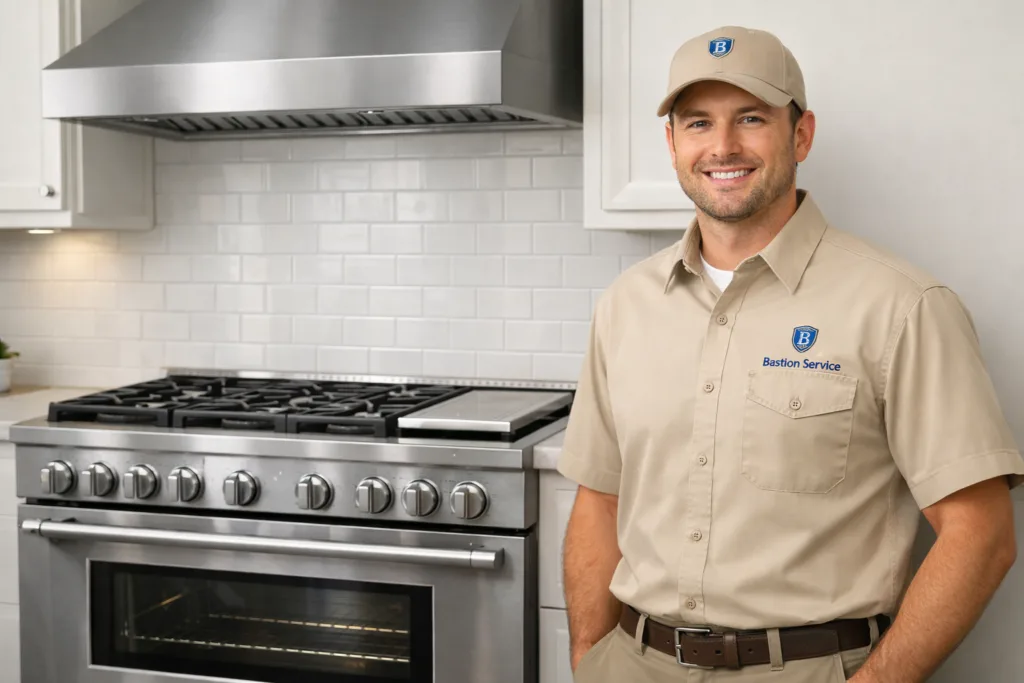
Small changes in burner flame, oven temperature, or control response often appear before a Thermador range fully stops working. Paying attention to the pattern helps narrow down whether the problem is tied to ignition, heat production, sensing, airflow, or electronic control. That distinction matters because two ranges can show the same cooking symptom for very different reasons.
Common Thermador range symptoms in Redondo Beach homes
Most range problems become obvious during everyday cooking. A pan takes too long to heat, the oven struggles to preheat, a burner clicks over and over, or the display behaves unpredictably. Looking at the symptom in context usually tells you more than the symptom alone.
Burner clicks but does not light
This is one of the most common complaints on gas ranges. In some cases, the cause is simple: a burner cap is slightly out of position, debris is blocking flame ports, or recent cleaning left moisture around the igniter. In other cases, the issue may involve the spark ignition system, switch harness, or gas flow to that burner.
If only one burner is affected, the fault may be localized to that burner assembly. If several burners show similar ignition trouble, the diagnosis may need to focus on shared ignition components or supply-related issues.
If you notice a persistent gas smell, stop using the appliance and address safety first before arranging repair.
Burner lights, but the flame is weak or uneven
A burner that ignites but does not heat properly can leave cookware with hot spots and longer cooking times. Uneven flame patterns may come from blocked burner openings, poor cap alignment, contamination, or a burner component that is no longer distributing gas correctly. Some homeowners first notice this when water takes longer to boil or sautéing becomes inconsistent from one side of the pan to the other.
Oven takes too long to preheat
Slow preheat is often the first sign of a heating-related problem. On a Thermador range, that can point to a weak igniter on gas models, a problem with a heating circuit on electric configurations, a temperature sensor issue, or a control problem that is not managing the heat cycle correctly. The oven may eventually reach temperature, but only after a much longer wait than normal.
Oven temperature is off during baking or roasting
If food is browning too fast, staying pale too long, or cooking unevenly from front to back, the range may not be maintaining temperature steadily. This can happen when the sensor is reading inaccurately, the control is cycling heat poorly, or the oven is losing heat through a damaged seal or door alignment issue. Temperature complaints are especially noticeable with baking, where small swings produce inconsistent results.
Oven will not heat at all
When the oven does not heat, the problem is usually more direct. Possible causes include a failed igniter, a broken heating component, a control failure, wiring trouble, or a power supply issue affecting the oven circuit. If the cooktop still works while the oven remains cold, that often helps isolate the problem to the oven system rather than the entire appliance.
Display, keypad, or controls act erratically
Flashing displays, unresponsive buttons, changing settings, or cooking cycles that stop unexpectedly often point to an electronic control issue. Sometimes the fault is in the interface itself; other times it involves wiring, power irregularities, or a failing board that becomes more unstable as it heats up. Intermittent behavior usually requires testing under real operating conditions rather than assumptions based on appearance.
Door does not close properly
A door issue can easily be mistaken for a heating failure. If the door is not sealing well, heat escapes and the oven may struggle to maintain temperature. Worn hinges, a damaged gasket, or a misaligned door can all affect performance. Homeowners often notice this as extended cook times, uneven browning, or excess heat around the front of the range.
Why the same symptom can have different causes
Ranges combine gas or electric heat systems, electronic controls, safety components, sensors, and mechanical parts. Because of that, one symptom does not always mean one part. Repeated clicking could be caused by moisture after cleaning, a misaligned cap, or a failed ignition component. Slow baking could point to an igniter, a sensor, a relay problem, or heat escaping from the oven cavity.
That is why symptom-based evaluation matters. It helps avoid replacing a visible part that is not actually causing the failure.
Signs the problem is getting worse
Some issues stay manageable for a short time, while others tend to progress quickly. These signs usually mean the range should be checked sooner rather than later:
- Preheat times are steadily getting longer
- A burner only lights after multiple attempts
- Clicking continues after ignition
- The oven temperature swings more than it used to
- The control panel randomly resets or loses input
- The door has to be pushed closed to keep heat in
- Error codes appear repeatedly during normal cooking
When a range still works intermittently, it is tempting to keep using it until it fails completely. The downside is that unstable ignition, inconsistent heating, and control interruptions can create a bigger repair later or make the appliance unreliable at the worst time.
When to stop using the range
Some symptoms go beyond inconvenience and call for immediate caution. It is best to stop using the range and arrange service if you notice any of the following:
- A strong or recurring gas odor
- Sparking or clicking that does not stop normally
- The oven overheats or burns food unexpectedly
- The appliance loses power during operation
- Scorching, smoke, or unusual electrical smells
- The control panel behaves unpredictably during cooking
These conditions can involve safety-related components or failures that affect normal operation in a more serious way.
Repair or replace: what usually makes sense?
For many households in Redondo Beach, repairing a Thermador range makes sense when the problem is isolated and the appliance is otherwise in good condition. Ignition parts, sensors, certain control-related issues, door hardware, and some heating failures are often practical to address when the rest of the range is performing well.
Replacement becomes a more realistic discussion when there are several major faults at once, a long history of repeat problems, or visible wear that goes beyond a single repair. The key question is not just the age of the range, but whether the current issue is specific and fixable or part of a broader decline in reliability.
What helps before a service visit
A few observations can make troubleshooting more efficient. It helps to note whether the issue affects the cooktop, the oven, or both; whether the problem is constant or intermittent; and whether it started after cleaning, a power interruption, or a recent cooking cycle with unusually high heat. If the display shows a code, write it down exactly as shown.
Simple details such as “front right burner clicks but does not ignite” or “oven reaches temperature, then drops during baking” are more useful than describing the range as simply not working right.
A focused repair approach for Redondo Beach homeowners
The best results usually come from matching the repair path to the actual behavior of the appliance in the home. A range that will not ignite needs a different process than one that heats unevenly or loses control settings mid-cycle. Once the symptom pattern is narrowed to the right system, it becomes much easier to judge whether the repair is straightforward, urgent, or no longer worthwhile.
For homeowners in Redondo Beach, that means less guesswork, fewer unnecessary part changes, and a better chance of restoring normal cooking performance without wasting time on the wrong fix.