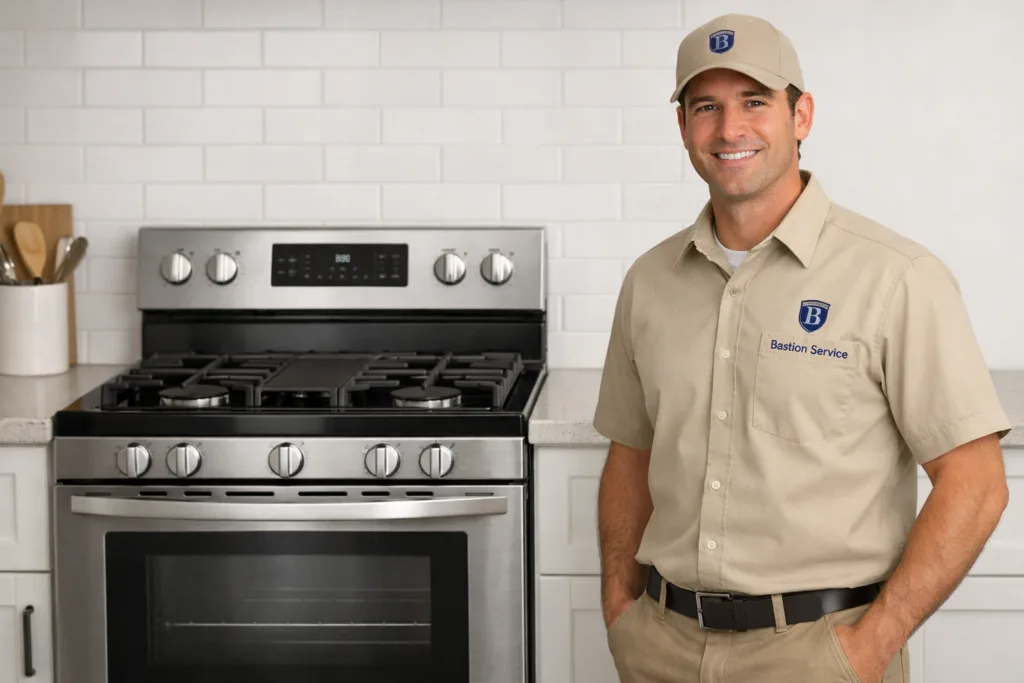
Range problems tend to disrupt the whole kitchen because the symptoms are not always limited to one cooking function. A surface burner can seem like the issue, only for the oven to show temperature drift or the controls to act unpredictably during the same week. With Whirlpool ranges, the most useful starting point is to match the symptom to the part of the system that is most likely failing, then confirm it with testing before any parts are replaced.
Common Whirlpool range problems seen in Redondo Beach homes
Most service calls fall into a few recognizable patterns. Knowing which pattern matches your appliance can help you decide how urgent the issue is and whether the range should stay off until it is checked.
Burner clicks but does not light
On gas models, repeated clicking usually means the ignition system is trying to spark but the burner is not lighting correctly. That can happen when the burner cap is misaligned, ports are blocked, moisture is trapped around the igniter, or the ignition switch is failing. If the clicking continues after the burner lights, the problem may involve the switch harness or moisture contamination that is keeping the igniter circuit active.
Burner heats weakly or unevenly
Electric surface elements that cycle too slowly, stay partially cold, or overheat may point to a worn element, a failing infinite switch, or a wiring issue at the receptacle. On gas burners, uneven flame or slow heating often comes from poor flame distribution, clogged burner openings, or a burner assembly problem. These issues can make everyday cooking frustrating because pans heat inconsistently even though the range still appears usable.
Oven takes too long to preheat
If preheat times have stretched out, the oven may have a weak bake element, a gas igniter that is drawing the wrong current, a sensor that is reading incorrectly, or a control problem that is not sending heat properly. Long preheat times are easy to ignore at first, but they often turn into underheating or incomplete cooking soon after.
Oven temperature is off
An oven that runs too hot, too cool, or swings widely during a bake cycle can produce uneven browning, undercooked centers, and unreliable roasting results. The cause may be sensor drift, a damaged seal, relay trouble on the control board, or a heating component that is no longer cycling correctly. In some cases, the oven can be recalibrated, but in others a component has already moved beyond normal adjustment range.
Display or controls stop responding
When the control panel goes blank, buttons stop responding, or error codes appear, the problem may involve incoming power, the electronic control, a failed membrane interface, or damaged wiring. A code can be helpful, but it is only a starting clue. The same code can sometimes be triggered by a different underlying failure, which is why proper diagnosis matters before ordering parts.
How symptom patterns help narrow the fault
Ranges combine several systems in one appliance: surface cooking, oven heating, temperature sensing, user controls, and sometimes spark ignition. Looking at the symptom pattern usually reveals whether the issue is isolated or whether it is affecting multiple functions.
- One burner only: often a localized burner, switch, igniter, or element issue.
- All surface burners affected: may suggest a broader power, supply, or control problem.
- Oven-only failure: more likely tied to bake, broil, igniter, sensor, or oven control components.
- Display and heating issues together: may indicate a shared control or electrical fault.
- Intermittent operation: often points to wiring, connection, relay, or moisture-related problems rather than a simple worn part.
This kind of symptom sorting helps avoid the common mistake of replacing the first visible part without confirming why it failed.
When the range should not be used
Some range problems can wait a short time for service, but others should be treated as a stop-use issue. If the appliance trips power, sparks visibly, overheats, fails to regulate burner heat, or produces a persistent gas smell, it should be shut off until it is inspected.
For gas models, repeated clicking without ignition should be evaluated before regular use continues. If you smell gas strongly or continuously, stop using the range right away and address the gas safety issue first. For electric models, a burner that will not turn down or an oven that overheats can create a safety risk and should not be ignored.
What causes uneven baking in a Whirlpool range
Uneven baking is one of the most common complaints because the oven still turns on, yet food quality drops noticeably. Cookies brown more on one side, casseroles take longer than expected, and baked goods may look done on top while staying undercooked in the center.
Possible causes include:
- a weakening bake or broil element
- a gas igniter that is no longer opening the valve consistently
- a temperature sensor sending inaccurate readings
- poor heat circulation inside the cavity
- a worn or damaged door gasket allowing heat loss
- control board relay issues affecting heat cycling
Because several of these problems can create nearly identical cooking results, uneven baking is a good example of why a diagnosis-first visit is more useful than guessing based on one symptom alone.
Repair or replace: what usually makes sense
Many Whirlpool range problems are worth repairing when the fault is limited to a burner component, heating element, igniter, sensor, switch, or a single control-related issue. These repairs are often more practical than replacing the appliance, especially when the rest of the range is in solid condition.
Replacement becomes more likely when the unit has multiple major failures at once, recurring electrical problems, severe wear, or a repair cost that is hard to justify against the overall age and condition of the appliance. If the range has become unreliable across several functions, it is reasonable to compare the repair path with replacement instead of focusing only on the immediate symptom.
What homeowners can check before scheduling service
A few basic checks can sometimes rule out a simple setup issue:
- Make sure burner caps are seated correctly on gas models.
- Look for visible debris around burner ports.
- Confirm the range is receiving power and that no breaker has tripped.
- Check whether the oven door closes fully and seals evenly.
- Note any error code exactly as it appears.
- Pay attention to whether the problem affects one function or several.
These observations can make the service process faster, but they should not replace electrical or gas-system testing when the problem persists.
What to expect from Whirlpool range repair in Redondo Beach
A well-handled service visit should identify whether the problem is confined to ignition, surface heating, oven heating, temperature sensing, or the electronic controls. From there, the next step is much easier to judge: targeted repair, further parts inspection, or a recommendation not to invest further in the appliance.
For households in Redondo Beach, the goal is not just getting the range to turn back on. It is restoring normal, predictable cooking performance so daily meals are not interrupted by weak burners, slow preheat, clicking ignition, or temperature problems that keep returning.