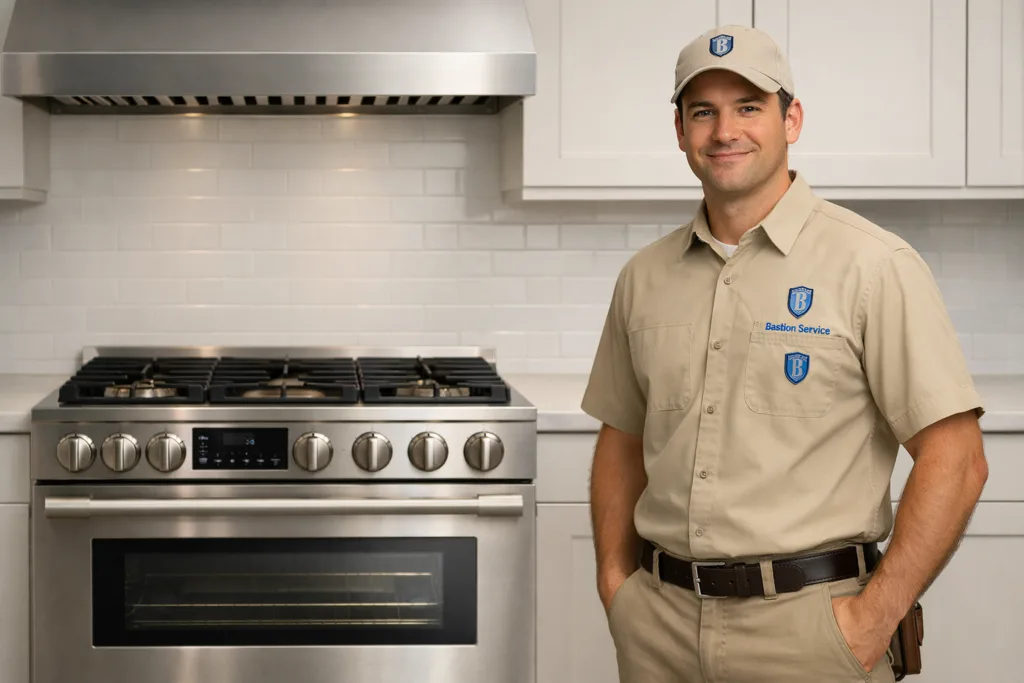
Common Monogram range problems in Redondo Beach homes

Range problems usually show up first in everyday cooking. A burner may start clicking after it lights, the oven may need much longer to preheat, or recipes that used to come out reliably may suddenly bake unevenly. On a Monogram range, those changes often point to a specific failed part or system issue, but the symptom and the root cause are not always the same thing.
Burners not lighting or clicking continuously
If a surface burner clicks repeatedly, lights late, or does not ignite at all, the cause may be as simple as moisture or burner cap misalignment, or it may involve the spark ignition system itself. Food spills, cleaning residue, and worn ignition components can all interfere with normal burner operation.
Watch for patterns that help narrow it down:
- One burner misbehaves while the others work normally
- Clicking starts after cleaning or boiling over
- The burner lights only after several tries
- The igniter clicks, but there is no flame
- The clicking continues even after the flame is on
If there is a strong or persistent gas smell, stop using the appliance until the issue is addressed. That is a safety concern, not just a convenience issue.
Oven not heating properly
An oven that runs cold, overheats, takes too long to preheat, or cannot hold a steady temperature can affect everything from weeknight dinners to holiday baking. In gas models, a weak igniter is a common reason for slow or incomplete heating. In other cases, the issue may involve a temperature sensor, control board, relay, or another component in the heating circuit.
Homeowners often notice this problem through food results before they notice it on the display. Cookies may brown unevenly, casseroles may stay undercooked in the center, or roasting times may start drifting far beyond what was normal before.
Uneven baking and temperature swings
Some temperature variation is normal during oven cycling, but wide swings are not. If one rack cooks much faster than another, the rear of the oven burns food, or dishes come out differently each time despite the same settings, the range may have a calibration problem, sensor issue, convection problem, or heat distribution fault.
This is especially frustrating with a premium range because the expectation is consistency. When the oven stops delivering repeatable results, the problem is usually worth diagnosing rather than working around.
Control panel, display, or keypad problems
Electronic control issues can appear in several ways. The display may go blank, buttons may stop responding, settings may reset, or the oven may start beeping or showing erratic behavior without a clear reason. Some control faults are isolated to the interface, while others involve power supply problems or internal board failures.
Because these symptoms can overlap, replacing parts based on guesswork can get expensive quickly. A proper diagnosis is often the difference between a targeted repair and a string of unnecessary part changes.
Door, fan, and self-clean related issues
If the oven door will not close fully, heat can escape and cooking performance can drop. If the convection fan becomes loud, intermittent, or stops running, airflow inside the oven may no longer be even. Some ranges also develop new problems after a self-clean cycle, especially if high heat puts extra stress on controls, door lock components, or nearby electronics.
These issues may seem secondary compared with a burner or heating failure, but they can still affect how safely and consistently the range operates.
Why symptom patterns matter on a Monogram range
Two ranges can show the same symptom and need completely different repairs. A burner that will not light may have a wet ignition area, a cracked igniter, a faulty spark module, or a switch problem. An oven that seems too cool may have a weak igniter, a drifting sensor, a control issue, or a door that is leaking heat. That is why symptom-based evaluation matters.
The most helpful service approach starts by identifying when the problem happens, whether it affects one function or several, and whether the change is constant or intermittent. For homeowners in Redondo Beach, that leads to a more realistic repair decision and helps avoid replacing parts that were not actually causing the failure.
Signs your range should be serviced soon
Some range issues are annoying but manageable for a short time. Others tend to get worse with continued use. If performance has clearly changed, scheduling service sooner can help prevent a minor issue from turning into a larger one.
Common signs that should not be ignored include:
- Burners that need repeated attempts to ignite
- Clicking that does not stop after ignition
- Preheat times that have become noticeably longer
- Food repeatedly cooking too fast, too slowly, or unevenly
- Controls that freeze, reset, or do not respond correctly
- Unusual fan noises, buzzing, or relay sounds
- An oven door that does not close or seal properly
When a range is overheating, behaving unpredictably, or showing ignition trouble, continued use can place more strain on related components. In those cases, prompt attention is often the better choice.
Repair or replacement: what usually guides the decision
Most homeowners do not make this decision based on age alone. A Monogram range may still be worth repairing if the issue is isolated and the rest of the appliance is in solid condition. On the other hand, if the range has several unrelated failures, recurring electronic problems, or broader wear affecting multiple functions, replacement may start to make more sense.
Useful factors include:
- Whether the problem is limited to one repairable component
- How the appliance has performed overall in recent years
- Whether the same symptom has returned after past repairs
- The condition of the burners, oven cavity, controls, and door system
- Whether normal performance can likely be restored without stacking major repairs
The goal is not to push one outcome over the other, but to base the decision on the actual condition of the range and the specific failure involved.
What to note before scheduling Monogram range repair
If you are trying to decide whether service is appropriate, a few details can make the next step easier. Try to note exactly what the range is doing, whether the issue affects the cooktop or oven or both, and whether the problem is constant or intermittent. That information can be more useful than a general description like “not working right.”
Helpful details include:
- Which burner or oven function is affected
- Whether the issue started suddenly or gradually
- If the problem began after cleaning, a spill, or a self-clean cycle
- Any unusual sounds, smells, or display behavior
- Whether performance changes after the appliance warms up
Even small observations can help connect the symptom to the right repair path.
How range issues show up in daily household use
In many Redondo Beach households, a range handles quick breakfasts, stovetop meals, baking, and longer oven use throughout the week. Because it gets used so often, performance changes are usually noticed quickly. A burner that once lit instantly may begin hesitating. An oven that used to bake evenly may start leaving one side underdone. Those changes are often the clearest early warning that service is needed.
When a Monogram range no longer responds the way it used to, the most practical next step is to have the exact symptom evaluated and determine whether a focused repair can restore normal cooking performance.