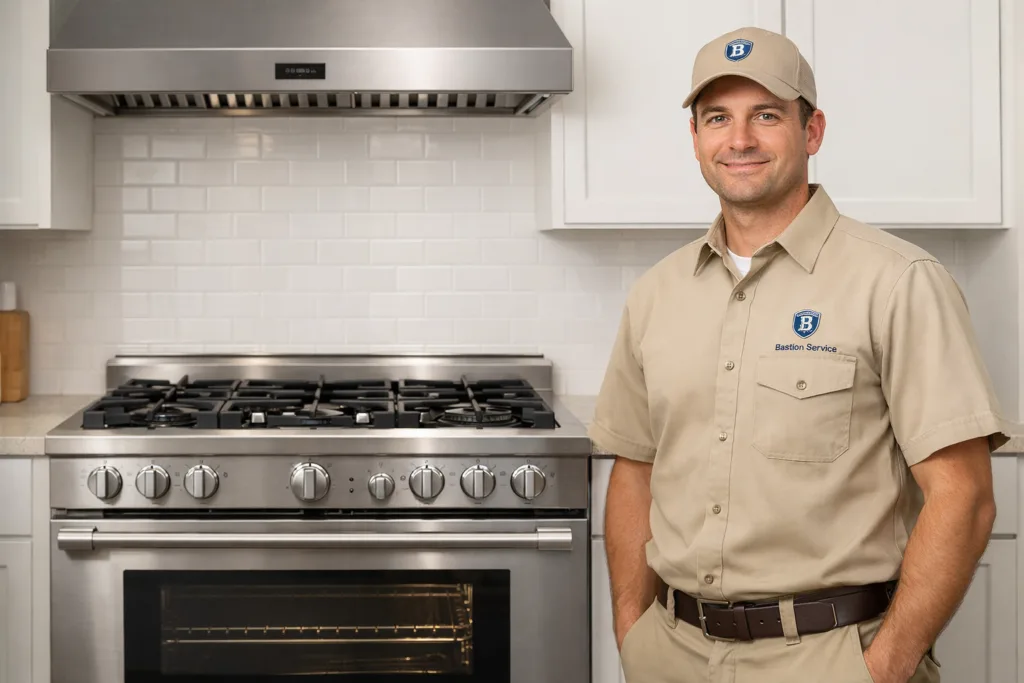
Range problems tend to show up in ways that disrupt normal cooking fast: a burner that clicks without lighting, an oven that takes too long to preheat, or temperatures that seem off from one meal to the next. With a Thermador unit, those symptoms can come from ignition components, sensors, controls, burner hardware, or power and gas-related faults, so the most useful next step is to match the repair to the exact pattern instead of guessing.
Common Thermador range symptoms and what they may indicate
Many household range issues fall into a few recognizable categories. Paying attention to when the problem happens, whether it affects one function or several, and whether it is getting worse can help narrow down the likely repair path.
Burner clicks but does not ignite
If a surface burner clicks repeatedly and fails to light, the issue may be as simple as burner cap misalignment or moisture around the igniter area, but it can also point to a worn igniter, spark module trouble, or a fault affecting gas flow to that burner. When only one burner is affected, the problem is often isolated to that section of the range. When multiple burners show the same behavior, shared ignition components become more likely.
Repeated clicking without normal ignition is not something to ignore. Delayed lighting can make cooking inconvenient and can also point to a condition that should be corrected before regular use continues.
Burner lights, but flame is weak or uneven
A burner that ignites but does not heat properly may have blocked ports, a mispositioned cap, valve-related issues, or an ignition flame problem that is not producing a stable burn pattern. Homeowners often notice this when pans heat unevenly or boiling takes much longer than expected.
If cleaning does not correct the issue, the range may need service to determine whether the problem is with the burner assembly itself or with a related control or supply component.
Oven will not heat or heats very slowly
When the oven does not start heating, struggles to preheat, or never reaches the selected setting, likely causes can include a failed igniter on gas models, a bad sensor, an element problem on electric configurations, or an electronic control fault. This often shows up first as long cook times, pale baked goods, or food that is still underdone even after a full cycle.
Because several parts can create similar complaints, this is one of the most common situations where replacing a part by assumption leads to wasted time and money.
Oven temperature is inaccurate
If the oven heats, but cooks too hot, too cool, or unevenly, the issue may involve temperature sensing, calibration drift, relay behavior, or control response. Sometimes the difference is subtle at first and only becomes obvious during baking, roasting, or longer cook cycles.
Inconsistent temperature control can be especially frustrating in a home kitchen because the range appears to work, yet results keep changing from meal to meal.
Controls, display, or settings behave unpredictably
Some Thermador range problems are less mechanical and more electronic. You may see flashing codes, nonresponsive buttons, canceled cycles, or settings that do not match what the appliance is actually doing. In other cases, the display works, but the oven or burner response is intermittent.
These symptoms can overlap with heating complaints, which is why proper testing matters. A visible symptom on the control panel does not always mean the panel itself is the failed part.
Signs the problem may be getting worse
A range rarely fixes itself. If any of the following patterns are happening more often, it is usually a sign that the underlying fault is progressing:
- Ignition takes multiple tries before a burner lights
- The oven preheats slower than it used to
- Food is suddenly overcooked or undercooked at familiar settings
- Clicking continues after flame appears
- Error messages come and go between normal use
- Controls respond inconsistently or reset unexpectedly
When the symptom changes from occasional to routine, the repair often becomes easier to justify because reliability has already started to drop.
When to stop using the range until it is checked
Some issues are inconvenient but manageable for a short time. Others are better treated as stop-use problems. It is smart to pause normal operation if you notice delayed ignition, an oven that overheats, burners that will not regulate properly, or electrical behavior that seems erratic.
Households in Mid-City often try basic cleaning or a reset first, which is reasonable for minor performance issues. But if the same symptom returns right away, there is usually a failed component or control problem that will not be solved by continued troubleshooting at home.
How diagnosis helps narrow the repair path
Good range service is not just about identifying one bad part. It also helps answer the practical questions homeowners care about most:
- Is the fault limited to one burner or does it affect the whole appliance?
- Is the issue tied to ignition, heating, sensing, or controls?
- Can the range still be used safely while waiting for repair?
- Is this likely to be an isolated failure or part of broader wear?
That matters with premium appliances because symptom overlap is common. A burner problem can look electrical, a temperature complaint can actually be ignition-related, and a control issue can imitate a heating failure.
Repair or replacement: what usually makes sense
For many Mid-City homeowners, the decision comes down to the age and condition of the range, the scope of the current failure, and whether this is the first major problem or one of several. Repair is often worthwhile when the appliance is otherwise in solid shape and the issue is tied to a serviceable component such as an igniter, sensor, burner assembly, or control-related part.
Replacement becomes more likely when performance problems are spreading across multiple systems, when the range has become unreliable over time, or when the cost of restoring it starts to approach the value of the appliance. The key is knowing whether the present symptom points to a focused repair or a wider decline in condition.
What homeowners can note before service
If service is needed, a few details can make the problem easier to isolate. Try to note:
- Whether the issue affects one burner, all burners, the oven, or multiple functions
- Whether the problem is constant or intermittent
- Any recent power outage, cleaning event, spill, or unusual noise
- Whether the display shows an error code
- If the problem happens during preheat, after the range gets hot, or only on certain settings
Those observations often help connect the symptom to the right component faster and reduce guesswork during the visit.
Focused Thermador range repair for Mid-City homes
A household range should heat predictably, ignite reliably, and respond normally every time it is used. When it does not, the best outcome usually starts with finding the actual cause of the symptom rather than treating every complaint as the same kind of failure.
For Thermador range repair in Mid-City, that means looking closely at burner behavior, oven performance, temperature control, and electronics so the repair path fits the appliance condition and the way the problem is showing up in the home.