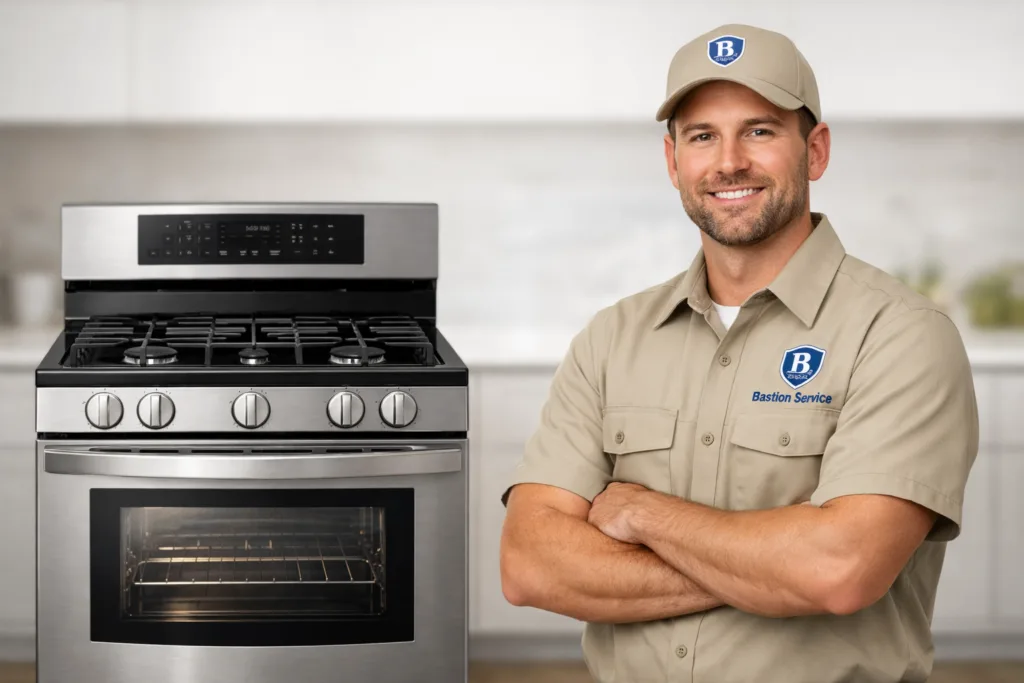
Cooking problems usually show up in patterns, and those patterns help narrow down what is actually failing on an LG range. A surface burner that clicks every time but lights only occasionally points in a different direction than an oven that preheats slowly, overshoots the set temperature, or never reaches cooking temp at all. Noticing exactly when the issue happens, whether it affects one function or several, and whether the problem is getting worse can make the repair path much more straightforward.
Start with the symptom, not the part
Many range issues look obvious from the outside but have more than one possible cause. Replacing a visible part without confirming the failure can waste time and money, especially when the real issue is in the switch, sensor, control, wiring, or power supply instead. For Mid-City homeowners, the most useful approach is to match the symptom pattern to the affected system before deciding whether repair is worthwhile.
Surface burners that click, won’t light, or heat unevenly
On gas models, repeated clicking often means the ignition system is trying to light the burner but something is interrupting normal ignition. That may be caused by moisture after cleaning, food debris around the burner head, misalignment of the cap, a weak spark, or a switch problem that keeps the igniter firing. If one burner is affected and the others are normal, the fault is often isolated to that burner assembly or its related ignition components.
On electric models, a burner that stays cool, heats only partway, or cycles strangely may have a worn element, a failing infinite switch, a damaged receptacle, or wiring damage under the cooktop. If the burner heats but not consistently, that often suggests a control issue rather than a completely open element.
- Clicking without ignition usually points to spark or burner assembly problems.
- A burner that lights late may have contamination or poor flame carryover.
- A burner that will not reduce heat may indicate a failed control switch.
- One weak electric burner can mean the issue is local, not whole-range.
Oven not heating, heating slowly, or cooking unevenly
When the oven is the problem, the details matter. If bake does not work but broil still does, the fault may be limited to the bake element, igniter, relay, or related circuit. If both bake and broil are affected, the diagnosis often shifts toward the sensor, control, wiring, or incoming power. Slow preheat can come from a weakening igniter on gas models or an underperforming heating element on electric models, but it can also be caused by temperature sensing and control errors.
Uneven baking is another complaint that deserves a closer look. Food that browns heavily on one side, bottoms that scorch before the center is done, or temperature swings that seem larger than normal can point to a failing sensor, weak heating component, poor convection performance on equipped models, or calibration issues. Those symptoms are frustrating because the oven may appear to be working while still producing unreliable results.
Display, keypad, and power problems
Electronic complaints can be more confusing because they overlap. A display that lights up but does not respond correctly may involve the control panel, user interface, or main board. A range that shuts off mid-cycle could have a control issue, a failing relay, overheating protection problem, or an unstable power connection. If the unit appears completely dead, the cause may be as simple as a breaker or as specific as a terminal block, fuse, cord connection, or internal board failure.
Error codes can be helpful, but they are not always a final diagnosis by themselves. In many cases, the code identifies the system where the fault is being detected, not necessarily the exact component that needs replacement.
Signs the range should not keep being used
Some range problems are inconvenient but not immediately hazardous. Others are worth stopping right away until the appliance is checked. If a burner keeps sparking after ignition, a surface element overheats, the oven temperature becomes wildly unpredictable, or the controls act erratically, continued use can increase wear and may create a safety concern.
Gas-related symptoms deserve extra caution. If there is a strong or persistent gas smell, stop using the appliance and address the gas concern first through the proper emergency or utility channel before arranging appliance service. If there is no gas smell but ignition is delayed or inconsistent, that still should not be treated as normal operation.
- Stop using a burner that will not turn down or shut off correctly.
- Pause oven use if temperatures are far above or below the set point.
- Do not keep resetting a range that loses power during cooking cycles.
- Repeated ignition problems should be checked before daily use continues.
What usually determines whether repair makes sense
Most homeowners are deciding between two practical outcomes: repair the current LG range or start planning for replacement. That decision often depends on the number of failed parts, the condition of the appliance overall, and whether the problem is isolated or part of a broader pattern.
Repair is often reasonable when the issue is limited to one burner system, one heating component, a sensor, an igniter, or a specific control-related fault while the rest of the range remains in good shape. Replacement starts to make more sense when there are multiple major failures, recurring electronic problems, visible wear across several systems, or a repair estimate that is hard to justify for the age and condition of the appliance.
For households in Mid-City, the goal is usually simple: restore predictable daily cooking without ending up in a cycle of repeated breakdowns. A careful diagnosis helps answer whether the current issue is a one-time repair or a sign of broader decline.
Common clues that help narrow down the problem
Before service is scheduled, a few observations can be genuinely helpful. Homeowners do not need to disassemble anything, but noting the behavior can make the issue easier to pinpoint.
- Does the problem affect one burner, all burners, the oven, or the full range?
- Is the issue constant, or does it happen only after cleaning or heavy use?
- Does broil work when bake does not, or vice versa?
- Is there an error code, unusual clicking, slow preheat, or overheating?
- Did the failure begin suddenly, or has performance been declining over time?
These details matter because two ranges with the same complaint can need completely different repairs. An oven that “isn’t heating” may have a failed element on one unit and a control or sensor problem on another. A burner that “won’t light” may need cleaning and realignment in one case but ignition component replacement in another.
Why accurate diagnosis matters on LG range repairs
LG cooking appliances can combine ignition systems, heating components, sensors, and electronic controls in ways that make symptom overlap common. That is why exact-fit diagnosis matters more than guessing from the most visible sign. It helps avoid replacing the wrong part, reduces the chance of repeat visits for the same complaint, and gives homeowners a better basis for deciding whether to move forward with repair.
When an LG range in Mid-City starts showing unreliable burner performance, uneven oven temperatures, or control problems, the best next step is to identify the failing system, address any safety concerns first, and then weigh the repair against the overall condition of the appliance. That approach usually leads to a better long-term result than continuing to use a range that is already showing unstable cooking behavior.