
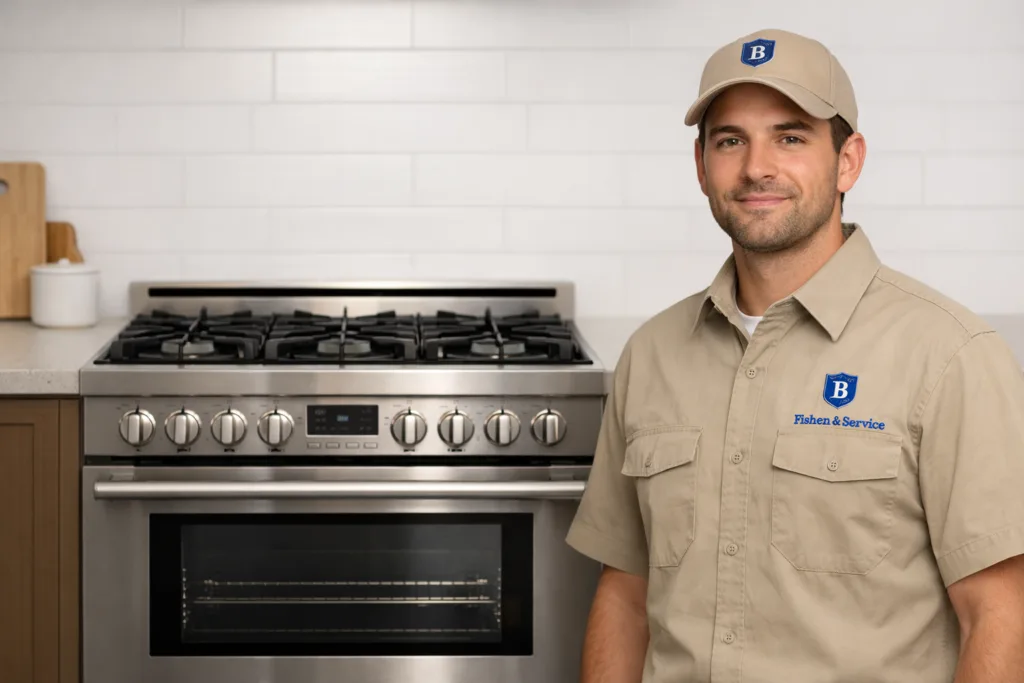




Common Fisher & Paykel range problems in Mid-City homes

Range trouble usually shows up in the middle of everyday cooking: a burner that keeps clicking, an oven that takes too long to preheat, or temperatures that seem to change from one meal to the next. With Fisher & Paykel ranges, those symptoms can come from several different sources, so it helps to look at the pattern before assuming a single part is to blame.
Related Fisher & Paykel and range service paths in Mid-City include Fisher & Paykel Appliance Repair in Mid-City, Range Repair in Mid-City, and Fisher & Paykel Refrigerator Repair in Mid-City.
A surface burner that will not light may be dealing with moisture, burner cap misalignment, blocked ports, a worn spark component, or a switch problem. An oven that bakes unevenly might have a weak igniter, a failing bake element, a temperature sensor issue, or a control problem affecting how heat is regulated. When the same symptom keeps returning, that usually points to a fault that needs more than a simple reset or cleaning.
Symptom-based signs that help narrow down the cause
Burners click but do not ignite
Continuous clicking often means the ignition system is trying to light gas but not completing the process correctly. Sometimes the issue is as simple as residue around the burner base or a cap that is not seated properly. In other cases, the spark switch may keep firing, or the burner assembly may not be directing gas evenly enough for ignition.
If one burner is affected while the others work normally, the problem may be isolated to that burner assembly. If several burners show the same behavior, the issue may involve shared ignition components or a broader electrical fault. Repeated clicking paired with delayed ignition should not be ignored, especially if you notice any lingering gas smell.
Oven is slow to preheat or does not reach temperature
When preheat takes much longer than usual, the range may still appear to be working while cooking results steadily get worse. Foods may need extra time, baked goods may rise poorly, or roasting temperatures may feel unpredictable. On many ranges, that symptom can point to an igniter that is too weak to open the gas valve properly, a heating element that is failing under load, or a sensor that is no longer reading oven temperature accurately.
Some homeowners first notice this as “it cooks fine sometimes, but not always.” That inconsistency matters. Intermittent heating problems often become more obvious over time and can eventually lead to a complete no-heat condition.
Food cooks unevenly or the oven overheats
Uneven baking can come from poor temperature regulation, heat distribution problems, or partial component failure. One rack may brown too quickly while another remains pale. A casserole may look done on top but stay undercooked in the center. These signs often suggest that the oven is cycling incorrectly or not maintaining the set temperature.
Overheating is a different issue, but it also points to temperature control problems. A faulty sensor, stuck relay, or control failure can cause the oven to run hotter than the display suggests. That is worth addressing quickly because excess heat can affect surrounding components as well as cooking results.
Display or controls do not respond normally
If the display is blank, buttons do not respond, or settings change unexpectedly, the problem may involve the user interface, the main control, wiring connections, or incoming power. A range that resets during use or loses functions intermittently can be especially frustrating because the fault may seem random even when it follows a pattern.
Power-related issues deserve prompt attention if the oven shuts off mid-cycle, the clock resets on its own, or multiple functions stop working together. Those clues often help separate a single failed feature from a wider electrical issue inside the appliance.
Door and seal problems affect performance
Not every temperature complaint starts with a heating part. A worn gasket, loose hinge, or door that no longer closes tightly can let heat escape and make the oven work harder than it should. In daily use, this often shows up as longer cooking times, inconsistent browning, or heat that seems to leak from the front of the oven.
Because those symptoms can overlap with sensor or control issues, it helps to evaluate the door and seal along with the heating system instead of treating them as separate concerns.
When to stop using the range and schedule service
Some range problems are inconvenient but stable for a short time. Others should be treated as a reason to stop using the appliance until it is checked. If a burner repeatedly fails to ignite, the oven overheats, the controls behave unpredictably, or the unit loses power during operation, it makes sense to pause normal use and have the problem diagnosed.
Stronger warning signs include persistent gas odor, sparking where it should not occur, visible wiring damage, or evidence that a burner is releasing gas without lighting properly. In those situations, safety matters more than finishing the next meal.
Why repeated use can make range repairs larger
Many cooking appliance failures start small. A weak igniter can become a no-heat call. A burner that clicks occasionally can turn into a switch or ignition-system issue that affects everyday use. A temperature problem that first seems minor can put added strain on controls and related components as the range keeps trying to compensate.
That is why recurring symptoms are worth taking seriously. Even when the appliance still works part of the time, continued use can increase wear, hide the original source of the problem, and make the final repair less straightforward.
Repair or replace: what usually makes the most sense
Many Fisher & Paykel range issues are repairable when the failure is limited to ignition parts, heating components, sensors, switches, door hardware, or an accessible control-related part. Repair tends to make the most sense when the appliance is otherwise in solid condition and the problem is clearly defined.
Replacement becomes a more realistic discussion when the range has several major faults at once, when the condition suggests broader age-related wear, or when the total repair picture starts approaching the value of keeping the appliance. For homeowners in Mid-City, the best decision usually comes down to the overall condition of the range, the exact failed system, and whether the appliance still has good remaining life after the repair.
What a thorough service visit should evaluate
A useful service appointment should start with how the problem appears in real household use: whether the burner clicks every time or only sometimes, whether preheat is slow on certain settings, whether temperature drift happens during longer bake cycles, and whether control issues affect one function or several. Those details often reveal more than the symptom name alone.
From there, the range should be checked for the specific cause rather than treated like a generic parts-swap problem. Separating burner ignition issues from oven heating faults, and electrical problems from wear-related failures, helps determine whether the repair is simple, safety-related, or part of a larger repair-versus-replacement decision.
What Mid-City homeowners can monitor before service
If the range is still safe to observe, it helps to note exactly what happens and when. Pay attention to whether the issue affects all burners or only one, whether the oven reaches temperature and then falls off, whether the display resets, and whether the problem appears after cleaning, heavy use, or moisture around the cooktop. Small details can shorten the path to the right diagnosis.
It is also helpful to notice changes in sound, smell, or timing. A longer delay before ignition, a louder-than-usual clicking pattern, or a preheat cycle that suddenly adds ten or fifteen minutes can all point to a component that is weakening rather than failing all at once.
Choosing service based on the symptom, not guesswork
The most cost-effective repair path usually starts with identifying the failed system accurately. That keeps the focus on the actual cause of the problem instead of replacing parts based on a broad symptom like “not heating” or “won’t light.” For a Fisher & Paykel range in Mid-City, that approach gives homeowners a clearer sense of what failed, what needs attention now, and whether the appliance is worth repairing for the long term.





