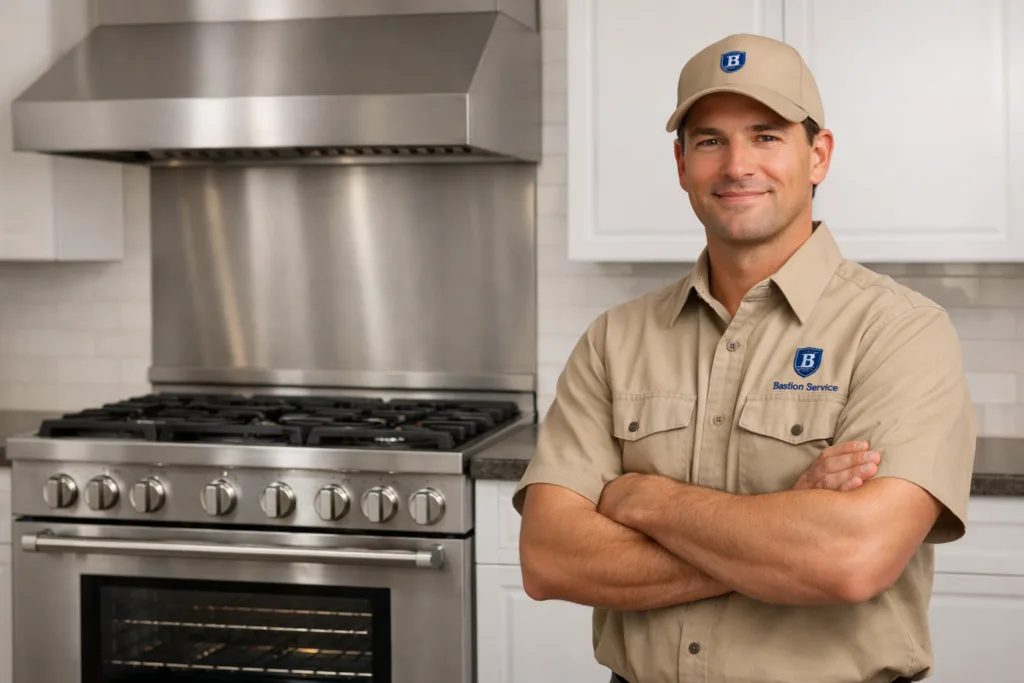
Range problems rarely stay confined to one meal. A burner that clicks over and over, an oven that takes too long to preheat, or temperature swings that ruin familiar recipes usually point to a fault that should be tested before more parts are stressed or cooking results get worse.
How Thermador range problems usually show up in everyday use
Most homeowners first notice a range issue through performance changes rather than a total shutdown. Water stops boiling as quickly as it used to. Roasted foods come out pale on one side and overdone on the other. A burner lights only after several tries. The display may still turn on, but the appliance no longer behaves predictably.
On a Thermador range, those symptoms can involve the ignition system, burner assemblies, oven sensor, heating circuit, convection components, control interface, or wiring. Because several different failures can create similar symptoms, a symptom-based diagnosis is usually the fastest way to identify what actually needs repair.
Common Thermador range issues and what they may mean
Burner clicks but will not ignite
This often happens when the burner cap is out of position, the ports are blocked, moisture is affecting ignition, or the spark system is not firing correctly. If the clicking continues after the flame appears, the issue may involve the ignition switch or another part of the spark system rather than the burner itself.
One burner failing while others work normally usually points to a localized burner or ignition problem. If several burners act up at once, the diagnosis may shift toward shared electrical or control-related causes.
Burner lights, but the flame is weak or uneven
An uneven flame can interfere with simmering, pan heating, and overall cooking control. Common causes include clogged burner ports, burner head alignment issues, regulator-related performance problems, or wear in the burner assembly. Homeowners sometimes notice this first with cookware that suddenly develops hot spots or takes much longer to heat.
Oven does not heat or heats too slowly
When the oven stays cold or struggles to preheat, the fault may involve the igniter, bake system, broil system, sensor, wiring, or electronic control. Some ranges begin heating but stall well below the selected temperature. Others appear to preheat, then lose heat during baking. These differences matter because they help narrow down whether the issue is a heat source problem, a sensing problem, or a control problem.
Oven temperature is off even though it still runs
If food consistently bakes too fast, too slowly, or unevenly, the range may not be regulating temperature properly. A weak sensor, convection fan issue, door seal problem, or calibration drift can all affect oven performance. This type of fault tends to build gradually, which is why many homeowners notice it only after several disappointing cooking cycles.
Control panel problems or flashing errors
Thermador ranges rely on electronic controls to manage timing, temperature, and cooking modes. If the display becomes unresponsive, settings change unexpectedly, or error codes appear, the issue may involve the control board, keypad, user interface, or incoming power. Since these faults can affect both oven and cooktop functions, testing should confirm the exact source before replacement decisions are made.
Signs the issue is becoming more urgent
Some range problems are inconvenient but manageable until a scheduled appointment. Others should be addressed more quickly because they can disrupt safe operation or lead to added wear. It is wise to stop putting off service when you notice:
- repeated ignition failure on the same burner
- clicking that continues after the burner lights
- an oven that cannot reach or maintain cooking temperature
- temperature swings that affect every bake cycle
- intermittent shutdowns or loss of power at the controls
- burners that work only occasionally or respond inconsistently
If the range trips power, behaves unpredictably, or starts showing multiple symptoms at once, the problem may be larger than a single worn part.
When to stop using the appliance right away
There are situations where continued use is not worth the risk. If you notice a strong or persistent gas smell, do not keep testing burners or trying to relight the appliance. Stop using the range and follow the appropriate gas safety steps before arranging repair.
It is also smart to stop using the oven or cooktop if ignition becomes erratic, controls do not respond normally, or the appliance shuts down unexpectedly during operation. Those symptoms can move beyond cooking inconvenience and into a safety concern.
Repair or replace: what usually makes sense
Many Thermador range problems are worth repairing when the issue is isolated and the appliance is otherwise in solid condition. Burner ignition faults, sensor failures, control issues, and certain heating problems often fall into that category. A targeted fix is usually easier to justify when the diagnosis points to one main failure rather than several overlapping ones.
Replacement becomes more reasonable when the range has a pattern of recurring breakdowns, multiple major systems are failing together, or the repair path keeps expanding after testing. Age matters, but it should not be the only factor. A well-built range with one confirmed fault may still be a practical repair, while a newer unit with repeated control and heating issues may deserve a harder look.
What a useful service visit should clarify
Homeowners in Del Rey usually want straightforward answers: what is failing, how it affects cooking performance, whether the range should be used in the meantime, and whether the repair is likely to solve the problem without turning into repeat service. The visit should identify the failed component or system and explain the next step in plain language.
That matters most with symptoms that can be misleading. For example, an oven that appears to heat can still have an ignition or sensing problem, and a clicking burner does not always mean the igniter itself is the only issue. Testing helps separate a simple adjustment or part replacement from a broader electrical or gas-related fault within the appliance.
Thermador range repair for Del Rey households
In a busy kitchen, a range needs to do more than turn on. It needs to ignite reliably, hold temperature, and respond the same way every time you cook. When your Thermador range stops doing that, the best next step is service built around the symptom pattern, the appliance condition, and the most sensible repair path for your home in Del Rey.