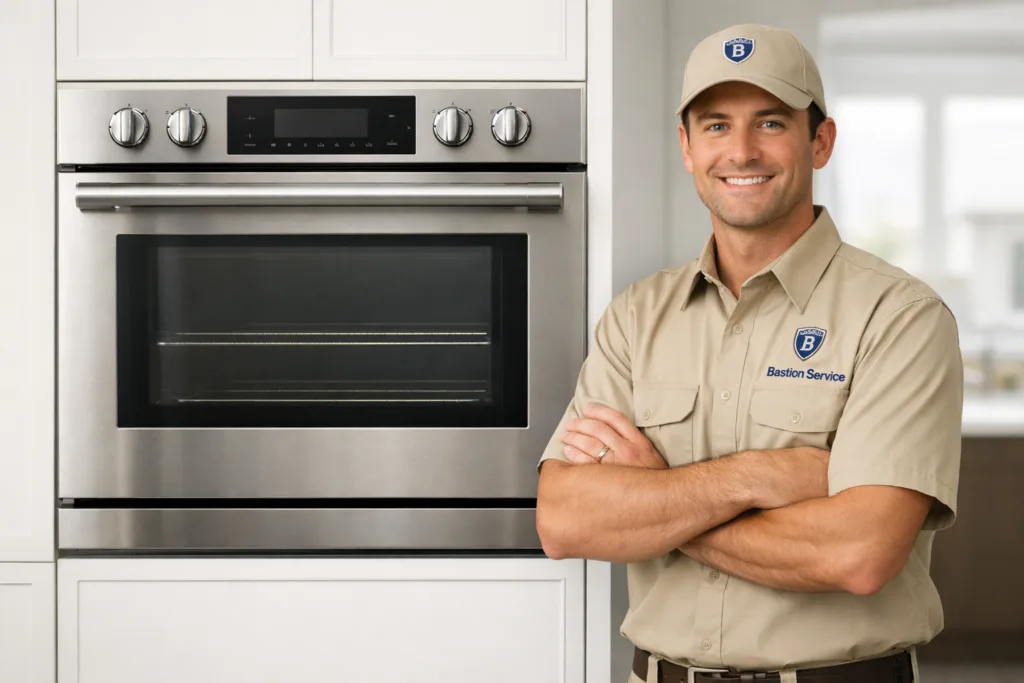
Cooking problems usually start with a pattern: food that comes out pale on one rack and overdone on another, preheat that takes far longer than it used to, or a control panel that responds inconsistently. On a Monogram oven, those symptoms can trace back to very different causes, so the smartest next step is to identify what the oven is actually doing before assuming which part failed.
Common Monogram oven symptoms and what they can mean
Different symptom patterns point in different directions. That is especially true with premium built-in ovens and wall ovens, where sensors, controls, latch systems, and heating components all affect performance.
Not heating at all
If the display works but the oven never warms up, the issue may involve the bake circuit, broil circuit, igniter on a gas model, relay function, wiring, or the control board. If nothing powers on, incoming power, terminal connections, fuses, or internal electrical protection may need to be checked first.
Slow preheat
Slow preheat often feels minor at first, but it can be an early sign that a heating element is weakening, an igniter is no longer drawing properly, or the control is not cycling heat as it should. Homeowners in Redondo Beach often notice this when routine meals suddenly take much longer than recipe times suggest.
Uneven baking
When cookies brown unevenly, casseroles need rotating every time, or one side of the oven seems hotter than the other, the problem may involve temperature sensing, calibration drift, airflow, or incomplete heating from one circuit. A unit can still get hot overall and still bake poorly.
Temperature swings or overheating
If the oven seems much hotter than the set temperature, burns food unexpectedly, or cannot hold a steady baking range, the sensor and control system usually deserve attention. Some ovens cycle too widely because the control is misreading cavity temperature; others overheat because regulation is failing altogether.
Will not start a cycle
A Monogram oven that lights up but refuses to begin baking may have a door lock problem, touchpad failure, selector issue, or control fault. If the problem appeared after self-clean, the latch system becomes especially important to inspect.
Error codes, beeping, or mid-cycle shutoffs
Repeated fault codes are not just nuisances. They can signal sensor readings outside the normal range, communication errors inside the control system, or a component that works intermittently until heat builds up. If the oven stops during cooking and restarts later, that still points to a problem worth diagnosing rather than ignoring.
What makes oven temperature problems so frustrating
Temperature-related faults do not always look dramatic. Many homeowners continue using the oven because it still turns on, but the results become less predictable week by week. A small sensor error, weak element, or unstable relay can change baking performance long before the appliance fails completely.
That is why symptom details matter. Helpful clues include whether broil still works when bake does not, whether preheat stalls at roughly the same point each time, whether the oven overshoots heat only after reaching temperature, and whether the issue affects every cooking mode or just one.
When to stop using the oven until it is checked
Some problems are mainly inconvenient. Others can create safety concerns or lead to more expensive damage if the oven keeps running in a faulty state.
- Stop using the oven for unattended cooking if it overheats, scorches food unusually fast, or does not regulate temperature.
- Pause use if the door will not latch, will not unlock, or does not close securely.
- Do not keep resetting the appliance if it repeatedly throws errors or shuts off mid-cycle.
- If a breaker trips when the oven is used, the electrical problem should be addressed before further operation.
- If you have a gas oven and notice a persistent gas odor, stop using it and contact the gas utility or emergency service first.
Why Monogram oven repairs should be symptom-led
On a Monogram oven, the same complaint can have more than one repair path. “Not heating” might mean a failed element, a weak igniter, a bad sensor, a control relay issue, or a power supply problem. “Won’t start” could be a keypad issue on one unit and a latch-related lockout on another.
That is why replacing parts based only on the most obvious symptom can waste time. A useful service visit should narrow the fault to the affected system, confirm whether the problem is isolated or part of a broader wear pattern, and identify whether continued use could cause additional damage.
Repair or replace: how the decision usually gets made
Many Monogram oven issues are worth repairing when the fault is limited to a specific component such as a sensor, igniter, heating element, latch assembly, or control-related part. Replacement becomes more likely when the oven has multiple problems at once, recurring electronic failures, or an overall condition that makes further repair hard to justify.
For most households in Redondo Beach, the decision comes down to three practical questions:
- What exactly failed?
- Is this a single repair or one of several age-related problems?
- Will the oven likely return to stable everyday performance after the repair?
Those questions matter more than the symptom alone. An oven with one well-defined failure is very different from one with repeated shutdowns, inconsistent temperature control, and multiple aging components.
Signs the issue may be isolated versus signs of broader wear
Often points to a single repair
- One cooking mode stops working while the rest of the oven behaves normally
- Preheat became slow recently rather than gradually over many years
- The problem appeared right after a specific event, such as a self-clean cycle
- The control is otherwise stable and no other functions have become unreliable
May suggest wider reliability concerns
- Temperature has been inconsistent for a long time and is getting worse
- The display, keypad, and cooking functions all show intermittent issues
- Error codes return soon after being cleared
- More than one major function has failed close together
What to note before scheduling Monogram oven repair in Redondo Beach
A few details can make diagnosis more efficient. Write down the exact symptom, whether the problem affects bake, broil, convection, or all modes, and whether the oven reaches any heat at all. If an error code appears, record the code before resetting power. It also helps to notice whether the issue started suddenly or developed gradually.
Those observations can help separate a temperature-sensing problem from a heating failure, or a control issue from a door-lock problem. For built-in units, that distinction matters because access, testing steps, and repair scope can differ significantly.
What homeowners should expect from a service evaluation
A thorough oven diagnosis should clarify whether the failure is electrical, mechanical, or control-related; whether the oven is safe to continue using; and whether the repair makes sense for the appliance’s age and condition. That gives you a repair plan based on the actual fault instead of trial-and-error part replacement.
For Redondo Beach homeowners, that approach is usually the fastest way to move from inconsistent cooking results to a clear next step, whether the answer is a targeted repair or a decision to replace the unit.