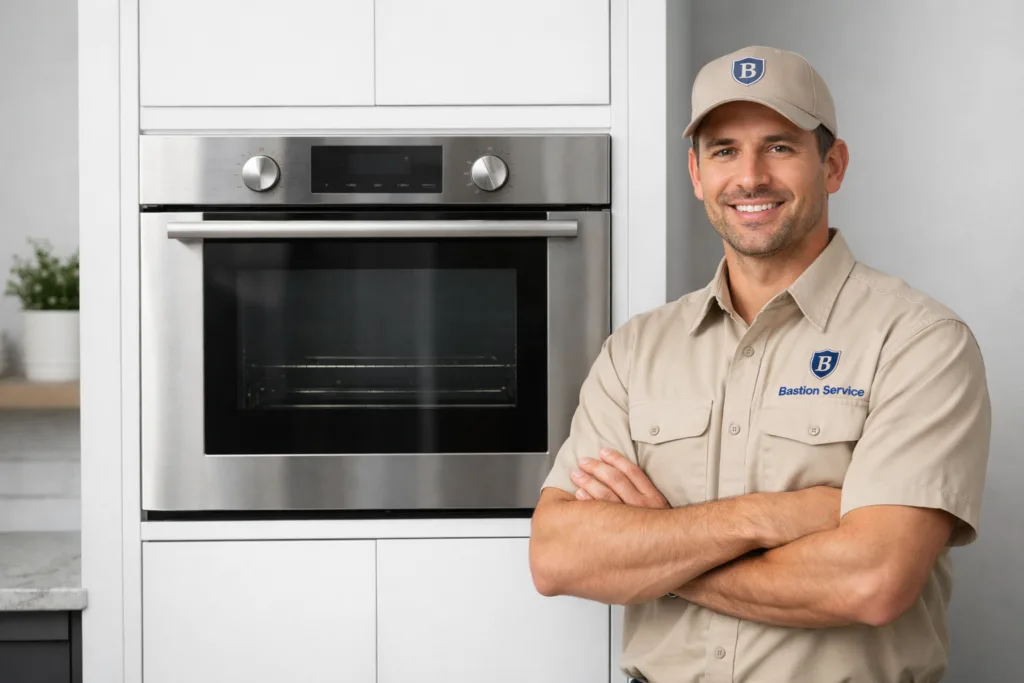
Cooking problems usually show up before a complete failure. A Miele oven may still power on, light up, and even appear to preheat, yet meals come out unevenly cooked, delayed, or overdone. That pattern often points to a component that is working inconsistently rather than one that has fully stopped.
Because Miele ovens rely on coordinated heating, sensing, airflow, and electronic control, the same symptom can come from several different faults. Accurate testing matters most when the oven is still partially working, since guessing based on the symptom alone can lead to unnecessary parts replacement.
What common Miele oven symptoms often mean
Not heating at all
If the display turns on but the cavity never gets hot, the problem may involve the bake element, broil element, power supply, thermal protection components, wiring, or the main control. On some units, one failed part can keep the oven from entering a normal heat cycle even though the controls appear responsive.
If the oven is completely dead with no display or response, that can shift attention toward incoming power, terminal connections, internal fuses, or electronic control failure.
Slow preheat
Long preheat times often mean the oven is heating, but not with full output. A weakened element, sensor issue, relay problem, or convection-related fault can all cause delayed heating. Homeowners sometimes notice this first when familiar recipes suddenly need extra time or when the preheat tone sounds long before the oven is truly ready.
Uneven baking
When cookies brown differently from one side of the tray to the other, or casseroles finish unevenly, the issue may involve poor heat circulation, inaccurate temperature sensing, or inconsistent cycling from the control system. In convection models, fan problems can also affect how evenly heat moves through the cavity.
Uneven results are especially frustrating because the oven can seem functional during quick checks while still failing under real cooking conditions.
Temperature swings or overcooking
If food burns on the outside while staying underdone inside, or if the oven feels much hotter than the set temperature, calibration may not be the only issue. A drifting sensor, failing relay, sticking control output, or improper element cycling can all create wide temperature variation.
These problems tend to become more noticeable during baking, where precision matters more than it does for short broiling or reheating.
Error codes or intermittent shutdowns
A Miele oven that stops mid-cycle, locks up, or displays a fault code may be reporting trouble with temperature regulation, latch operation, cooling performance, or electronic communication within the appliance. Error codes are helpful clues, but they are not complete diagnoses by themselves. The same code can still require confirmation through testing.
Door not sealing correctly
A loose or misaligned door can let heat escape and interfere with normal cooking. Worn hinges, damaged gaskets, latch issues, or frame alignment problems may be involved. In daily use, this can show up as longer cook times, excess heat on surrounding cabinetry, or moisture and heat venting in unusual ways.
Burning smells, smoke, or unusual sounds
Food residue can certainly create odor, but repeated burning smells during normal use should not be ignored. Buzzing, clicking that becomes excessive, scraping fan noise, or signs of smoke can point to electrical overheating, a fan motor issue, insulation problems, or residue contacting a hot surface where it should not.
Symptoms that deserve faster attention
Some oven problems are inconvenient. Others should move to the top of the list because continued use can increase damage or create safety concerns.
- Breaker trips when the oven starts heating
- Burning electrical smell that does not go away
- Visible sparking or arcing
- Display resets or the oven shuts off unpredictably
- Door will not close securely
- Control panel becomes unresponsive during use
- Cabinets or nearby surfaces feel unusually hot
In these situations, stopping use until the unit is checked is usually the safer choice.
Why partial operation can be misleading
One of the more confusing service calls is the oven that “mostly works.” A Miele oven may still heat enough to cook simple meals while failing in ways that affect performance, timing, or reliability. That can happen when one heating circuit is weak, the sensor is reading incorrectly, or the control is cycling at the wrong intervals.
For homeowners in West Los Angeles, this often shows up as recipes that suddenly become inconsistent even though no dramatic failure has occurred. If the appliance behaves differently from its normal pattern, that change itself is useful diagnostic information.
What is usually checked during Miele oven diagnosis
A thorough evaluation typically starts with the exact complaint: no heat, slow preheat, uneven baking, control fault, door problem, or repeated error code. From there, testing may include the heating circuits, sensor readings, control output, fan operation, door seal condition, and electrical connections.
The goal is to confirm the failed part or system, not just identify the symptom. That matters because similar complaints can have very different repair paths. A temperature complaint could involve the sensor, the control, the fan, an element, or a door seal problem that is allowing heat loss.
Self-clean cycle caution
If the oven is already showing signs of temperature trouble, latch issues, display faults, or inconsistent operation, running the self-clean cycle can make the problem worse. Self-clean places heavy thermal stress on components, and weakened electronic parts or door-lock assemblies may fail under that load.
When an oven is already acting unpredictably, it is better to resolve the underlying problem first rather than using self-clean as a test.
Repair or replace?
Many Miele oven repairs are worth considering when the problem is limited to a sensor, heating element, fan motor, latch assembly, or another isolated component and the rest of the appliance remains in good condition. A built-in oven with strong overall condition often makes more sense to repair than to replace over a single failed part.
Replacement becomes a more serious discussion when there are multiple major faults, repeated electronic failures, severe interior damage, or repair cost starts approaching the value of keeping the appliance long term. Age matters, but condition and failure pattern matter just as much.
How West Los Angeles homeowners can help before service
A few details can make the problem easier to pinpoint. It helps to note whether the issue happens in bake, broil, or convection mode; whether preheat completes unusually fast or unusually slow; whether the problem began suddenly or gradually; and whether any error code appears consistently.
Useful observations include:
- Foods cooking too fast on top or bottom
- One rack position performing differently than before
- Display flickering or resetting
- Fan continuing too long after cooking or not running when expected
- Door resistance changing when opening or closing
Those details often help distinguish a heat-production issue from a temperature-reading or airflow problem.
A focused approach to Miele oven repair in West Los Angeles
The most effective service path is one based on symptom verification, electrical and component testing, and a straightforward explanation of what failed. For households in West Los Angeles, that means getting beyond vague “temperature issues” and identifying whether the problem is tied to heating output, sensing, airflow, controls, or door sealing.
Once the fault is narrowed down, it becomes much easier to judge whether repair is sensible, whether continued use risks more damage, and what to expect from the next step.