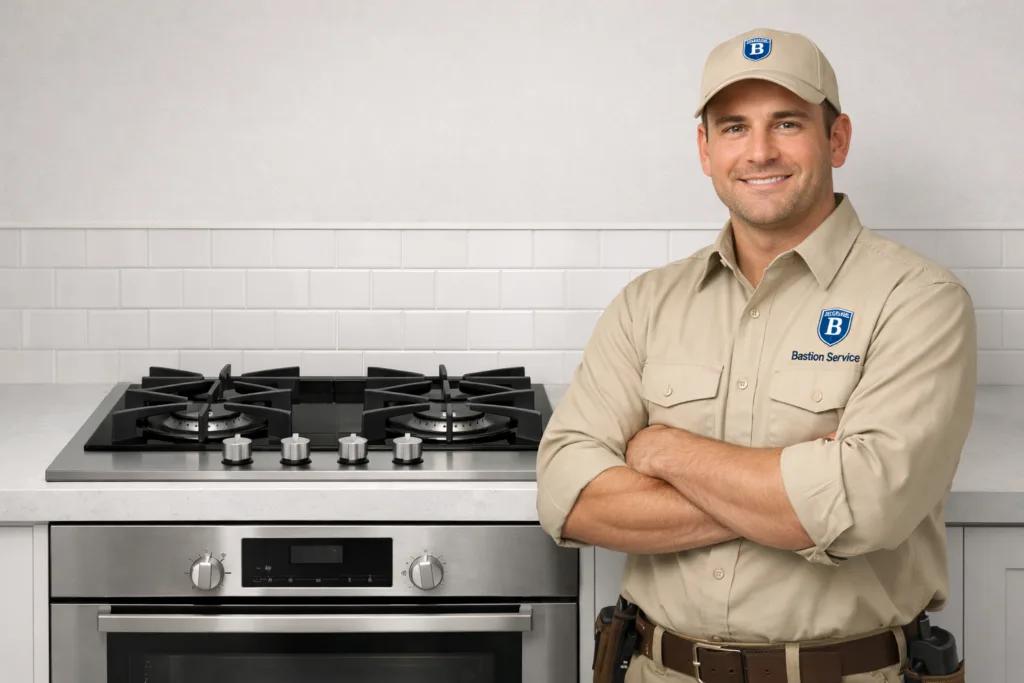
Cooktop problems tend to show up at the worst time: a burner that will not light, heat that drops off midway through cooking, or controls that stop responding when you need them most. With Miele units, the visible symptom does not always point to a single obvious cause, which is why the most useful repair path starts with identifying whether the issue is isolated to a burner assembly, ignition system, surface element, sensor, or control component.
What different cooktop symptoms often mean
Many Miele cooktop complaints sound similar at first, but the underlying failure can be very different. Looking at the exact pattern helps narrow the repair path and avoid replacing parts that are not actually causing the problem.
Burner clicks but does not ignite
On gas models, this often points to clogged burner ports, a burner cap that is not seated correctly, moisture around the ignition area, a worn igniter, or a spark system problem. If only one burner is affected, the fault is often local to that burner. If several burners show the same behavior, a shared ignition component may be involved.
Clicking continues after lighting
Constant or repeated clicking can happen after spillovers or cleaning if moisture gets into the ignition area, but it can also be caused by a failing switch or spark module. If the clicking continues even when the burner is dry and assembled correctly, the cooktop should be checked before regular use continues.
Burner lights but flame is weak or uneven
An uneven flame usually means the gas is not distributing properly across the burner head. Blocked ports, residue buildup, misalignment, or wear in burner components can all affect flame shape and heating performance. Home cooks usually notice this as slower boiling, hot spots, or difficulty maintaining consistent heat.
Electric element does not heat or heats poorly
On electric models, weak or missing heat can come from a failed element, damaged wiring, a switch problem, or a control issue. If the cooktop powers on but the element does not respond normally, the repair question becomes whether the heating component itself has failed or the control system is no longer sending power correctly.
Induction zone powers on but does not heat cookware
On induction models, this can point to pan detection issues, sensor faults, power board problems, or electronic control faults. Sometimes homeowners notice the zone cycling oddly, shutting off early, or showing an error instead of heating. That pattern usually needs component-level diagnosis rather than guesswork.
Touch controls are unresponsive or display errors
When a Miele cooktop shows error codes, locks up, or ignores touch input, the problem may be in the user interface, a communication circuit, or the main control. Since these issues can resemble one another from the outside, the repair decision depends on finding out which section of the system has actually failed.
Signs the problem is getting worse
Some cooktop faults stay intermittent before they become complete failures. A burner that works every third try, a control that responds only after repeated tapping, or heat that fades in and out can all be early warnings that a component is failing rather than a one-time glitch.
- Ignition takes longer than usual or requires repeated attempts
- One burner performs differently from the others
- Heat output is inconsistent at the same setting
- The cooktop shuts off unexpectedly during use
- Error messages return after resetting power
- Burners or zones stop working after spillovers or heavy cleaning
When these symptoms start repeating, waiting usually does not improve the outcome. Small ignition or control problems can turn into broader usability issues if the appliance keeps being used in an unstable condition.
Problems Hawthorne homeowners should not ignore
Some symptoms are more than just inconvenient. They suggest the cooktop may not be safe or reliable enough for continued household use until it has been inspected.
- A persistent gas smell near the cooktop
- Burners that release gas but do not ignite properly
- Visible sparking on electric units
- Breakers tripping when the cooktop is used
- Cracked glass on radiant or induction surfaces
- Controls that activate unpredictably
If there is a strong gas odor, stop using the appliance immediately and address the immediate safety concern before scheduling appliance service. For electric and induction models, signs of overheating, arcing, or breaker trips should also be treated as prompt-service situations.
Cracked glass and surface damage
A cracked glass cooktop is not just a cosmetic issue. On radiant and induction models, surface damage can affect safe operation, allow moisture into internal components, and create a risk of further breakage from heat or impact. Even if the unit still powers on, continued use is usually a poor idea until the extent of the damage is assessed.
Minor chips around trim areas may not have the same urgency as a crack crossing an active cooking zone, but any visible damage on a Miele glass surface should be evaluated carefully before normal use resumes.
Why one failed burner does not always mean a simple repair
Homeowners often assume that if only one burner is acting up, the fix must be small. Sometimes that is true. A single burner issue can come from a localized igniter, burner switch, element, or assembly problem. But it can also be the first visible sign of a larger control or wiring fault, especially if the symptom is intermittent or paired with odd display behavior.
That distinction matters because it affects both cost and confidence in the repair. Replacing an obvious surface component makes sense when the fault is clearly isolated. If the symptom traces back to electronics or shared power distribution, the repair path can be different.
Repair or replace?
For many households in Hawthorne, the better choice depends on three things: what part failed, how the rest of the cooktop is aging, and whether the problem appears isolated or part of a broader pattern. Repair is often worth considering when the issue is limited to an igniter, burner assembly, switch, element, or another single component and the rest of the appliance is still performing well.
Replacement becomes more reasonable when multiple major parts are failing, electronic problems keep returning, glass damage is severe, or the expected repair cost starts approaching the practical value of keeping the unit. Age alone does not decide the issue. Condition, symptom history, and parts involvement usually matter more.
What to do before a service visit
A few simple observations can make the problem easier to pinpoint and help avoid confusion between a one-time interruption and a repeatable failure.
- Note whether the issue affects one burner or multiple zones
- Pay attention to whether the problem started after cleaning or a spill
- Write down any error code exactly as shown
- Notice whether the cooktop fails immediately or only after warming up
- Check whether the problem is constant or intermittent
These details can be especially helpful with Miele cooktops because control and heating faults can overlap in ways that are not obvious during normal daily use.
What homeowners usually want to know
Most people are trying to answer a few practical questions: Is the cooktop safe to use right now? Is the problem likely limited to one part or part of something larger? Does repairing this Miele unit make sense, or is it time to think about replacement?
Good service should answer those questions plainly. For households in Hawthorne, that means understanding the symptom pattern, the likely failure point, and whether the appliance can reasonably be restored to consistent cooking performance without turning a straightforward fix into a drawn-out parts chase.